

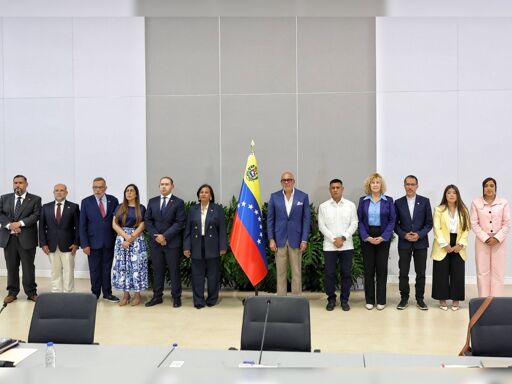
Caracas (OrinocoTribune.com)—On Thursday, the first round of talks between the Venezuelan government delegation and representatives of the defunct 2015 National Assembly concluded in Caracas, formally initiating a new cycle of political dialogue. Both parties declared themselves in permanent working session until August 12.
The inaugural meeting took place at the Simón Bolívar Park Convention Center in La Carlota, Caracas. The government delegation was led by National Assembly President Jorge Rodríguez, accompanied by Education Minister Ana María San Juan and United Socialist Party of Venezuela (PSUV) deputies Jorge Arreaza, América Pérez, Génesis Garvett, and Pedro Infante.
The far-right opposition delegation was represented by a commission composed of former deputies Dinorah Figuera, Marco Aurelio Quiñones, Ramón López, Juan Miguel Matheus, Sergio Vergara, and Desiree Barboza.
Controversies surrounding opposition delegates
Far-right Miami-based journalist Patricia Poleo condemned the composition of the opposition delegation, noting that its members—largely unknown to most Venezuelans—belong to First Justice (PJ) and Popular Will (VP) and answer to Leopoldo López and Julio Borges. Poleo questioned their integrity, linking them to financial mismanagement surrounding Monómeros and seized foreign assets.
Internal opposition records and independent financial tracking show that former legislators spent roughly $354.4 million in seized Venezuelan state assets between 2019 and 2025 under direct authorization from Washington, as reported by the US government-funded Voice of America.
Part of those funds went toward monthly stipends for “deputies,” which reached up to $5,000 per month from 2020 to 2021. From 2022 to 2025, former legislators reportedly received “reduced” payments of $2,130 monthly distributed via the fintech platform AirTM.
Agenda, principles, and joint declaration
During Thursday’s session, both sides reviewed the meeting methodology. They established a priority agenda focused on assistance for victims of the June 24 double earthquake, as well as strengthening democracy and political guarantees.
In separate but identical statements, the delegations confirmed that the plenary will remain in permanent session through August 12 to determine future meetings.
The official statement issued by the government delegation outlines the core principles guiding the negotiations:
In Caracas on August 6, 2026, talks were initiated between the national government’s delegation and the 2015 National Assembly’s delegation. During the plenary session, the methodology, work cycles, and agenda of topics to be addressed were agreed upon.
For the first work cycle, we will be in permanent session until Wednesday, August 12, and the continuity of the plenary session will be determined based upon the priority that this process has for the well-being of Venezuelan men and women.
The delegations subscribe to the principles of respect for national sovereignty; good faith negotiation; the pursuit of benefits for Venezuela; a peaceful, democratic, and constitutional political solution; mutual recognition and respect between the parties; political equality and equal treatment at the table; verifiable compliance with commitments; and the protection of human rights and the political rights of all groups.
It was agreed to promptly report the progress achieved in these conversations to the entire country.
Public criticism and questions over sovereignty
The process has drawn skepticism inside Venezuela regarding claims of sovereignty, given Washington’s heavy involvement. Observers highlight that the negotiation format reflects direct US tutelage over the opposition. Meanwhile, the Venezuelan government remains under significant US diplomatic and economic pressure following the events of January 3.
Venezuela Launches Talks With Former Opposition Lawmakers, Demands End to Sanctions
Responding to a statement made by Figuera expressing gratitude for US “accompaniment,” Orinoco Tribune published on social media: “This is the new far-right opposition’s chief negotiator: ‘We Venezuelans will always be grateful for the United States’ support of our country.’ Looks like someone just locked up the US State Department’s Employee of the Month award. Congratulations Figuera.”
Additionally, political figures from across the political spectrum have voiced concern over the exclusion of current National Assembly opposition deputies as well as the faction represented by María Corina Machado. Critics are calling for the talks to expand to include broader domestic political sectors, ensuring solutions are generated natively by Venezuelans rather than dictated externally
Special for Orinoco Tribune by staff
OT/JRE/SF
From Orinoco Tribune via This RSS Feed.