

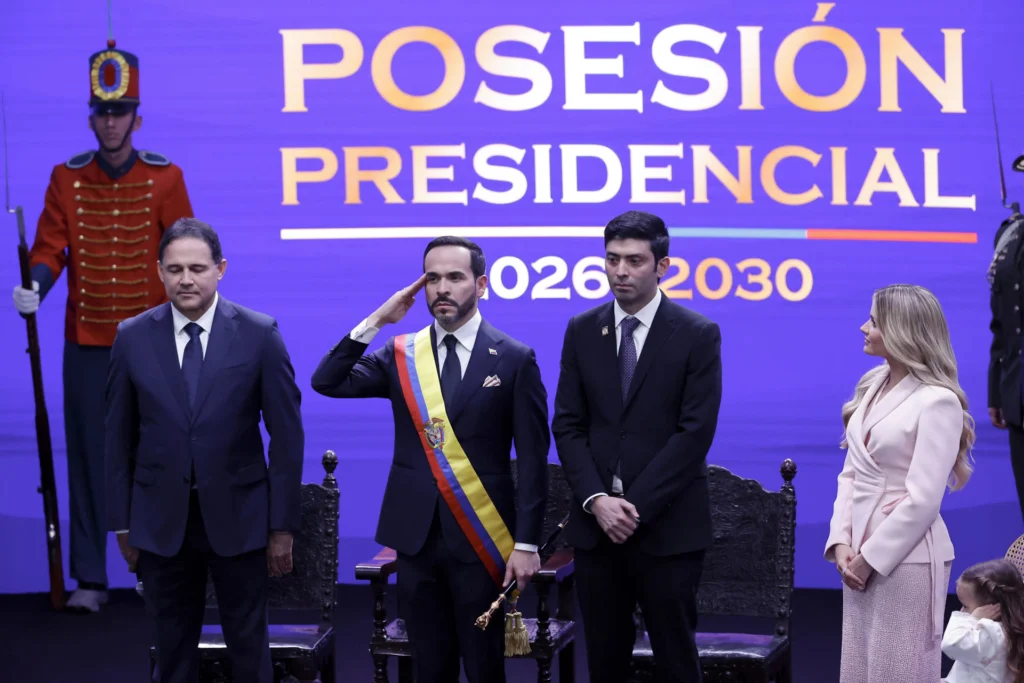
Far-right lawyer Abelardo de la Espriella was sworn this Friday as Colombia’s President for the 2026-2030 period at the USC Arena of Santiago de Cali University, amid social mobilizations rejecting the new government across the country.
“I swear to God and promise the people to faithfully comply with the Constitution and the laws of Colombia,” said the 48-year-old De la Espriella before Congress President Honorio Henríquez, who then placed the presidential sash on him, succeeding former President Gustavo Petro.
Simultaneously, Army soldiers fired 21 cannon salutes with the colors of the Colombian flag from the José María Córdova Military Cadet School in Bogotá. De la Espriella then administered the oath to his vice president, José Manuel Restrepo.
RELATED: Colombian Social Movements Reject De la Espriella Presidential Inauguration
The guest list included Spain’s King Felipe VI and the presidents of Argentina, Javier Milei; Ecuador, Daniel Noboa; Paraguay, Santiago Peña; Panama, José Raúl Mulino; Dominican Republic, Luis Abinader; Chile, José Antonio Kast, and Honduras, Nasry Asfura, as well as FIFA President Gianni Infantino. The United States sent a nine-member delegation led by Todd Blanche, acting attorney general and former personal lawyer of President Donald Trump, the White House reported.
“Colombia”:
Porque Abelardo de la Espriella asumió como nuevo presidente pic.twitter.com/BalosxxEEe— ¿Por qué es tendencia? (@porquetendencia) August 7, 2026
Former Colombian presidents César Gaviria (1990-1994), Andrés Pastrana (1998-2002), Álvaro Uribe (2002-2010) and Iván Duque (2018-2022) also attended, while Ernesto Samper (1994-1998) and Nobel Peace Prize laureate Juan Manuel Santos (2010-2018) were not invited. After the ceremony, De la Espriella moved to the Pichincha Military Canton, 2.5 kilometers from the auditorium, where he delivered his first presidential speech before the country’s military chiefs.
The inauguration of De la Espriella marks the return to power of sectors linked to the formula that, according to analysts, left millions of victims in Colombia, and opens a cycle of political confrontation between the new Executive and the social movements that maintain their presence in the streets.
Congratulations to the people of Colombia and their new President @ABDELAESPRIELLA! I was struck by his decision to be sworn in not in the capital of Bogotá, but in Cali (where, by coincidence, my own parents lived from 1954-57) as a sign of his commitment to decentralize the… pic.twitter.com/1y3bvZ7UJe
— Christopher Landau (@DeputySecState) August 7, 2026
Peace Dialogue Option Exhausted
Speaking before the country’s military chiefs at the Pichincha Military Canton in Cali, De la Espriella said that “the possibility that Colombia transits the path of freedom, of institutions and the rule of law” had won.
The president warned that “there will be no space for maneuvers that threaten the stability of the nation or the legitimate mandate that begins today.” In a direct accusation against the outgoing administration, he held responsible for the assassination of Miguel Uribe Turbay, without presenting any evidence to support his claim.
In the security field, De la Espriella announced that in the coming hours he will publish a list of the groups he described as alleged “narco-terrorist” to combat them. “The option of dialogue is completely exhausted,” he assured, marking a rupture with the peace policy promoted by the Petro´s Government.
De la Espriella highlighted former right-wing president Álvaro Uribe, asserting that during his governments terrorism was confronted firmly and the authority of the state was restored. The reference aligns the new Executive with the political tradition of the Colombian right and distances it from the progressive administration of Gustavo Petro, whom the new president did not mention by name but repeatedly criticized.
Glyphosate Fumigation Resumed
The new Colombian President confirmed that his administration will advance with the eradication of illicit crops through fumigation with herbicides, a measure that revives a controversial practice in the country. The aerial spraying of glyphosate, suspended in past years after judicial rulings and health and environmental concerns, had been one of the most debated elements of the Colombian counter-narcotics strategy.
The announcement generated immediate reactions from social and peasant organizations, which warn that fumigation affects food security and the health of rural communities. The new approach also distances Colombia from the dialogue-based strategies that the Petro’s government had promoted with armed groups under the banner of “total peace.“
Analysts interpret the speech as a return to the security doctrine of the Uribe era, characterized by military confrontation with insurgent groups and a hard line on drug policy. De la Espriella’s statements come on the same day that massive mobilizations rejected his inauguration in Cali and other cities, under a strict security deployment.
From teleSUR English via This RSS Feed.