

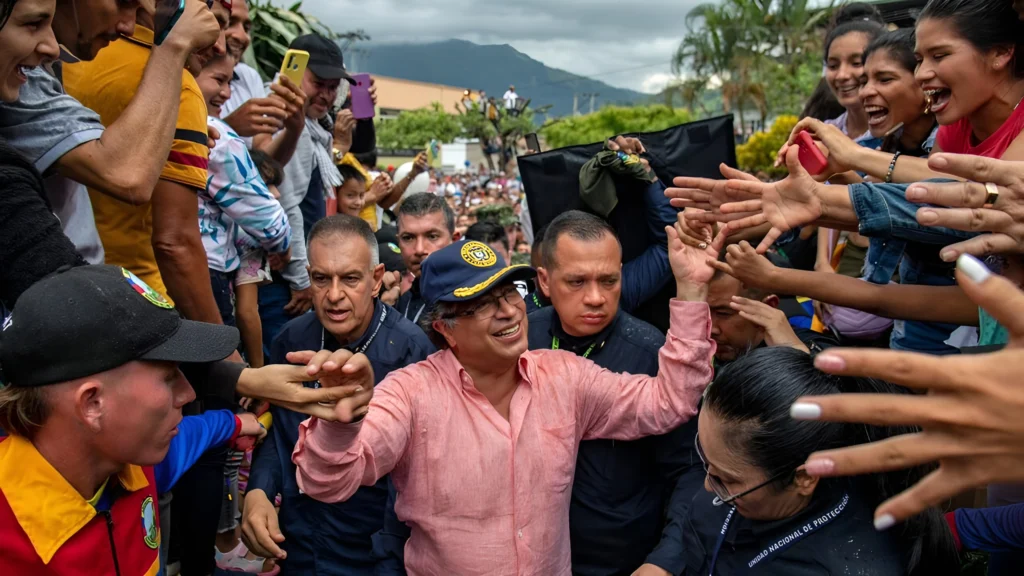
The Petro “Total Peace” framework shifted national strategy away from militarized conflict toward dialogue, human security, and rural investment.
The inauguration of Gustavo Petro in August 2022 marked a significant turning point in Colombia’s political history. His election broke a continuous line of conservative and liberal presidential administrations, which had governed the country for more than two centuries.
RELATED: Petro Visits Cuba, Calls for Peace in the Caribbean
Petro served as Mayor of Bogotá and as a national senator, and secured the presidency alongside Vice President Francia Márquez under the banner of the Historic Pact coalition.
Analyzing Petro’s administration requires examining how its counter-hegemonic program has interacted with established political and economic structures. Over its term, the Petro administration has faced challenges in executing its platform due to resistance from traditional political parties, corporate trade associations, independent oversight agencies, and a divided Congress.
Total Peace: Redefining Security and Conflict De-escalation
A core initiative of Gustavo Petro’s administration was the implementation of “Total Peace“, formalized through Law 2272 in late 2022. This strategy departed from the security approach of previous governments, such as President Iván Duque’s “Peace with Legality” framework, which emphasized military operations against illegal organizations and forced eradication of illicit crops.
Instead, Total Peace prioritized simultaneous negotiations with the remaining insurgent organizations, such as the National Liberation Army (ELN), as well as legal submission frameworks for criminal organizations and FARC dissident networks.
The administration achieved early milestones by establishing figures such as the Peace Cabinet and the Peace Regions, and establishing mechanisms to seek the suspension of arrest warrants for members of armed groups participating in the dialogues.
Data gathered by conflict monitoring organizations such as the Armed Conflict Location & Event Data Project (ACLED) showed a distinct drop in direct combat engagements between state security forces and illegal armed organizations during the early phases of these ceasefires.
Investigations by independent platforms like “Rutas del Conflicto” documented that while state forces reduced offensive operations, several illegal groups, including the Gaitanist Self-Defense Forces of Colombia (AGC / Clan del Golfo) and competing FARC dissident factions, expanded their territorial influence. Furthermore, Indepaz reported that massacres and targeted assassinations of local social leaders remained a persistent human rights challenge.
The administration also shifted its national drug policy away from the forced eradication of coca crops, which had historically created friction with small-scale farming communities. The government redirected focus toward voluntary crop substitution programs, rural infrastructure investment, and interdiction at shipping hubs.
After visiting Cuba, Gustavo Petro had a message for Washington.
Watch what he said: pic.twitter.com/XjGAFaAWGW
— Belly of the Beast (@bellybeastcuba) August 3, 2026
Pension, Health, and Labor Battlegrounds
The Petro’s administration centered its legislative agenda on restructuring Colombia’s social safety net through major reforms in pensions, healthcare, and labor relations. A major legislative achievement occurred in July 2024 with the passage of Law 2381, known as the Pension Reform. This law restructured Colombia’s traditional dual pension model, which forced public administrator Colpensiones to compete directly with private pension funds (AFP), into a unified four-pillar system.
Under the new framework, mandatory contributions on income up to 2.3 times the minimum monthly wage are managed by Colpensiones under a public pillar, while earnings above that threshold are directed to private savings accounts. The law expanded income coverage for low-income and vulnerable elderly citizens through a basic solidarity allowance, while establishing transition periods for long-term contributors.
Conversely, the restructuring of the national health system generated intense institutional and public debate. The administration’s proposal aimed to diminish the role of Health Promoting Entities (EPS), private intermediation companies that manage public health funds, and replace them with direct public financing for regional primary care networks.
As legislative negotiations stalled in Congress, the national government intervened in several major Health Promoting Entities experiencing financial insolvency, assuming administrative control to guarantee healthcare service delivery across marginalized municipalities.
Another pillar of the social package, the Labor Reform, focused on restoring worker protections that had been reduced by flexible employment legislation over the preceding two decades. The bill sought to advance standard overtime pay schedules to start at 7:00 PM rather than 9:00 PM, increase compensation for Sunday and holiday labor, limit the use of temporary subcontracting, and establish formal labor protections for digital delivery platform workers and agrarian laborers.
The passage and modification of these bills reflected changes in parliamentary dynamics. In early 2023, the initial broad political coalition built by Petro in Congress broke down as traditional conservative and centrist parties withdrew their support over key reform clauses. This shift required the administration to negotiate each bill individually, leading to significant legislative modifications and frequent procedural delays.
Agrarian Reform and Decarbonization: Reversing Historical Extraction
Rural development and environmental policy formed another central pillar of the Petro administration’s program, focusing on land redistribution and an energy transition away from fossil fuels.
To advance Point 1 of the 2016 Havana Peace Accord, the Petro’s government tasked the National Land Agency (ANT) with accelerating rural land acquisition and titling. Rather than relying on compulsory expropriation, the administration pursued voluntary land purchases, negotiating agreements with private landowners and agricultural groups like the Federation of Colombian Cattle Ranchers (FEDEGAN).
Official reports from the Ministry of Agriculture and ANT documented the acquisition and titling of more than 1.2 million hectares and nearly 300,000 hectares for the Land Fund, for small farmers, indigenous communities, and Afro-descendant populations, with a specific emphasis on rural female heads of household.
In environmental policy, President Petro advanced a Just Energy Transition designed to reduce Colombia’s dependence on extractive industries and fossil-fuel exports. As part of this agenda, the Ministry of Mines and Energy halted the issuance of new hydrocarbon exploration contracts and banned hydraulic fracturing, or fracking, projects.
This approach sought to meet global climate targets by redirecting state resources toward renewable energy developments, particularly solar and wind installations. Achieving a substantial increase in solar energy, going from 2% of the energy mix in 2022 to more than 14% in 2026.
The administration integrated intersectional social perspectives into its rural and environmental framework, led in part by Vice President Francia Márquez and the newly created Ministry of Equality and Equity. Coverage from independent platforms highlighted how government programs sought to address the combined impacts of environmental degradation, social marginalization, and armed conflict.
Colombia’s President Gustavo Petro says he has escaped an assassination attempt while travelling by helicopter with his daughters, after warning for months about an alleged plot by drug traffickers who want to target him. pic.twitter.com/ucwUCWfmLC
— Al Jazeera English (@AJEnglish) February 11, 2026
Counter-Hegemonic Governance vs. Institutional Hegemony
The attempt to execute a structural transformation from the Executive power brought Petro’s administration into constant collision with Colombia’s long-established institutional framework. Tensions intensified between the presidency and powerful oversight bodies led by officials appointed under previous conservative governments, notably the Attorney General’s Office under Francisco Barbosa and the Inspector General’s Office.
These institutions frequently initiated investigations into administrative decrees, key political appointees, and campaign funding channels. Petro’s allies characterized these actions as a form of lawfare designed to block the executive mandate, while institutional critics maintained that the investigations were necessary checks and balances against overreach.
This institutional friction extended to the national media ecosystem. Major Colombian commercial media conglomerates provided critical coverage focused on frequent cabinet replacements, fiscal uncertainty, and political scandals. In response, the administration leaned heavily on direct presidential communication through social media and expanded public broadcast networks; investigative outlets filled a crucial middle space, examining both the administration’s policy execution flaws and the systemic opposition mounted by corporate and landed interests.
Faced with congressional bottlenecks and judicial challenges to executive decrees, President Petro repeatedly invoked the concept of a soft coup. To counter parliamentary inertia, the administration called for social mobilization, urging trade union federations, indigenous groups, and civic associations to demonstrate in public squares.
Historical Legacy and the Unfinished Dialectic
Gustavo Petro’s presidency represents a landmark moment in Colombia’s political history. By opening the executive power to progressive and social movements, the Historic Pact broke two centuries of political rule by traditional elites.
Petro’s government demonstrated that while executive power can reorient national priorities and deliver targeted redistributive gains, achieving permanent structural change requires deeper institutional realignment.
The legacy of this term lies not in the complete resolution of Colombia’s historical inequality, but in permanently reshaping the national political baseline and proving that progressive governance can be a durable feature of Colombian democracy.
Sources: RTVC – Radio Nacional Colombia – La Silla Vacía – Vorágine – RUMS – Rutas del Conflicto – Volcánicas – El Tiempo – El Espectador
From teleSUR English via This RSS Feed.