

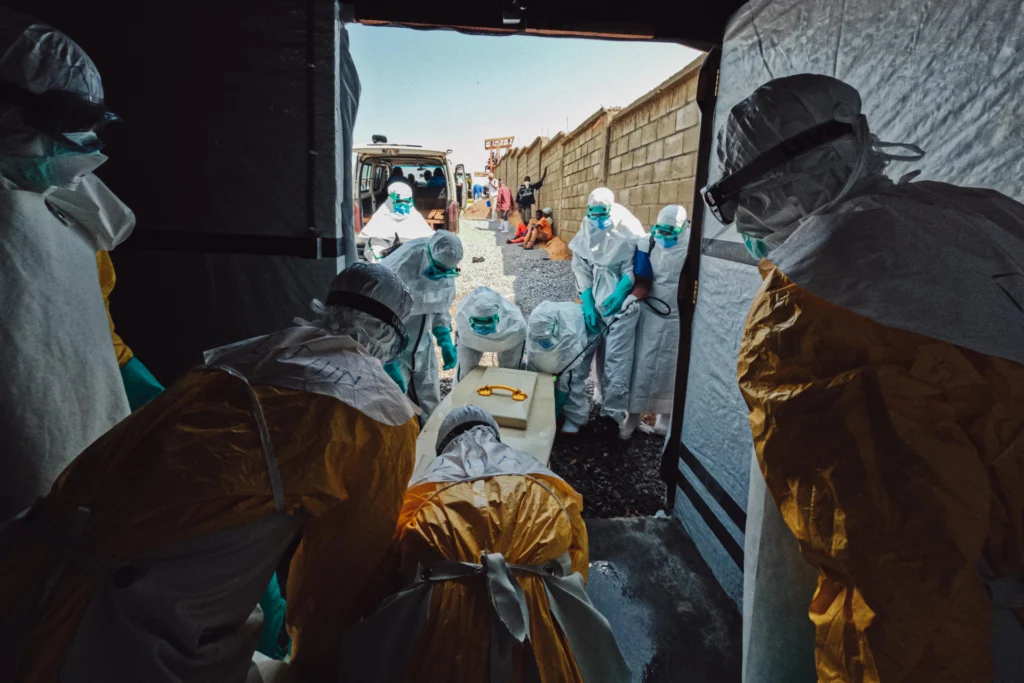
The Democratic Republic of the Congo confirmed this Friday that its Ebola outbreak has surpassed 4,053 cases, marking a rapid acceleration of the deadly epidemic with a 45.7% lethality rate.
The Ministry of Communication of the Democratic Republic of the Congo (DRC) released an official health bulletin on August 7, confirming that the nation registered more than 1,000 new infections in just two weeks. This rapid escalation pushed the cumulative number of confirmed Ebola cases to 4,053 since the official declaration of the health crisis on May 15.
According to government authorities, the epidemic has reached a critical stage, exhibiting an alarming 45.7% lethality rate that poses an immediate threat to public health across the African continent.
RELATED: WHO Recommends Prioritizing Ervebo Vaccine for Human Trials in Congo Ebola Outbreak
Official government registries compiled from May 15 to August 5 reveal that 694 patients currently remain in isolation or hospitalized in specialized centers. Meanwhile, healthcare workers have successfully helped 793 individuals who recovered from the disease.
Despite facing severe logistical challenges, epidemiologists have maintained a 77.7% contact tracing rate to curb transmission. The virus actively propagates through five major provinces, with Ituri persisting as the epicenter of the disease, alongside North Kivu, South Kivu, Haut-Uélé in the east, and Tshopo in the north-central region.
“Before the epidemic, we had an average of 500 patients per month. When the [Bundibugyo] Ebola virus epidemic was declared, we saw a complete drop in patients, ” – Lokudu Richard, a doctor at Mongbwalu hospital.
The worst Ebola outbreak on record for DR Congo has instilled fear… pic.twitter.com/lH4c2ToL5H
— UNICEF (@UNICEF) August 6, 2026
Deadly Untreatable Strain
The World Health Organization (W.H.O.) warned that this 17th epidemic represents the fastest-growing Ebola outbreak in the history of the DRC since its initial declaration. Historically, the lethality rate for this particular strain ranges between 30 and 50%, which severely limits the response capabilities of regional healthcare systems in Sub-Saharan Africa.
This current crisis officially became the second-largest Ebola outbreak in the history of the DRC on July 31. It surpassed the major eastern Congo epidemic of 2018-2020, which resulted in 3,481 cases and 2,299 documented deaths. Globally, this emergency is only surpassed by the devastating West African outbreak of 2014-2016, which claimed more than 11,000 lives and infected 28,000 people. The rapid acceleration of the current virus has triggered national mobilization to prevent a similar catastrophic scenario.
Some good news on #Ebola: new data from two animal studies show that Ervebo vaccine (the only licensed vaccine against Ebola Zaire) might offer some level of cross-protection against Bundibugyo virus. The studies were done in line with @WHO’s call for more research.
The WHO…
— Tedros Adhanom Ghebreyesus (@DrTedros) August 7, 2026
W.H.O. currently categorizes the risk of viral expansion as “high” within Sub-Saharan Africa, while maintaining a “low” risk evaluation internationally.
The Ebola virus transmits through direct contact with the bodily fluids of infected humans or animals, causing severe symptoms like hemorrhagic fever, vomiting, diarrhea, and internal bleeding. To combat the spread, local health institutions investigated 1,158 alerts within the last 24 hours while reinforcing medical capabilities across all affected territories to control the disease.
From teleSUR English via This RSS Feed.