

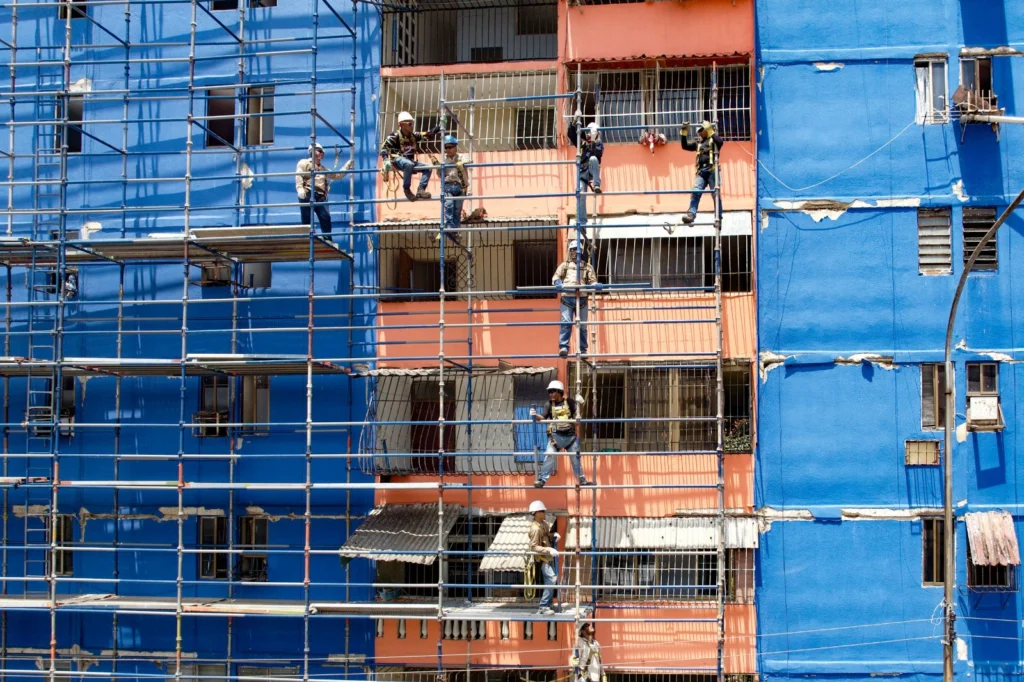
Caracas maintains post-earthquake inspections, meanwhile exports are restricted to support national reconstruction.
Mayor Carmen Meléndez announced 22,241 structural inspections in Caracas to assess damage from the June 24 earthquakes, while Venezuela activated a temporary export ban to protect reconstruction supplies.
Inspections operate under the supervision of the Presidential Commission for the Evaluation of Habitability and Infrastructure. Officials confirmed that red-level buildings will receive priority in the reconstruction schedule.
RELATED: Venezuela Launches Economic Reactivation Plan Post-Quakes in La Guaira
The Semaphore classification system assigns each structure a color-coded risk category. Green indicates habitability without major intervention, yellow signals the need for partial repairs, and red requires comprehensive structural evaluation before residents may return.
Following this methodology, 88% of reviewed structures received green or yellow certification, meaning they are habitable or require partial repairs. The remaining 12% were classified at red level, indicating severe damage that demands deeper evaluation.
Buildings classified in the red category will undergo exhaustive reviews to define the appropriate measures within the Venezuela Rises Plan. The Caracas Mayor’s Office acts as the executing entity of that plan, with its secretaries and directors coordinating actions across affected zones.
En Caracas, hemos realizado 22.241 inspecciones para identificar daños causados por los terremotos del #24Jun
De acuerdo a la metodología del Semáforo, el 88% de estas construcciones ha recibido certificación Verde o Amarilla, y el 12% Roja.
Estas inspecciones las realizamos… pic.twitter.com/83MNeQhsQG
— Carmen Meléndez (@gestionperfecta) August 6, 2026
Text reads: “In Caracas, we have carried out 22,241 inspections to identify damage caused by the earthquakes of 24 June. According to the Semaphore methodology, 88% of these constructions have received Green or Yellow certification, and 12% Red. These inspections are carried out under the supervision of the Presidential Commission for the Evaluation of Habitability and Infrastructure, and every day more neighbors feel reassured, because experts arrive at their homes to carry out the respective reviews.”
Export Ban in Force
In parallel, the temporary prohibition on exporting construction materials and supplies entered into force after publication in Official Gazette No. 43.409. The measure, established under Decree No. 5.376 of the Presidency of the Republic, will remain in effect until December 31, 2026.
The decree assigns the affected goods the Legal Regime 1, defined as “Export Prohibited,” through a partial modification of the current Customs Tariff. The suspension covers materials destined to address the effects of the June 24 earthquakes, including cement, steel, glass and other inputs essential for large-scale rebuilding.
According to the instrument, the decision seeks to “guarantee the supply, availability and access” to inputs in the national market. These resources will be allocated to advancing the reconstruction and repair of housing, health centers, educational institutions and affected road infrastructure.
The twin earthquakes struck Venezuela on June 24, leaving widespread structural damage in the capital and surrounding regions. The national government immediately deployed engineering teams and launched the Plan Venezuela Renace to coordinate evaluation and housing rehabilitation. Municipal authorities have prioritized inspections of apartment buildings, schools and hospitals, given the dense concentration of residential infrastructure in Caracas.
The national government has pledged financing of up to 80% of housing reconstruction for families affected by the double earthquake. Municipal teams are coordinating with the Ministry of Housing to process applications from homeowners whose properties suffered structural damage.
Residents of affected neighborhoods have expressed cautious optimism about the pace of inspections while demanding greater transparency in the classification of damaged buildings. Community organizations have formed committees to assist families in red-zone structures with temporary relocation, meanwhile officials project that most affected structures will complete evaluation by the end of 2026, with reconstruction works continuing into 2027.
From teleSUR English via This RSS Feed.