



The Washington Post (8/5/26) wrote that El-Sayed “carries heavy baggage into the general election”—and cited four policy positions that are all supported by a majority of voters.
It’s sad commentary on US media when two national newspapers, historically representing different poles of the American establishment, appear to share editorial writers. When it comes to the nomination of progressive Abdul El-Sayed in the Michigan Democratic Senate primary, the Washington Post (8/5/26) and Wall Street Journal (8/5/26) editorial boards practically plagiarized each other. It’s further testament that the Post is no longer known as the paper that took down Richard Nixon; rather, it’s a mouthpiece for the oligarchy that has very much taken the side of the current administration.
Both papers fear that El-Sayed’s victory is another notch in the wave of victories by the left: Zohran Mamdani taking the New York City mayoralty last year, the Democratic Socialists of America primary victories in June, and now El-Sayed—who is not a DSA candidate but who is, as the Cold Warriors might call him, a fellow traveller.
‘Radical views’
Just look at how both boards reject the idea that El-Sayed distances himself from the organized socialist movement, with the Journal condemning his “radical views” and the Post bemoaning his “heavy baggage.”
The Post:
While El-Sayed rejects the “socialist” label, he campaigned on Medicare-for-all, opposition to Israel, raising taxes on the wealthy and abolishing US Immigration and Customs Enforcement.
The Journal:
He continues to support Medicare for All. He favors a wealth tax and an enormous expansion in federal entitlements for child care and more. He wants to abolish Immigration and Customs Enforcement, saying the agency “is about normalizing paramilitary force on our streets.”… Mr. El-Sayed wants to cut off all US military aid to Israel, which he accuses of genocide in Gaza.
Editorialists might not like these ideas, but it is clear voters do. Both government-assured healthcare (WITI, 12/14/25) and taxing the wealthy (Pew Research, 3/19/25) are supported by large majorities. And they’re not minor concerns. From KFF (7/16/26):
Healthcare costs top the list of voters’ healthcare priorities for the midterm elections, with half (51%) of all voters and more than half of Democratic (60%) and independent (55%) voters saying the issue is extremely important for candidates to talk about.
It doesn’t cross the minds of those in Beltway and Manhattan media bubbles that Michiganders are well-acquainted with their neighbors in Canada who, like those living in many other industrialized democracies, enjoy universal healthcare.
The papers also forget some history. Single-payer health insurance is far from a radical idea: A bipartisan group of senators in 1970, with some support from the Nixon administration, explored “national health insurance, a plan to cover the medical needs and costs of all Americans” (New York Times, 9/22/70). Health reform’s champion at the time, Sen. Edward Kennedy (D-Mass.), “wanted the government to be the nation’s single-payer for healthcare” (WBUR, 8/25/20). If anything, El-Sayed and his supporters are channeling the party’s former glory on this, rather than importing some fringe ideology.
Mainstream positions
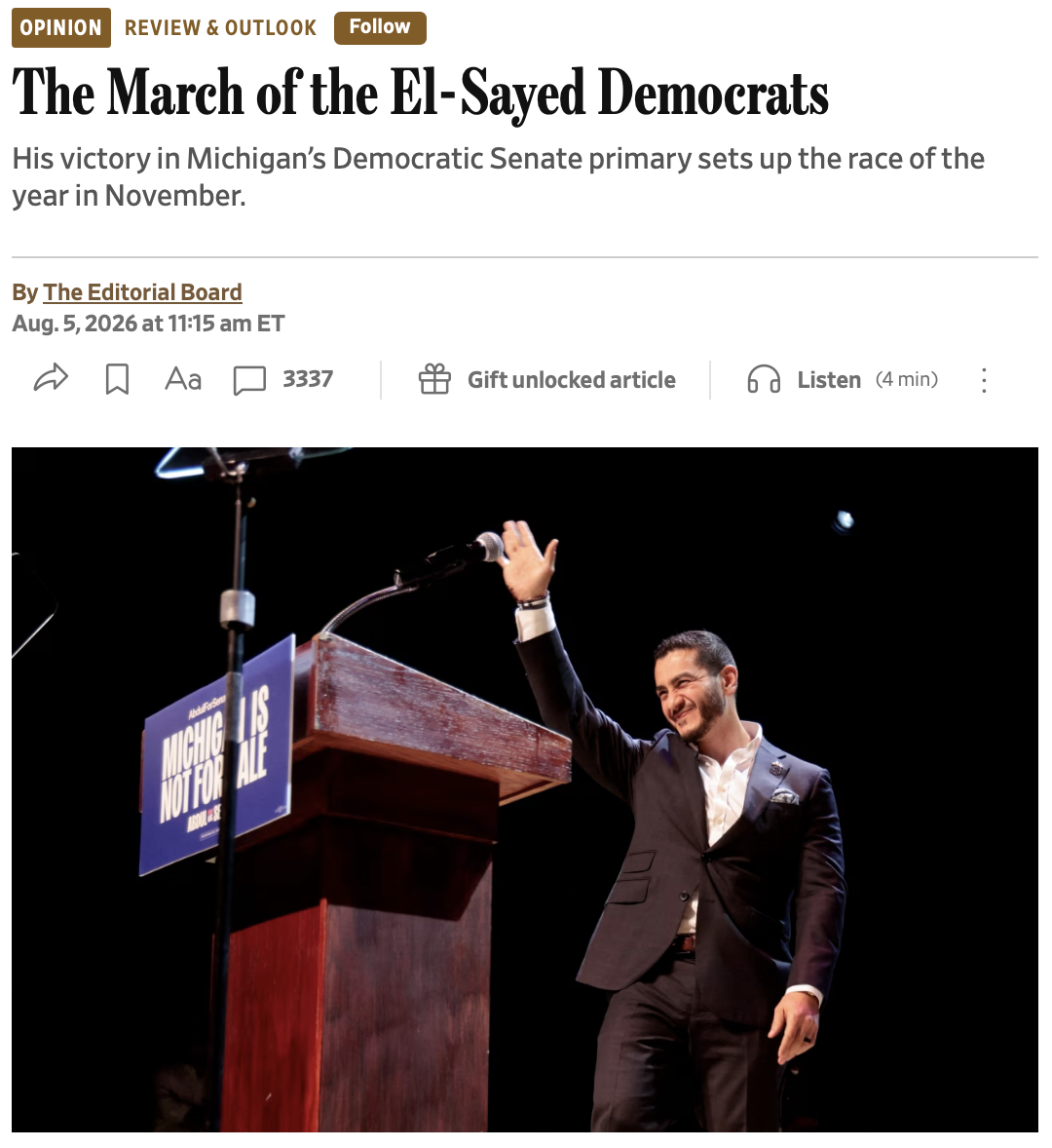
To the Wall Street Journal (8/5/26), El-Sayed is an “articulate” man “with radical views” who should “maybe hold off on French Revolution 2.0.”
Trump’s brutal war against immigrants polls horribly (YouGov, 7/21/26; The Hill, 8/3/26). From YouGov (3/3/26):
Support for abolishing ICE has hit a new high in this week’s Economist/YouGov poll. Half (50%) of Americans now somewhat or strongly support abolishing ICE. Only 39% oppose abolishing the agency.
El-Sayed believes ICE is “about normalizing paramilitary force on our streets”? Anyone who has paid attention to what has happened in Minneapolis, Chicago and Los Angeles this last year knows that this is an accurate assessment.
“Opposition to Israel” is also a mainstream position. More Americans sympathize with Palestinians than with Israelis, according to Gallup (2/27/26), and 62% have an unfavorable view of the Israeli government (Pew, 7/9/26). From Al Jazeera (5/21/26):
A new poll from the New York Times/Siena has found that nearly three-quarters of voters aligned with the Democratic Party oppose US military aid to Israel, up from 45% three years ago.
That Israel is committing genocide against Palestinians is the consensus view of global human rights groups like Amnesty International, Human Rights Watch and B’Tselem, as well as the International Association of Genocide Scholars and a UN Independent Commission of Inquiry.
That both papers think these moderate positions are “out there” shows that someone here is out of touch, but it’s not the Democratic primary voters of Michigan.
‘Path out of the wilderness’
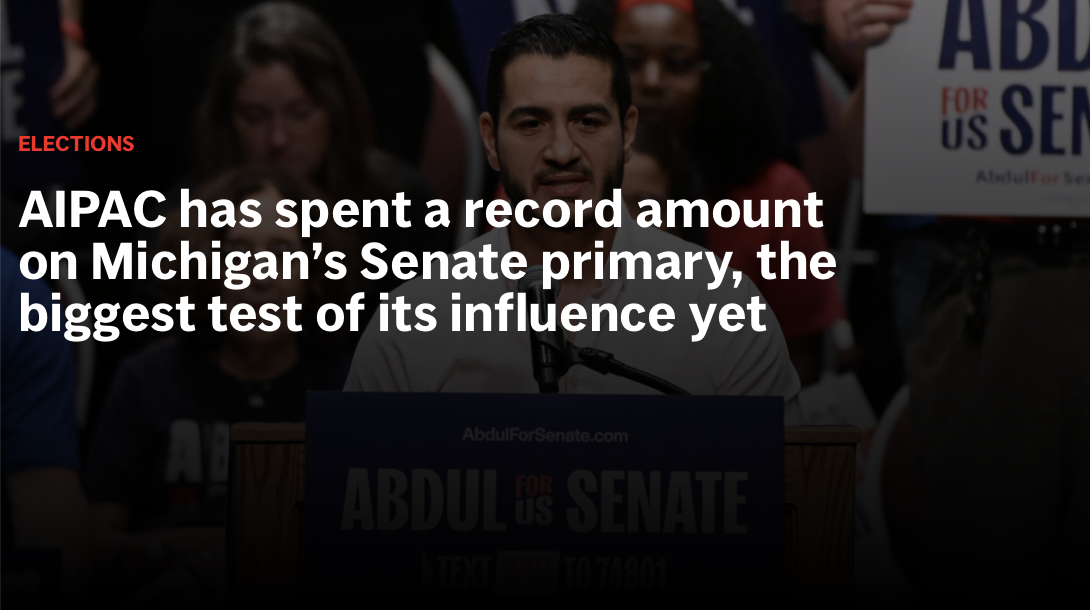
According to AP (7/19/26), AIPAC spent $30 million on Stevens’ campaign. Her total dark-money haul reached some $60 million total, compared to El-Sayed’s $3.5 million. El-Sayed outraised Stevens in individual donations, $14.5 million to $11.9 million (Al Jazeera, 8/2/26).
Then, both papers worry that Trump’s disastrous reign could allow voters to elect a man like El-Sayed, or that he could be so distasteful to the independents of Michigan that he could keep the Senate in Republican hands next year. The Post:
Trump is so unpopular right now, and the national environment is so favorable for Democrats, that El-Sayed might win despite himself. If he loses, and the GOP controls the Senate for the last two years of Trump’s term as a result, it could teach Democrats an important lesson heading into 2028. Pragmatism, not radicalism, offers the best path out of the wilderness.
The Journal:
Mr. El-Sayed is counting on anti-Donald Trump fury to unite Democrats despite his radical views…. Nominating a leftist could cost the party a Senate majority that is very much in reach. If [Republican Senate nominee Mike] Rogers wins, one lesson will be that Mr. El-Sayed was too far left to win in a swing state even in what is likely to be an excellent Democratic year. Democrats might rethink this year’s headlong rush left as they consider the 2028 presidential race.
Once again, the prose here is so similar that it makes one wonder why we must suffer through multiple newspapers at all—it’s like Walmart and Whole Foods, conservative and liberal-coded respectively, selling the same parasite-infected lettuce.
The Michigan primary race was notable for a huge amount of pro-Israel spending meant to stop El-Sayed—an attempted repeat of the lobby’s successful defeat of New York DSA congressmember Jamaal Bowman two years ago (FAIR.org, 6/28/24). As the AP (7/19/26) reported, AIPAC and “its affiliated groups have spent close to $30 million backing” El-Sayed’s opponent Congresswoman Haley Stevens, “their largest investment ever in a single race.”
For what it’s worth, Al Jazeera’s calculation (8/2/26) was more damning:
Federal Election Commission records show that AIPAC and other political action committees have spent more than $54 million to help Stevens. A dark-money group called the Center for Democratic Priorities has also spent about $6.5 million on ads supporting Stevens, according to local media reports—increasing the grand total to more than $60 million.
That’s actually the one notable difference between the two editorials: The Journal at least mentioned AIPAC’s heavy spending, while the Post did not. There was a time, before Amazon founder Jeff Bezos turned the Post ideologically toward the Trump administration (New Republic, 11/3/25), when the paper regularly attacked the influence of big money in American elections (Washington Post, 1/9/12, 4/22/12, 2/4/14, 10/12/14, 1/20/20). Times change.
The top Senate Democrat, Chuck Schumer of New York, didn’t publicly endorse Stevens, but reportedly pushed donors toward her campaign (New York Times, 6/5/26). She also had the backing of former House Speaker Nancy Pelosi. Former President Barack Obama didn’t publicly endorse Stevens, but “AIPAC-linked” supporters “spent $5 million airing an advertisement nearly 4,000 times that features Obama praising her work as chief of staff for the US Auto Rescue Task Force during the 2008 financial crisis” (CNN, 7/17/26), giving the impression that he was behind her.
If by “Democrats” the papers mean party leadership, the top brass already chose Stevens–they don’t need any editorial encouragement to avoid the progressive option.
Beltway Risk
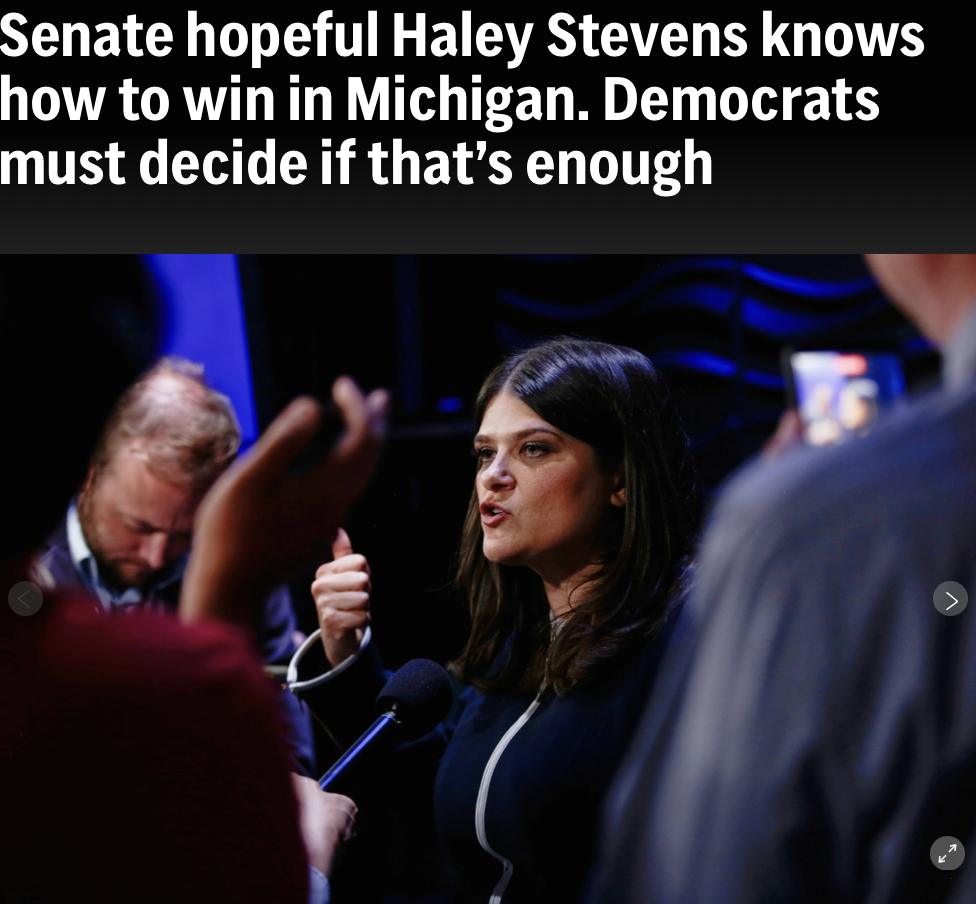
AP‘s headline (7/9/26) didn’t age well.
But if the editorials, when they admonished “Democrats,” meant the everyday people who chose El-Sayed, then they’re making a clear case against voters having small-d democratic agency. No, little voters in Grand Rapids or Kalamazoo, you can’t vote for what you believe is best for your job, health and bank account. You have to assume other people (who are in much the same boat as you) are going to vote against their interests–and vote the way they would.
Voters have been told repeatedly that the only way to counter the extreme rise of MAGA is to forgo socialist candidates like Bernie Sanders and opt for establishment centrists like Hillary Clinton and Kamala Harris (Mother Jones, 12/16/16; Fox Business, 2/24/20; FAIR.org, 10/25/25). Certainly, in the last 10 years, the Republican base’s move from the old guard to more radical ideas haven’t hampered the party’s results at the ballot box. After these Democratic leadership failures to win power, maybe voters are interested in a different strategy.
Not only did the editorial boards not acknowledge that El-Sayed’s platform of single-payer healthcare and taxing the rich was appealing to voting people, they could not admit that the centrist politics they push as an alternative were a turnoff. Stevens’ enormous corporate warchest couldn’t make up for the fact that people, as one voter put it (AP, 7/9/26), “don’t want a moderate,” and instead “want somebody who’s going to come in and effect change.”
In other words, for the Post and Journal editorial boards, politics and voting aren’t about how people express themselves and their needs and interests. Rather, they’re an ongoing game of Beltway Risk, in which the needs and views of living, breathing people are just pieces on a board.
From FAIR via This RSS Feed.