

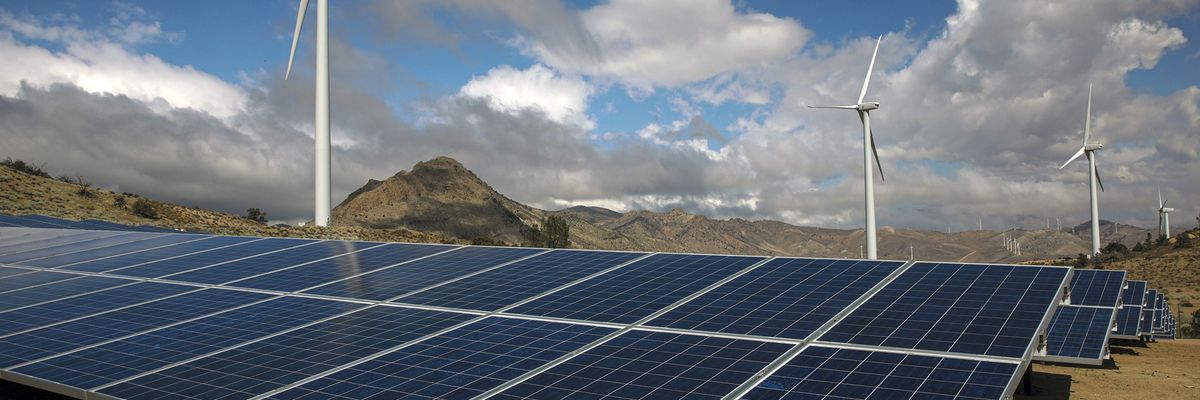
Despite the Trump administration’s staunch support for the climate-wrecking fossil fuel industry and equally aggressive attacks on renewable energy, the US is generating more power from the sun and wind than ever, according to the latest figures on the matter.
Updated state-level data confirmed this week that solar generation eclipsed every other source of electricity in Utah for the first time in its history, with photovoltaic panels producing nearly 1 terawatt-hour in May. That’s enough to power roughly 90,000 homes for an entire year, according to the US Department of Energy.
That amount represented nearly one-third of all electricity generated in Utah that month, according to data from the global energy think tank Ember. Natural gas generated 32% of Utah’s electricity in May, while coal produced 28%, and wind 2%.
“The trend of more and more solar in Utah is wonderful news for air quality, it’s wonderful news for the climate, and it’s wonderful news for jobs and the economy,” Dan Schroeder, a physics professor at Weber State University in Ogden, told Grist in an article published on Thursday.
Meanwhile, California achieved an even more significant milestone. Solar was already the largest source of electricity generation in the Golden State. In May, solar produced 51% of California’s electricity, the first time a renewable energy source generated more than half of a state’s power for an entire month. Solar also outproduced natural gas in every month of 2026 through May, the last month confirmed.
Also in May, solar supplied more of the nation’s electricity than coal for the first time, and solar and wind combined generated the majority of electricity in seven states and more than 30% of power in 20 states.
Good morning with good news: Solar & wind generated more than 50% of electricity in 7 US states & more than 30% in 20 states in May 2026! Top 10 S&W states:IA 67%SD 64%NM 63%CA 58.9%KS 58.3%MA 56.9%CO 51.8%VT 49%OK 48.6%ME 45.7%S&W generated 24.2% of US power in May.#energysky
[image or embed]
— John Hanger (@jrfhanger.bsky.social) August 7, 2026 at 4:42 AM
“We’re going to see milestones like this increasingly happen,” Logan Mitchell, a climate scientist and energy analyst with Utah Clean Energy, told Grist.
According to the US Energy Information Administration, approximately 51% of new utility-scale electricity generation in the United States is projected to come from the sun this year, as the nation is expected to add another 43.4 gigawatts of solar, compared to 6.3 gigawatts of natural gas generation and no new coal.
More broadly, the US produced nearly three times as much solar, wind, and geothermal power in 2025 than it did in 2016, with renewables accounting for more than 20% of the nation’s power production, as shown by the recently launched State of Renewable Energy online dashboard published by Environment America Research & Policy Center and Frontier Group.
Renewables accounted for 21.4% of national retail electricity sales in 2025, up from just 8% in 2016. South Dakota led the nation by generating the equivalent of 95% of its retail electricity from wind, solar, or geothermal.
“In 2026, America is getting more power from the sun and wind than ever,” Wendy Wendlandt, president and chairwoman of Environment America Research & Policy Center, said in May. “Renewable energy is reliable, resilient, and shows up for free every day. When we replace polluting energy sources with solar and wind, it delivers a cleaner, healthier future for all Americans.”
The surge in renewables comes amid efforts by the administration of President Donald Trump—who ran on a “drill, baby, drill” energy platform during a 2024 presidential campaign generously supported by the fossil fuel industry—to boost oil, gas, and coal and roll back clean power initiatives.
At times, the Trump administration’s animus toward renewables has been downright inane, like when Interior Secretary Doug Burgum—a billionaire who has personally profited from an oil lease on family land—infamously trashed solar by saying that “when the sun goes down, you have a catastrophic failure called sunset and there’s no solar energy produced,” prompting some observers to question whether he’s aware of batteries or how they work.
The One Big Beautiful Bill Act signed into law by Trump last year includes billions of dollars in handouts for the fossil fuel industry, boosts drilling on millions of acres of public lands, mandates oil and gas lease sales, and imposes new fees on renewable development. A report published last month by BlueGreen Alliance revealed that “23 manufacturing, clean energy, and industrial projects are already facing cancellations and delays representing at least $82.8 billion in capital investment, which could cost 111,765 jobs.”
Last month, Common Dreams reported that Trump’s rollback of clean energy policies will cost American consumers $650 billion in additional energy bills by 2040, based on figures from the San Francisco-based energy and climate policy think tank Energy Innovations.
Trump has also twice withdrawn the US from the Paris Agreement, rolled back Environmental Protection Agency rules, signed pro-fossil fuel executive orders—including one declaring what critics say is a “phony” energy emergency—resumed and accelerated approvals for new natural gas export terminals following a moratorium enacted during the Biden administration, and paid billions of taxpayer dollars to kill clean energy projects around the world.
The “energy emergency” has been invoked to fast-track fossil fuel permits, including for extraction projects on public lands. This, despite overwhelming evidence that burning fossil fuels is the leading driver of the climate emergency.
Still, clean energy advocates are buoyed by recent reports of rising renewables.
“Wind plus solar is on a tear right now,” said Mitchell. “We may have achieved liftoff.”
From Common Dreams via This RSS Feed.