

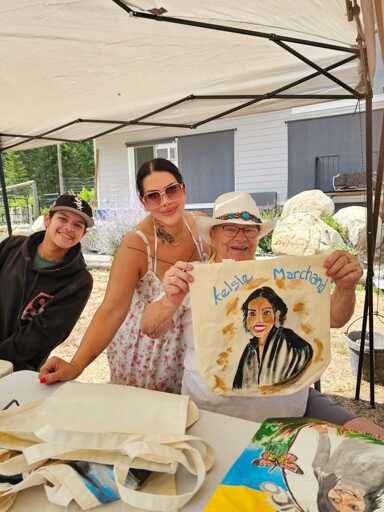
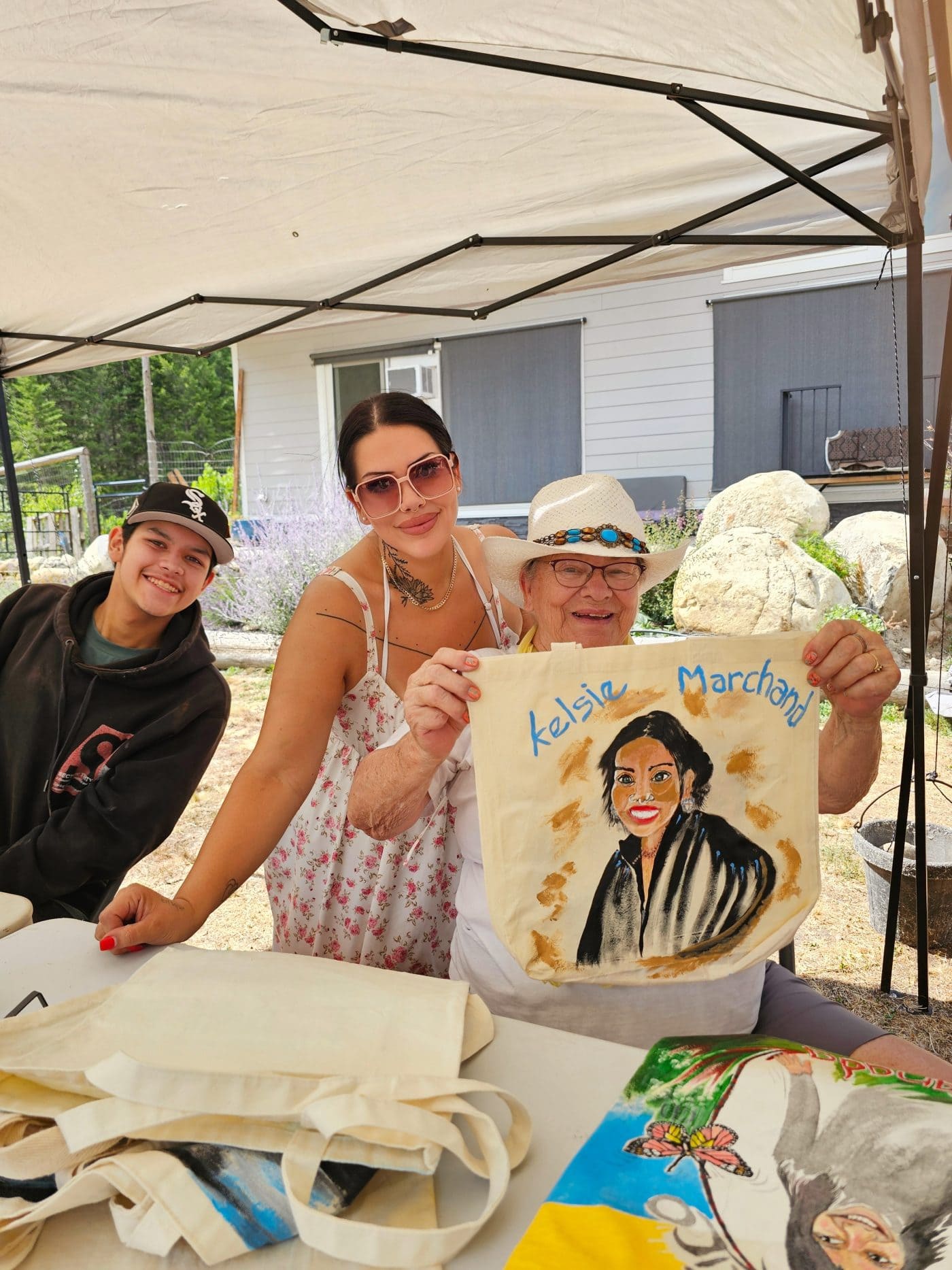
Photo: Justin Bambrick
The Bradley Creek wildfire ignited on reserve lands at nk̓maplqs (the head of Okanagan Lake) on Friday, July 31. More than 30 band members have lost their homes, while around 200 homes and structures belonging to non-band members are also gone. kelsie, who was evacuated and has not yet returned home, shared her reflections in the midst of the evacuation. This story was co-published with IndigiNews.
Saturday, Aug. 1, started like any other day.
I woke up early with my partner. We sat on the front deck, coffee in hand, watching the morning unfold. We talked about the day ahead, my son Skookamina’s graduation party and my grandmother’s 83rd birthday. There was meat to smoke, cakes to bake, tables to set. The day felt like a blessing because we had so much to celebrate.
I checked my phone. A small fire had started the night before, nothing unusual for this time of year. Our Okanagan Indian Band fire department is amazing. I figured it’d be out by noon, so I kept moving.
I seasoned the meat, I lit the smoker, and I sang while I cooked, the way I always do in my kitchen.
But I kept checking my phone, as we had family that was traveling in for the event.
Mid-morning, we decided as a family to move the party from the beach in town to my uncle’s house in the community. Some of our family had community obligations they’d need to tend to if the fire got out of control. We wanted to be close.
Everyone was there. My grandmother sat in her chair, full of joy as each person arrived. Skookamina was surrounded by his cousins, and the sound of our family filled the air, aunties laughing loud, making outlandish jokes, the familiar banter of people who know each other’s rhythms.
For one hour, we were just a family celebrating, living our lives the way we always do.
Then, one by one, family members started picking up their phones.
Some stood up. They’d been put on evacuation alert. They had to go home, pack, and wait. I watched them go, first one, then another, then a handful until the room thinned. The laughter quieted and my grandmother sat in her chair, watching her grandchildren leave, one by one. She didn’t say much, she didn’t need to, she knew this dance, she’d done it before.
Eventually, I had to leave too.
We packed the rest of the food. We hugged. We said “see you soon,” and we meant it. Then everyone went home. My father had to evacuate with only minutes to spare. I raced to my dad’s house and we helped him pack what we could as the fire grew at an alarming speed toward him. He was evacuated two minutes from my house, so I knew I was next.
By the time I got home, our family friends were already there, packing for me. They’d already been evacuated without time to take anything with them. Now they were saving us while their own home burned behind them.
One minute I was laughing with my son. The next minute I was grabbing what I could carry. I was not thinking about taking what was valuable, I only grabbed what was irreplaceable. Old ceremony blankets, medicine necklace materials, baskets, photographs, my computers with language recordings and the eagle feather my son gave me. Everything else I left.
On my way out, I looked back, and the smoke was climbing toward us. Flames moved over the ridge toward my house, and the sky was turning black. I felt an overwhelming need to just get out, this fire had taken on a life of its own. I could tell this fire doesn’t know our names the way our cultural burns do. It was consuming everything equally, the sacred and the ordinary, the medicine plants and the invasive brush.
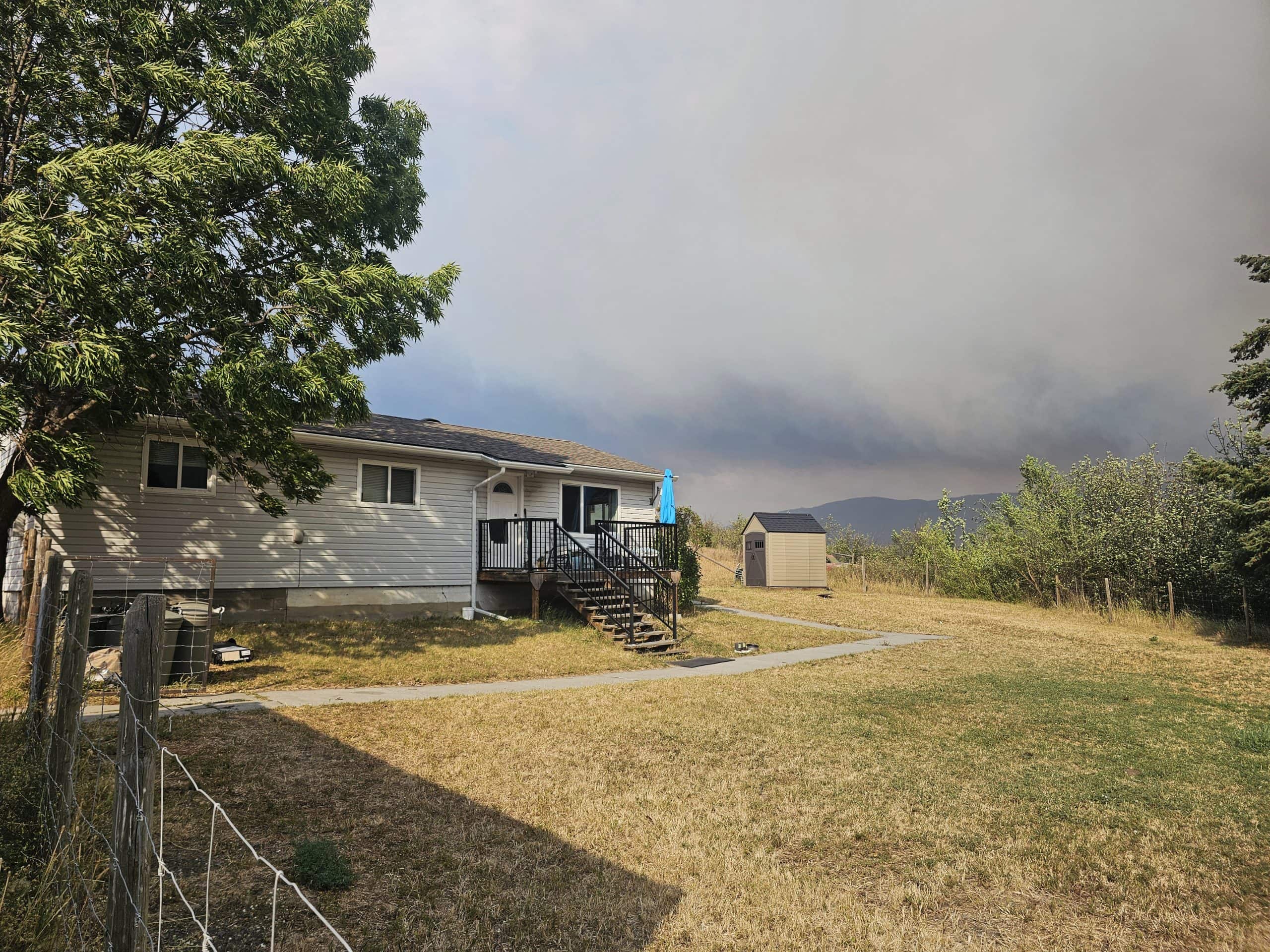
The last photo kelsie took of her house before evacuating. “Four generations, my great great grandmother, my grandfather, my father, me, my son, all held by these walls. I think it’s still standing. I’m grateful for that. But I needed to remember it the way it was, no matter what comes next.” Photo: Supplied by kelsie kilawna
But, even as I watched the fire consume everything in its path, I realized this is exactly what my people prepared me for. This is why they taught me about grief.
They taught me that grief is not a destination, it’s like a creek — you don’t stop it. You discipline yourself to sit beside it, make kin with it, let it flow, and let it carry away what it needs to carry.
They taught me that grief has a shape. They taught me that grief is so special to us that it has its own ceremony, its own songs, its own prayers for specific losses. I was always told, “Name your grief, give it boundaries. Tell it, I see you. You are welcome here. But you will not take me with you.”
They taught me that the deeper you love, the deeper you grieve. That grief and joy are not enemies. That you can weep and laugh in the same breath. That you can feed people even when you can’t eat yourself.
My people taught me that a community that grieves together stays together. To suppress grief is to go against our own syilx intellect, against the very way we are made to commune with the world. Feeling is not weakness, we are to honour that it is our Way of Knowing. It is the thread that connects us to what we love, to cut it is to sever ourselves from the land, from each other, from the truth of what we carry.
My people taught me that grief is not something to outrun. It is something to sit beside, to name, to sing, to let drip into each other’s minds, drop by drop, until a shared truth emerges. The image of that process is enowkinwixw, the syilx word for a gentle way of coming to understanding together. The word itself conjures liquid being absorbed drop by drop through the mind, filling in gaps, softening resistance, building a common picture. The process is about finding clarity, where each person is offering what they know, no matter how small, until the whole circle sees more clearly. That is how we hold the loss in the centre of the circle and face it together.
I could tell this fire doesn’t know our names the way our cultural burns do. It was consuming everything equally, the sacred and the ordinary, the medicine plants and the invasive brush.
So now I think about that morning. Coffee on the deck, with my partner beside me. The sun rising over the valley. I didn’t know it would be the last ordinary morning for a while. I didn’t know I would spend the next few days learning what my people have always known, that you can lose everything and still have everything that matters.
Okanagan Indian Band Chief naspəpʕásəs Dan Wilson confirmed as of Aug. 5, more than 30 band members have lost their homes to the fire, and numerous other structures are also gone. Some families have been contacted directly, and others are still waiting, still hoping, still not knowing if their homes are standing.
He told IndigiNews, “Our loss is measured in the family histories that have been lost — especially the Elders who have lost their homes. The old pictures, the memorabilia; the Salish baskets.”
As I write this, it’s Aug. 6. I wash dishes in someone else’s sink. I cook without my grandmother’s tools. Today, I am learning to grieve the way my people taught me, by sitting with it, and letting it flow like the little creek that runs beside my house.
Tomorrow I will wake up and make coffee. I will stand on whatever deck I am given and be grateful for it. I will look out at whatever sky is above me and I will remember that I am grateful to be sqilx’w in these times, I am blessed to be syilx, and I am proud to be from the Okanagan Indian Band, proud to have called it home my entire life. Now, I have both the responsibility and the profound honour to continue dreaming, as we have been directed by our Creator to do, and that does not end when the smoke clears.
If you are a member of the Okanagan Indian Band and are struggling, help is available through the OKIB Mental Health and Wellness team at 250-540-7416. Resources are also available from First Nations Health Authority and Interior Health.
The Narwhal’s reporters are telling environment stories you won’t read about anywhere else. Stay in the loop by signing up for our free weekly dose of independent journalism.
From The Narwhal | News on Climate Change, Environmental Issues in Canada via This RSS Feed.