

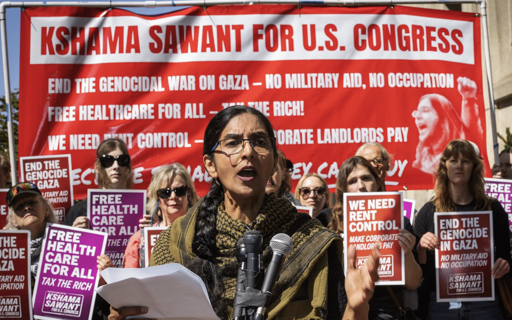
In Washington’s 9th Congressional district, independent socialist candidate Kshama Sawant took over one in seven votes in Tuesday’s primary elections. At over 15 percent of the vote (accounting for 16,408 ballots, with more still being counted), this marked a third-place finish, coming behind Rep. Adam Smith, the Democratic candidate who won 51 percent of the vote, and Doug Basler, a Republican who carried 24 percent of the vote.
In the calculus of the top-two primary system, the results effectively end her campaign. Smith and Basler will face off in the November elections. Yet these results obfuscate the crucial takeaway from the night. Sawant, an open and independent socialist ran against the two capitalist parties — including a 29-year Democratic incumbent who has won 15 straight elections in the district — and won a significant base of support in a district that stretches from south Seattle to deep into its suburbs. Despite not advancing to November, her campaign shows the space there is for class-independent politics and, with it, the necessity for the working class and the Left to fight for a party of our own.
Behind Sawant’s Campaign
In 2013, Sawant became Seattle’s first socialist city councilmember in generations and spent a decade in office using it as an organizing platform. In office, she fought for the country’s first $15 minimum wage, the first tax on Amazon, as well as for a ceasefire resolution against Israel’s genocide in Gaza, calling for an end to all U.S. military aid to Israel. In the midst of the George Floyd protests in 2020, Sawant also let protesters into City Hall, where they demanded the resignation of Mayor Jenny Durkan and cuts to police funding. In the face of these attacks, both big business and the Democratic establishment joined forces and spent heavily to recall her in 2021 — a campaign that she mobilized to beat, before leaving voluntarily at the end of 2023.
Her congressional run carried much of the same politics onto a larger stage. She ran a campaign to tax the rich to fund healthcare for all, to end U.S. military aid to Israel, to stop the growth of data centers and AI layoffs, taking Big Tech and the energy giants into democratic public ownership, to build millions of affordable homes, and to stop deportations and shut down detention centers. Notably, she ran as an independent, launching what she billed as a “working-class, antiwar, anti-genocide” campaign. Her program stood in stark contrast to that of Smith, who’s a senior member of the Armed Services Committee and voted for the Iraq War, voted to create ICE, and has voted to send tens of billions of dollars to arm Israel’s assault on Gaza.
With more than 800 volunteers, Sawant’s campaign raised about $645,000, most of it in small donations at a median of about $25. She out-raised everyone else in the field, including Basler and the other Democrat, Melissa Chaudhry, but was still outspent roughly three to one by Smith, who raised close to $1.9 million. Against the wider progressive slate now sweeping Democratic primaries, hers was a lean operation. Abdul El-Sayed raised more than $12 million for his Michigan Senate bid, Francesca Hong raised more than $1.1 million for her Wisconsin governor race, and Mamdani’s New York mayoral run mobilized tens of thousands of volunteers and maxed out the city’s matching funds.
This gap points to the other half of the story: despite the space for new ideas, the hurdles for Sawant’s campaign were significant. Endorsements came from the activist Left like the Washington Green Party, The Stranger, Mumia Abu-Jamal, and the Seattle Gay News. The institutions with real muscle — the unions, the big progressive groups, and DSA — stayed on the sidelines. In March DSA’s convention voted 91 to 67 to not even reopen consideration of endorsing her, with critics inside DSA citing a long, fractious relationship and accusing her camp of “entryism.” The real debate that Sawant’s campaign posed, however, was that instead of continuing with DSA’s longstanding strategy of using the Democratic party ballot line and attempting to transform it into a vehicle for the working class and the Left, there exists an actual space to fight for class independent politics.
The Progressive Sweep and the Fight for Socialism
Savant’s showing in the primaries lands at a time when the progressive wave is indeed ascendant. On Tuesday, progressive Abdul El-Sayed won Michigan’s Democratic Senate primary. In Detroit, democratic socialist Donavan McKinney knocked off a sitting congressman. In previous months, a slew of DSA-endorsed candidates swept the primaries in both blue and purple states. These all follow Mamdani’s win in the country’s largest city in the Mayoral elections last year.
The mood behind these wins is unmistakable, with “socialism” increasingly becoming popular and as both parties face a huge loss of prestige. A record 45 percent of Americans now call themselves political independents, 43 percent told a New York Times/Siena poll they are dissatisfied with both major parties, with the numbers hitting nearly two-thirds of those under 30. According to another poll, a majority of people believe the two parties do such a poor job of representing people that there is need for a third party.
Gallup found capitalism’s favorability among U.S. adults at its lowest since it began asking the question. Among Democrats, socialism now polls better than capitalism, at 66 percent to 42 percent. DSA has more than doubled its membership in under two years, passing 120,000 to become the largest socialist organization in American history. Sawant read the anger at both parties, and the thirst for something new, correctly.
People are done with both parties, and hungry for political representation that names the culprits — billionaires, an imperialist war machine, an economy rigged against them — and actually helps to build the fight against them.
We Need a Party of Our Own
This is the real lesson of Sawant’s third place finish in Tuesday’s primaries. If her campaign — outspent, against a 15-term incumbent, and running against the tide from outside both parties — can still win over one in seven voters, imagine what we can accomplish if we actually mobilize our full forces behind independent, working-class politics.
In this, DSA, especially, with its vast membership, apparatus and resources, flying the banner of socialism, has a particular role to play. With tens of thousands flocking to the organization searching for real political alternatives, we cannot funnel this momentum back into a capitalist, imperialist party in crisis.
Yet, this is precisely our current course. Of the roughly 150 candidates DSA has endorsed this cycle, with more than a dozen for Congress, nearly all are running on the Democratic ballot line. And the more wins they continue to rack up, the more nervous the establishment grows. Republicans have made anti-communism the centerpiece of their midterm messaging as Trump brands Mamdani and the DSA “communists,” and has virulently attacked candidates like El-Sayed. The Democratic establishment is answering the surge two ways. On one hand, with hostility, with the likes of former DNC chair Jaime Harrison, telling socialists that if they hate the party, then “please don’t run for our nomination,” or the 15 Democrats who signed the pledge to keep socialists out of the Democratic party. The other is co-optation, welcome the insurgents into the “big tent” and let the pressures of office do the rest.
And that proof is in the pudding. In the last eight months in office, Mamdani has set aside the fight to tax the rich that defined his campaign, cutting a budget deal with Governor Hochul that left the millionaire’s tax untouched and trimmed housing vouchers for the poor instead. And while he passed a first budget without major austerity, it has only kicked the can down the road. Administering the capitalist state for means, sooner or later, administering its attacks: balancing its budgets on the backs of the poor, keeping its order, managing the very machinery we set out to dismantle. At a time when hundreds of thousands are coming to political life, expressing their anger against the rich and the imperialist state, we need to build a political force that isn’t content with governing from above in a system that is stacked against us. We need to build an actual political force that will help us build the fight from below.
When new generations are rejecting capitalist misery and are drawn to the prospects of socialism, we need to fight for a party of our own: a working-class socialist party that can help organize us, in our schools, in our workplaces, and in the streets, to beat back every attack from the Right and the bosses, fights for our own program, and builds toward a future run by and for the working class — not the rich.
The post Kshama Sawant’s Third-Place Finish Shows the Space for a Party of Our Own appeared first on Left Voice.
From Left Voice via This RSS Feed.
There are socialist parties in North America though.
