

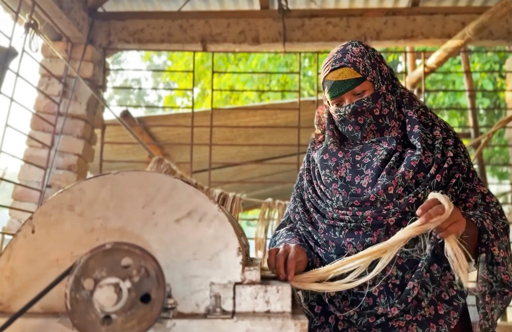
Bananas make up 20% of all fruit crops grown in Bangladesh, and the country has begun to unlock the hidden potential of the plant’s agricultural byproducts. Banana fiber, extracted from post-harvest stems, is emerging as a versatile biodegradable material that can be used to manufacture textiles, blended yarns and handicrafts. In Bangladesh, banana fiber is used to make handcraft biodegradable items like the highly celebrated Kolaboti saree, curtains, mats, bags, handicrafts, ropes, paper, packaging material and eco-friendly composite products . According to World Population Review data, Bangladesh ranked 27th in global banana production in 2024, producing roughly 813,600 tons annually. India was the largest producer, with about 37.6 million tons. A 2024 study shows that Bangladesh could produce around 37,800 tons of banana fiber annually and generate more than $94 million in export earnings if the sector is commercialized effectively. In the Bangladeshi market, banana fiber is sold by some small and medium entrepreneurs for around 150 takas to 500 takas per kilogram (roughly $1.20 to $4 for 2.2 pounds). Processed and dyed banana fiber. Image by Mahmudul Hasan. The study also shows that Bangladesh has significant potential for banana fiber production because banana is cultivated across 54,756 hectares (133,305 acres) of land. The country generates substantial biomass from banana pseudo-stems, estimated at around 3.78 million tons annually, of which approximately 1% can be extracted as fiber. According to the study, banana fiber is generally more cost-effective on the raw material end because it uses agricultural waste, while jute requires…This article was originally published on Mongabay
From Conservation news via This RSS Feed.