

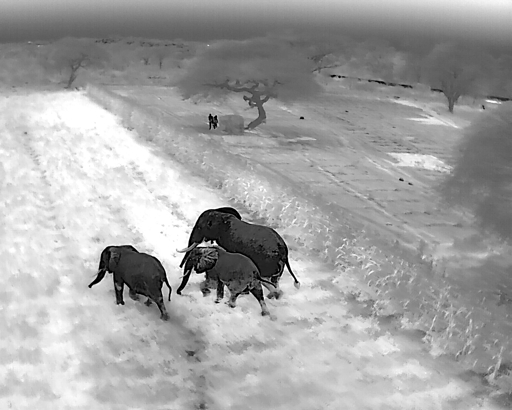
Dominic Mutua, a smallholder farmer from Inkoisuk village some 30 kilometers (19 miles) from Amboseli National Park, has often clashed with two elephants that enter his farm and destroy crops. “We had to stay up guarding most nights and chasing them away,” Mutua told Mongabay in a telephone interview. The 2025 census conducted by the Kenya Wildlife Service (KWS) recorded a population of 42,072 elephants (Loxodonta africana) in Kenya, 1,903 of which were counted in the Amboseli park and its surrounding areas. The absence of a perimeter fence means elephants can move freely beyond the national park’s boundaries. To address human-wildlife conflict in this remote rural region of southern Kenya, drones equipped with thermal-imaging technology enable conservation teams to monitor animal movement, detect wildlife at night and warn communities early before encounters escalate. Amy Baird, Deputy Director of the Big Life Foundation, says that aside from data collection, the drones can also safely deter elephants from entering farms and settlements by guiding them away from these areas. The US-based nonprofit works with communities to protect elephants and conserve habitats in the larger Amboseli ecosystem. An Amboseli elephant. Image courtesy of Big Life Foundation. Approximately 200,000 people live within the park and in the broader Amboseli region, which encompasses about 8,093 square kilometers (3,125 square miles) of rangelands, wetlands and wildlife corridors, according to the park’s management. As the park itself covers only 392 sq km (151 sq mi), its survival depends heavily on the health of the surrounding community lands.…This article was originally published on Mongabay
From Conservation news via This RSS Feed.