

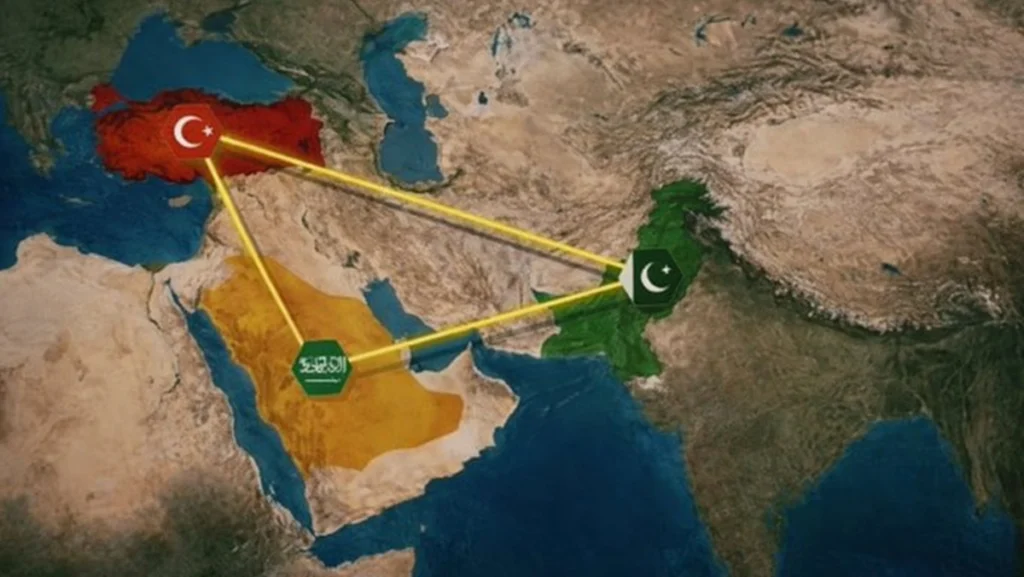
Trilateral Agreement Declares Attack on One Member an Attack on All Amid Rising Regional Tensions.
On Friday, Saudi Arabia, Türkiye and Pakistan signed a trilateral defense agreement in Mecca to strengthen collective deterrence, stipulating that any attack against any of the three countries will be considered an attack “against all of them.”
RELATED:
The Houthis Vow Strikes on Oil Facilities if Saudi Arabia Launches Major Offensive
The Joint Defense Agreement of Mecca was signed during a summit in the city — the holiest site in Islam — by Saudi Crown Prince Mohammed bin Salman, Pakistani Prime Minister Shehbaz Sharif and Turkish President Recep Tayyip Erdogan.
“The agreement aims to strengthen collective deterrence against any act of aggression and stipulates that any armed attack against any of the three states shall be considered an attack against all of them,” the statement said.
The pact provides for “the strengthening of all aspects of cooperation” in defense matters among the three allied countries, which are also currently participating in mediation efforts to end the wars involving Iran and the Gaza Strip, at a particularly critical time for Saudi Arabia.
The agreement was also signed because of the “long-standing historical ties” and bonds of “Islamic solidarity” linking the three countries, which now seek to expand “their shared strategic interests” to “further strengthen their collective security and promote peace” in the Middle East.
With this move, Türkiye joins the agreement signed last September between Pakistan — a nuclear power — and Saudi Arabia, which established similar terms for joint defense.
The newly signed “Mecca Defense Pact” establishes a pivotal trilateral security alliance between Türkiye, Saudi Arabia, and Pakistan, creating a powerful regional axis getting labele as an “Islamic NATO”. Officially finalized by leaders in Saudi Arabia, this agreement integrates… pic.twitter.com/QPpZuX5Izc
— Khadim Hussain مؤرخ (@Karima82312Jan) August 7, 2026
The Effects of the U.S. War on Iran.
This comes amid growing tensions in the Middle East over the U.S. war on Iran, which has had severe repercussions for the Persian Gulf countries because of Iranian retaliatory attacks against Washington’s Arab allies and the closure of the Strait of Hormuz, through which about 20% of the world’s crude oil passed before the conflict.
Saudi Arabia — OPEC’s largest producer — is facing another maritime blockade, this time imposed by Yemen’s Houthi rebels, who accuse Riyadh of controlling its airspace and territorial waters, as well as carrying out the bombing of Sanaa Airport in July.
Since then, the Houthis have launched repeated attacks against Saudi territory — particularly energy infrastructure — and against oil tankers linked to Riyadh in the Red Sea, prompting the Saudi monarchy to establish the Multinational Alliance for Maritime Security last week.
The coalition was ratified in a founding document signed by 14 countries, including Pakistan and Türkiye, and Saudi Arabia says it is purely defensive in nature and intended to protect navigation in the Red Sea, the Bab al-Mandeb Strait and the Gulf of Aden.
With the Strait of Hormuz closed, Saudi Arabia redirected about 70% of its oil exports through the Red Sea, an alternative route for Riyadh that is now being blocked by the Yemeni rebels, who are allied with Iran and have been fighting the Arab country since the Saudi intervention in the Yemen war in 2015.
Indeed, the conflict between the Houthis and Saudi Arabia has escalated to unprecedented levels in the past five years, and early Friday the Riyadh-led military coalition intervening in Yemen announced that an insurgent attack wounded 11 civilians in a Saudi border area adjacent to Yemeni territory.
teleSUR/ JF
Source: EFE
From teleSUR English via This RSS Feed.