

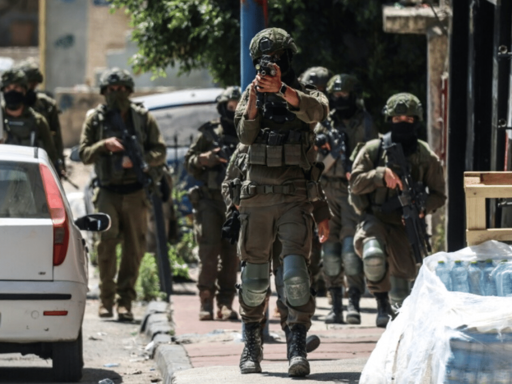

Israeli occupation forces (IOF) have ended their raid on Qalandiya Refugee Camp and neighbouring Kafr Aqab, north of occupied East Jerusalem. This followed a dawn assault on 5 August that saw roads blocked and residents placed under strict curfew.
The Palestinian Prisoner’s Society (PPS) reported that more than 60 Palestinians had been arrested and interrogated by 12pm local time on 6 August. Those detained included women and children.
Israeli occupation forces continued their raid on Qalandiya refugee camp for the second day, demolishing shops, raiding homes, and blocking roads. The Palestine Red Crescent said 10 Palestinians were injured, while its crews were prevented from reaching patients. pic.twitter.com/xuC9jBVyo0
— Government Communication Center (@pal_gcc_en) August 6, 2026
Israeli occupation forces raid Qalandiya
Freelance journalist Mohammad Turkman, who has been covering the Qalandiya Refugee Camp raid over the past two days, told the Canary:
They closed the road between Kafr Aqab and al-Ram until 10 or 11. Anyone who tried to pass during that period was assaulted. They searched vehicles and people’s ID cards, harassing and mistreating them.
The IOF’s arrest and interrogation campaign in the refugee camp was accompanied by serious assaults and violations against civilians. A total of 51 Palestinians were injured. Of those, 35 were hospitalised after being severely beaten. One person was hit by a rubber-coated steel bullet. Meanwhile, 60 others were treated for suffocation caused by tear gas inhalation.
Shops were demolished. In addition, the IOF raided the headquarters of the Popular Service Committee and Palestinian homes in Qalandiya Refugee Camp. Families were forced out at gunpoint as soldiers vandalised their homes and stole cash and jewellery. The occupation forces also seized several homes. These were then turned into interrogation centres, military outposts, and surveillance positions.
Turkman explains:
The situation in the camp was very difficult, to the point that the Jerusalem governorate, together with the Civil Affairs Liason managed to bring in bread, medicine, and other supplies to the people who had been trapped throughout the day. The occupying forces also prevented the Red Crescent and ambulance crews from reaching a number of medical cases, except after hours of interventions and lengthy coordination efforts with them. There were also repeated attacks on press crews, suppressing and preventing media coverage during this raid.
The IOF also tried preventing coverage of the raid, forcing journalists away from the camp’s main entrance and closing the road from the adjacent Sikkal neighbourhood near the main Jerusalem–Ramallah road to block access. Journalist Muhammad Sumrin was reportedly severely beaten while covering the assault, while other reporters were targeted with stun grenades
Israel’s assault on refugee camps
The Jerusalem Governorate has called for urgent international action. It said these violations must end, and that Palestinian refugee camps must be protected as a core element of the inalienable rights of the Palestinian people.
What happened in Qalandiya is not an isolated incident. West Bank refugee camps have faced Israeli military violence for decades. But since the start of Israel’s genocide in Gaza, they have witnessed an unprecedented escalation in scale and intensity.
In January 2025, Israel launched Operation Iron Wall, targeting Jenin, Nur Shams, and Tulkarem refugee camps in the northern West Bank. The IOF destroyed large parts of these camps, using helicopter gunfire, airstrikes, ground operations, and tanks against largely unarmed residents. More than 40,000 Palestinians were forcibly displaced during the operation. In the process, the Israeli occupation emptied the camps, destroyed homes and infrastructure, and continued preventing Palestinians from returning.
Operation Iron Wall: A campaign of expulsion
According to the UN, the occupation targeted these camps with more than 100 airstrikes. These statistics show that the IOF killed 361 men, 10 women, 70 boys, and 4 girls. 258 people were killed by airstrikes and 46 by shoulder-fired projectiles.
Less than 10 days before the Qalandiya Camp raid, the occupation’s so-called “defence” minister, Israel Katz, instructed the IOF to capture another Palestinian refugee camp in the West Bank. Although he did not identify which camp would be next, he said the operation should follow the:
Tulkarem, Nur Shams and Jenin model.
Palestinians in Qalandiya Refugee Camp were understandably extremely worried and concerned, as this violent raid could have been the start of a much bigger military operation. Next time they may not be so lucky.
Despite the growing mountain of evidence of war crimes and crimes against humanity government’s continue to remain silent. According to Human Rights Watch:
Katz’s announcement shows that when serious international crimes go unpunished, they can happen again.
Human Rights Watch has warned that when serious international crimes go unpunished, they can happen again. The organisation is calling on governments to act urgently to prevent further forced displacement, including by sanctioning those responsible for grave human rights violations, suspending arms transfers, ending trade with illegal settlements, and supporting the International Criminal Court’s investigations and arrest warrants.
But for Palestinians in Qalandiya and across the West Bank, the question is not only what happens after another raid — it is why repeated warnings, documented violations, and mounting evidence of crimes have still failed to stop them.
Featured image via the Canary
By Charlie Jaay
From Canary via This RSS Feed.