

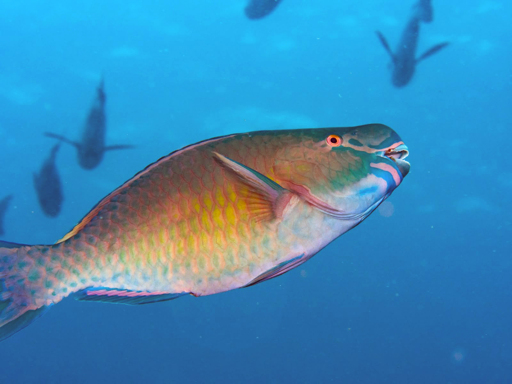
It started six years ago when Shaha Hashim began seeing posts across social media: Vulnerable and protected species were being fished throughout the atoll islands of the Maldives, and some were even turning up in fish markets. This included animals like the giant clam (genus Tridacna), Napoleon wrasse (Cheilinus undulatus), and even species of parrotfish (subfamily Scarinae). These species weren’t historically targeted by Maldivian fishers, but were rising in popularity over the last decade. This came to a head in the midst of the COVID-19 pandemic, as tourism workers were being let go from their jobs at resorts, and fishing became more popular recreationally, as well as a means of earning money and providing food. “This was the only way for them to earn an income at that time,” Hashim told Mongabay by video call. Today, she’s the co-founder and executive director of Maldives Resilient Reefs (MRR). Hashim said the parrotfish were particularly concerning. At the time, they weren’t a protected species, though they played a key role in recycling sediment and generating new habitat for coral reefs. Protecting them means safeguarding accretion: An important sedimentary process that is intertwined with the resiliency and natural management of atolls. “Accretion really is the deposition of sediment above the water level,” said Paul Kench, a coastal scientist and the pro vice-chancellor of Te Wānanga Pūtaiao Division of STEM at the University of Waikato in New Zealand. He told Mongabay by video call that accretion allows atolls to naturally combat climate change by…This article was originally published on Mongabay
From Conservation news via This RSS Feed.