


Ecuador’s coast has become a crime scene, and Washington’s fingerprints are all over it.
The Canary interviewed two local humanitarians, published under pseudonyms for their protection. They generously offered us first-hand knowledge of the repeat attacks inflicted upon Manabita communities.
On June 14, prosecutor Alexandra Bravo was gunned down outside a café in Manta by a hitman on a motorcycle. Her sister, who threw herself in front of her, died too. Five shell casings. No sign of the police detail supposedly guarding her.
Bravo was, shockingly, the twenty-sixth member of Ecuador’s justice system murdered since 2020. She was the second person investigating US-linked state crimes killed in that same week.
What was she investigating? Three fishing boats — the Fiorella, the Negra Francisca, the Don Maca — hit by drone strikes in the Ecuadorian Pacific this year. Survivors say they were dragged aboard a US-flagged patrol ship, hooded, beaten, and starved for eight days before being dumped in El Salvador as “shipwreck survivors.” Thirty-six came home. Eight are still missing.
Ecuadorian lawyer investigating US drone strikes assassinated
So, why did they sink?
Tommy, a humanitarian worker with decades of experience documenting abuses on Ecuador’s coast, asks:
So, why did they sink? Why were those vessels attacked? There is no explanation.
Not from the Ecuadorian navy, nor from the port captaincy that ignored distress calls. Certainly there’s no clarity coming from Washington. US State Department war footage shared online first claimed the boats were trafficking drugs. Sure enough, the department went silent the moment survivors started talking.
Meanwhile, the receipts keep piling up. Drop Site News obtained tracking data placing the US Coast Guard cutter Bertholf near the Negra Francisca at the exact hour it was bombed. This was before the ship went dark and resurfaced off Costa Rica. Then, on the same day, tortured fishermen were handed over to Salvadoran authorities. (El Salvador’s ruthless president Nayib Bukele has made the country a US prison colony.)
NASA thermal imaging confirms the boat fire. Eyewitnesses even filmed the cutter itself. Yet the Coast Guard’s answer came resoundingly with flat-out denial: it
does not disclose cutter movements during law enforcement missions.
This is Operation Southern Spear — Washington’s extrajudicial bombing campaign. It’s now claimed 221 lives across the region, under the banner of fighting “narco-terrorism.” It involves no courts, no evidence and no accountability. Ecuador, under Miami-born billionaire president Daniel Noboa, has become its testing ground.
Noboa recently tore up a constitutional ban on foreign military bases that 60% of Ecuadorians had voted in late 2025 to keep. He’s let the FBI set up a seemingly permanent shop. He handed US forces the diplomatic immunity that now shields the very personnel accused of torturing his own citizens. All this from a president whose own family shipping company has been caught trafficking cocaine to Europe.
This is not incidental violence. It’s policy for oligarchic and military capture of Ecuador’s state machinery.
Trump’s war in Ecuador is about elite control, not about drugs
Ecuador’s reign of state terror
Describing a wave of forced disappearances carried out by army patrols, Tommy explains:
Between the military or public forces in general and criminal gangs, there is no distance — it’s fused.
There are at least 51 documented cases, including four Black children abducted and murdered in late 2024. When public outrage forced a rare prosecution in that case, the pattern didn’t stop. Tommy says:
It transformed into another type of abuse, because they no longer took them and hid the bodies, but instead they left them… badly beaten at the foot of hospitals or riddled with bullets, extrajudicial executions.
Anyone who investigates any of this swiftly ends up in the ground or in a cell. Environmental defender Mónica Silva was murdered in Montañita. An activist was jailed for 30 days over a tweet. Bravo herself was quietly reassigned off the boat cases days before she was shot, her replacement barred from speaking to press. The Attorney General’s office calls the file sealed — done and dusted.
Behind the prosecutors and the activists, families are left with nothing. Ana, a humanitarian worker with experience coordinating aid for fishing families in San Mateo and Jaramijó, says:
The wives and the mothers… don’t have access to food, they don’t have access to a house.
Some have fled to other areas entirely — internal displacement, driven not by gangs but by the lack of men who vanished off their own boats. Ana describes a legal system in collapse: staff at the judicial system resigning under threat, judges terrified, silence descending over an entire coastline.
Trump’s American empire: US operations are firing up across the continent
‘Probably the US military’
Speaking of whom survivors blame, but who fear keeps from ever filing complaints about, Ana says that survivors and the communities affected believe:
It’s probably the US military. If it was the US military… they have no interest in people knowing that it was the US military that made them responsible for what they did. They just want to let the cases go.
That is the entire strategy, laid bare: bomb first, deny always, and disappear anyone who asks questions. Then, let a client government in Quito do the dirty work of burying the file.
Ecuador’s November elections won’t touch any of it. As Tommy bluntly puts it, whoever wins
will have to subordinate themselves to that criminal and mafia dynamic.
The violence, the corruption, the impunity: they’re already “installed… in coexistence.”
Alexandra Bravo tried to pull one thread. She’s now dead for it. Somewhere off the coast of Manabí, eight fishermen are still missing. The empire that killed them isn’t even bothering to lie convincingly anymore.
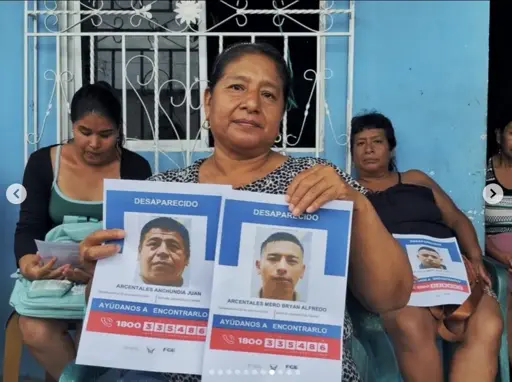
View this post on Instagram
Ecuador — ‘Pain stopping time in a woman’s eyes’
Reporting after meeting the ‘Women of the Fiorella’, local journalist Ana Maria Islas wrote online:
It’s been a long time since I felt so much pain gathered in one place. Locked up, suffocating and filling the silence that leaves the disappearance of a family member. Pain stopping time in a woman’s eyes. …
Pain that does not know how to name itself, a pain that is a suffocated scream in the throat waiting to come out but that is held back because, again, hope says they will return.
The shroud of state silence chokes the women’s search for their fathers, husbands and sons. It likewise throttles their hopes for something approaching justice. Speaking of the vessels, Islas continues:
The two who returned are the only ones who have been able to give clues of what happened with their eight companions, clues that the State has wanted to silence in many ways.
From [the] Fiorella nothing but spinel was found, … and a column of smoke, an image that for six months has plagued the hearts of these women.
Islas underlines how the desperation surrounding the Fiorella occurs amid a growing US military presence in Caribbean and Latin American waters and airspaces. US military operation ‘Southern Spear’ terrorises Caribbean and Pacific fishermen and boat workers for almost a year, murdering hundreds. Islas calls it:
A presence that has killed and disappeared human beings and sunk boats at will. …
A presence supported by an Ecuadorian state that has handed over with full hands the sovereignty of its people, its sea and its land to the United States in exchange for belonging to a privilege club that promises “peace and security”.
View this post on Instagram
The eight Fiorella fishermen who have not returned are: Gabriel Aladino Mero Delgado, Jefferson Ariel Mero Cueva, Bryan Alfredo Arcentales Mero, Juan Alfredo Arcentales Anchundia, Joel Steven Valencia Mero, José Norberto Mero Quijije, Juan Carlos Valencia Mero and Carlos Adrián Mendoza Macias.
Featured image via Ana Maria Islas
From Canary via This RSS Feed.