

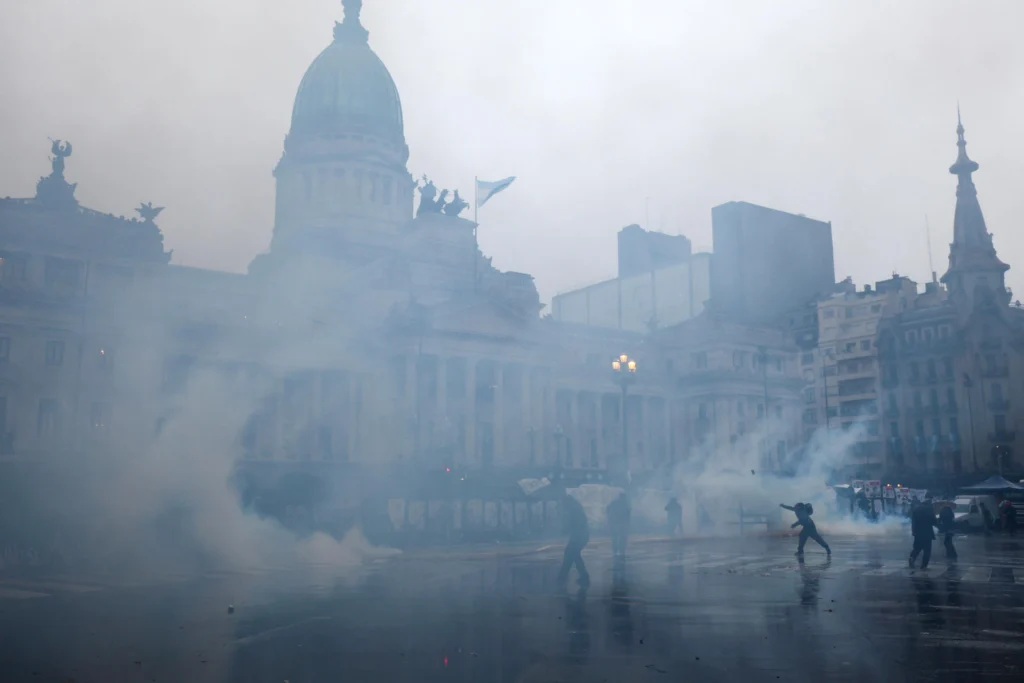
Argentina’s police used water cannons, tear gas and pepper spray this Thursday against protesters outside Congress during the Land Law debate, escalating tensions at the massive march.
The repression occurred while the debate on the Land Law project continued inside the legislative chamber, in a day marked by the strong presence of union, social and political organizations.
The images of the repression circulated rapidly on social networks, generating condemnation from various political sectors and amplifying the visibility of the protest at a moment of maximum legislative tension.
RELATED: Massive Protests in Argentina Target Controversial Property Reform Bill
The security operation was developed under the so-called “anti-picket protocol,” with a wide traffic restriction perimeter in the surroundings of Congress and a significant presence of federal force personnel.
Social organizations highlighted that the repression occurred precisely when the debate reached its most sensitive points, which they interpreted as an attempt to silence legitimate protest in the framework of a democratic discussion.
Ver esta publicación en Instagram
Una publicación compartida de teleSUR English (@telesurenglish)
Mass Rally Against Reform
The mobilization had begun at noon and brought together thousands of people under slogans such as “The land is not sold, not burned, not evicted.” The call was initially promoted in rejection of the Land Law reform, although the ruling party eventually withdrew that chapter from the project being discussed in the lower house. Despite the retreat, the organizations maintained the mobilization to express their rejection of the remaining provisions and the overall direction of government policy.
The events of this Thursday add a new chapter to the conflict over the legislative agenda promoted by the far-right government of Javier Milei, which has faced sustained resistance from unions and social movements. Observers noted that the combination of mass mobilization and police repression could intensify polarization around the reform process, while the Senate continues to evaluate the project’s viability in a context of fragile legislative consensus.
From teleSUR English via This RSS Feed.