

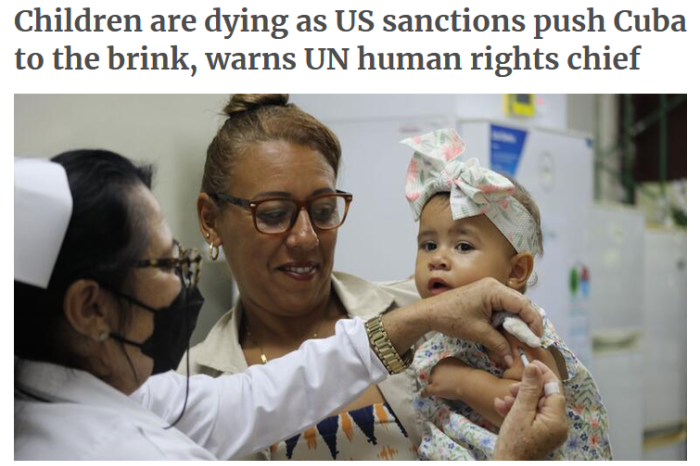
As a result of US-imposed sanctions, UN News (6/8/26) reported, “infant mortality has doubled to 9.9 per 1,000 births; childhood cancer survival rates have fallen from 85% to 65%; and essential medicines are available at only around 30% of normal supply levels.”
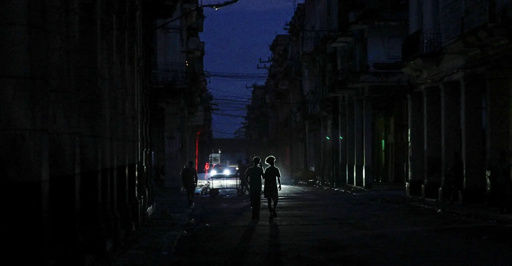
The energy blockade that the Trump administration has imposed on Cuba is hammering the island. As UN High Commissioner for Human Rights Volker Türk (UN News, 6/8/26) recently pointed out:
The fuel restrictions imposed since early 2026 and recent tightening of extraterritorial sanctions, taken together, are directly harming Cubans, especially the most vulnerable. Children are dying because doctors lack access to essential medical supplies and medicines…. These sanctions must be lifted immediately.
Broad swaths of the US media’s chattering class have taken a different angle, suggesting that the Cuban government is the primary—if not the sole—cause of the pain being inflicted on the country. The function of such propaganda is to justify the US’s economic warfare: If the Cuban government can’t run the country, the logic goes, then the US is right to try and bring it down.
It’s the same narrative pushed by US officials and Cubans in exile, who together constitute the large majority of sources in news coverage of Cuba from prominent US outlets, as a recent FAIR study (7/15/26) showed.
Much of the US commentariat is also pretending that the Cuban revolution’s extraordinary achievements have not occurred. Acknowledging them would, of course, get in the way of the narrative that Cuban leaders are so malign and incompetent that the US is obligated to bring about a counter revolution.
‘A golden opportunity’
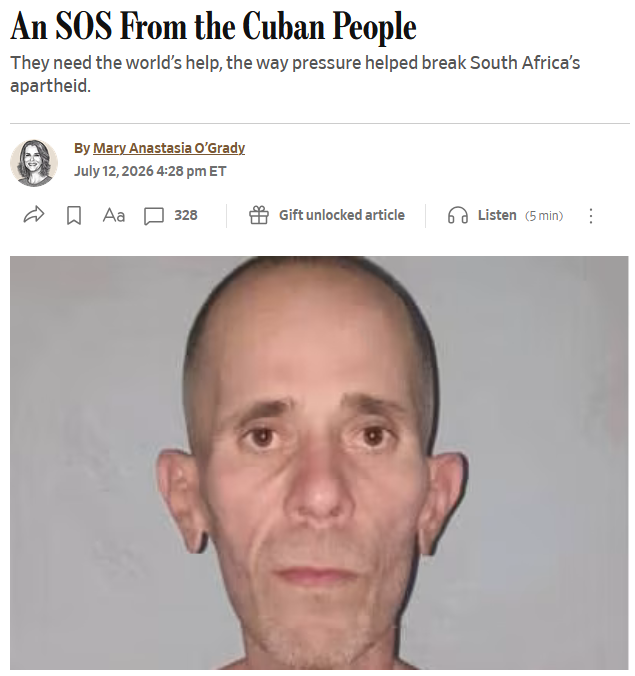
The Wall Street Journal (7/12/26) compares Cuba’s government to South African apartheid—which Cuba opposed, and the Journal supported.
At times, the punditry is explicit in its support for regime change in Cuba. In the Wall Street Journal (7/12/26), Mary Anastasia O’Grady wrote:
Once South Africa ceased to be a Cold War pawn, the economic costs of sanctions imposed by countries across the globe broke the government’s resistance…. Cubans aren’t likely to escape tyranny without a similar leg up from the outside.
The South African apartheid analogy is absurd: Upon taking power, the Cuban revolution made fighting racial discrimination a priority (Black Perspectives, 3/8/16), and Cuba played a crucial part in supporting South Africa’s struggle against apartheid.
But what’s most relevant here is O’Grady’s suggestion that “the outside” is inflicting “the economic costs of sanctions” so that Cubans can “escape tyranny.” As Türk pointed out, this anti-“tyranny” plan involves killing children by depriving them of “access to essential medical supplies and medicines.”
The Washington Post’s editorial board (2/6/26) sounded impressed by the effects of Trump’s siege. “Washington’s pressure on Havana is working,” it wrote:
Cuba looks ready to implode. The island suffers from food shortages, energy blackouts and looming economic collapse. President Donald Trump’s decision to remove Venezuelan dictator Nicolás Maduro from power has cut off the Cubans from what has historically been their main source of oil. Having successfully pressured the Mexican government to also slash oil supplies, Trump has effectively created a blockade that has brought the regime to its knees.
With such extraordinary leverage, it would be unwise to settle for anything less than dramatic change on America’s terms: economic, personal and political freedom for all Cubans.
The paper, in short, cheered the US blockade creating “food shortages, energy blackouts and looming economic collapse” so that Cuba would be forced to make “dramatic change on America’s terms.”
The editors’ assertions relied on a simplistic caricature of personal and political life in Cuba, and on what appears to be an assumption that their readers won’t notice that depriving people of food, energy and even minimal economic security—as the blockade does—also denies them economic and personal freedom. However, the more salient point is probably that the US has no right under the UN Charter to interfere in Cuba’s affairs, let alone to use food as a weapon to restore capitalism, which, as any conservative will tell you, is what “economic freedom” means.
In an op-ed for the Washington Post (2/11/26), former New York Times reporter Lizette Alvarez claimed that “Trump’s love of the deal and Cuba’s imminent collapse present a golden opportunity to finally drive meaningful change on the island.”
Even before the Trump administration intensified the energy blockade at the start of the year, as UN special rapporteur Alena Douhan (11/21/25) noted, the “golden opportunity” created by the embargo had resulted in “the widespread inaccessibility of 69% of medicines to Cubans, including medicine against cancer, heart diseases, repellents, tests for dengue and other infections.”
Alvarez contended that the US “could lift the embargo,” but that “Cuban President Miguel Díaz-Canel would have to agree to deadline-driven reforms,” including “eliminating restrictions that hamper private investment and business.” At no point did the author spell out why she believes that the US is entitled to “drive” change in Cuba, much less deprive Cubans of medicine until they allow “private investment and business” to operate unimpeded.
‘No ring of Navy warships’
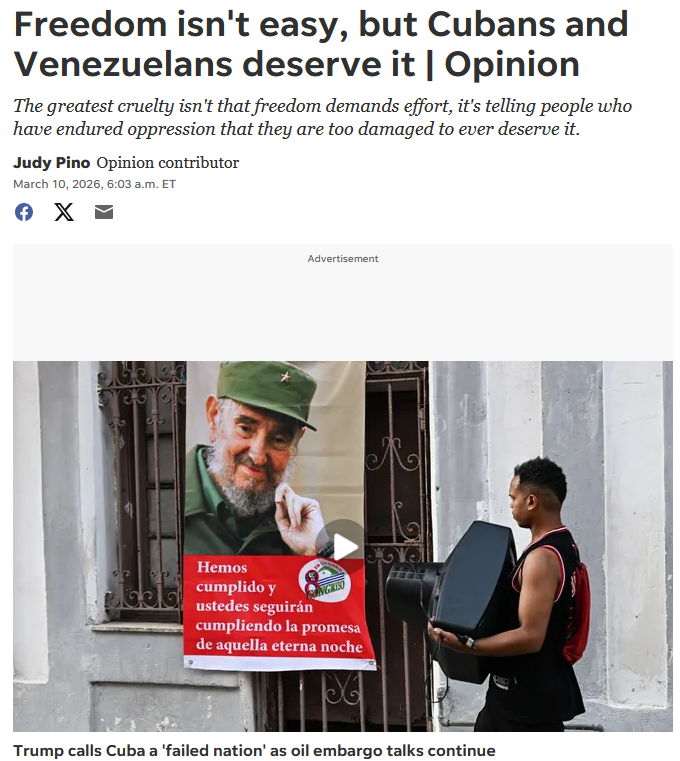
USA Today‘s Judy Pino (3/10/26) argues that “freedom demands effort”—and by “effort,” she means the devastation of one’s economy by a neighboring superpower.
The US began to impose a blockade on Cuba in 1960 to “decrease monetary and real wages, to bring about hunger, desperation and overthrow of government.” Rather than recognize such factors in Cuban suffering, many voices in the corporate media have embraced the political and economic equivalent of flat Earthism.
For instance, Judy Pino (USA Today, 3/10/26) euphemistically referred to Trump’s aggression against Cuba as “pressure on the regime” and said that “daily life [in Cuba] shows the cost of [the Cuban government’s] repression and chronic mismanagement.” In 2018, the UN estimated that the embargo had cost Cuba’s economy $130 billion (Reuters, 5/8/18)—from a country whose entire GDP, according to the World Bank, is $107 billion—but Pino wrote as though that’s not a leading cause of the challenges Cubans are facing.
A Wall Street Journal editorial (7/9/26) wrote that US Ambassador to the United Nations Mike Waltz
took apart the claim that the US blocks Cuba’s access to world markets. “If there’s an embargo, a blockade, whatever name they want to put on it, how did humanitarian aid from Belize, Canada, Chile, China, Colombia, the European Union, Mexico, Spain, Russia, Uruguay and the UN itself reach the country just in the last few months?” Mr. Waltz asked. “There is no ring of Navy warships sitting around this island blocking trade or humanitarian aid going into Cuba. It’s fake. It’s false. It’s a lie. Period.”
Economic blockades don’t require naval encirclements, of course. The Journal gaslit its readers, denying US subversion and writing as if allowing smatterings of aid into Cuba to mitigate the effects of that subversion is the same as permitting Cuba to participate in the global economy.
‘Facts tell a different story’
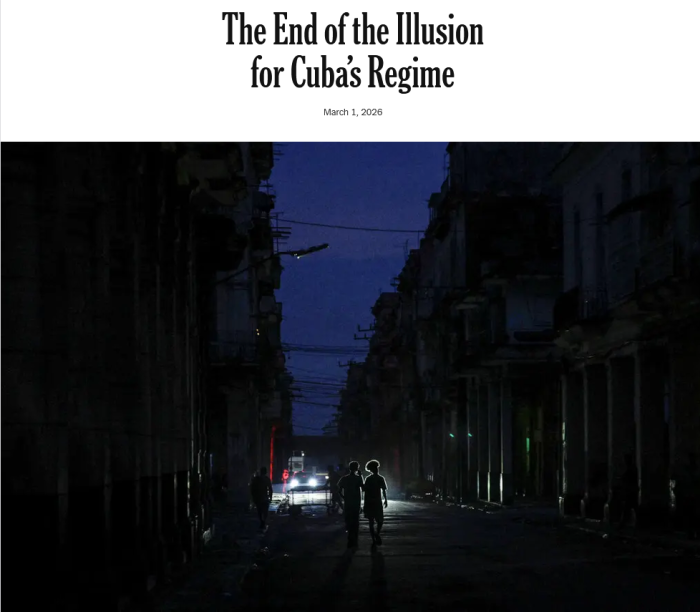
The “illusion” that Mauricio de Miranda Parrondo (New York Times, 3/1/26) celebrates Cuba losing is the notion that it’s possible for a small Latin American country to choose an economic system that Washington disapproves of.
O’Grady (Wall Street Journal, 6/21/26) wrote that “the [Cuban] dictatorship’s excuse for the widespread misery is the same as it ever was: Washington’s Cuba policy. The facts tell a different story.”
The US-based Center for Economic and Policy Research has marshaled quite a few facts that refute O’Grady’s view. CEPR (4/27/26) pointed out that, because the US tightened the embargo during Trump’s first term and the Biden government did next to nothing to ease it, Cuban medical importers have been unable
to obtain at affordable prices many basic medical supplies, such as syringes, inhalers, and even saline solution; more sophisticated medical equipment, such as imaging and ultrasound systems; and inputs for the manufacturing of pharmaceuticals. The redesignation of Cuba as a State Sponsor of Terrorism in 2021 has made it extremely challenging to obtain financing for the purchase of these goods—at any price—or to simply execute international payments to purchase them. The end result of these multiple barriers generated by these sanctions has been massive shortages of medical goods— supplies, equipment, medicines.
Thus, CEPR concluded that “the primary cause” of an
unprecedented rise in Cuba’s [infant mortality rate], and the crisis in its once robust health care system, is almost certainly the hardening of US sanctions that began in 2017 and increased steadily in the years thereafter, with only a minor easing during the Biden administration.
In the New York Times (3/1/26), economist Mauricio de Miranda Parrondo asserted that
the [Cuban] leadership prioritizes political control over the needs of the population. The Cuban economy has suffered greatly for it. The country is no longer capable of producing the basic goods it needs; today it imports most of the food it consumes, despite the fertility of its lands and its long agricultural tradition.
This view ignores US sabotage, a rather significant factor. For instance, a team of UN Special Rapporteurs and Independent Experts pointed out that the US’s groundless decision to classify Cuba as a “State Sponsor of Terrorism” worsens problems in Cuba’s agricultural production
by exerting directly or indirectly more pressure on States and businesses trading with Cuba. In particular, access from abroad to agricultural inputs, including fertilisers, is almost completely blocked, as is the case for spare parts for the maintenance or repair of agricultural machinery and infrastructure.
Thus, the American “leadership prioritizes political control [of Cuba] over the needs of the [Cuban] population.”
Erasing Cuba’s accomplishments
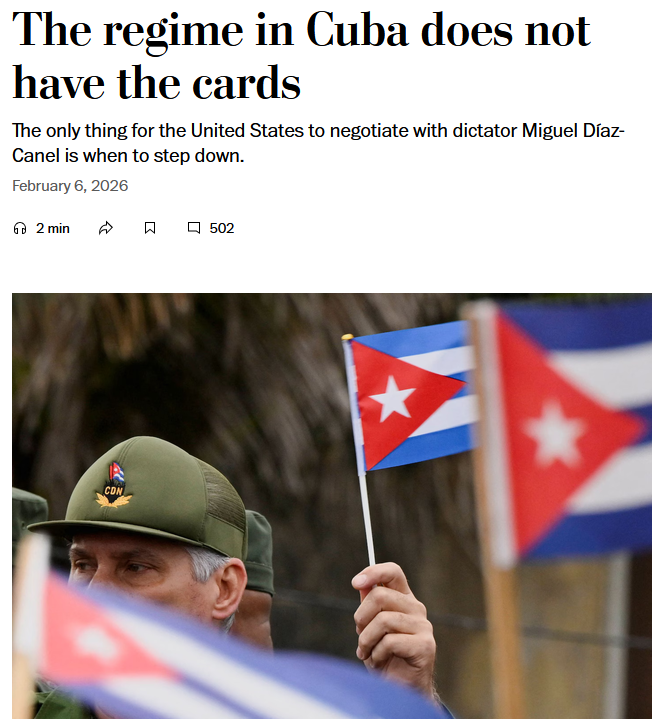
The Washington Post (2/6/26) mocks the idea that the Cuban government wants to be “treated as an equal” in negotiating with the United States.
Corporate media outlets rarely admit that Cuban socialism achieved a great deal despite US aggression.
The Washington Post (2/6/26) argued that Cuba’s “67-year experiment with Communism has been an abject failure.” Consider the most recent rankings from the UN Human Development Index (HDI), which measures long-term progress in three key dimensions of human development: a long and healthy life, access to knowledge, and a decent standard of living. Based on 2023 data, Cuba was classified as having a high level of human development and ranked 97th out of 193 countries and territories. While conditions in Cuba appear to have deteriorated since the US enacted the oil blockade earlier this year, faring well on the HDI very recently makes clear that it’s absurd to say that Cuba’s last 67 years have been nothing but an “abject failure.”
Alvarez (Washington Post, 2/11/26) said Cuba has an “unworkable Communist economic system.” But it wasn’t long ago that Cuba had the same rate of infant mortality as Canada, and a better one than the United States. That suggests that it’s the US that has an unworkable capitalist economic system, particularly when one considers that Cuba successfully cared for its infants under the US embargo, and the US itself faced no such aggression.
George Will of the Post (6/24/26) claimed that “the only good [Communist Cuba’s] evil ever produced” is the memoir of Armando Valladares, an opponent of Fidel Castro’s government who later served as US ambassador to the United Nations during the Reagan and first Bush administrations.
For Will, it seems, it was “evil” to provide vital support to Haiti, Indonesia and Pakistan after devastating earthquakes hit each of these countries (Al Jazeera, 2/16/10). It was “evil” to fight Ebola in West Africa (Time, 11/5/14) and Covid-19 in Italy (Reuters, 3/22/20) at the peak of the pandemic nightmare. Helping liberate Angola, Namibia and South Africa from colonialism, imperialism and apartheid (Warscapes, 4/11/16; Jacobin, 5/20/22)? That’s “evil” too, apparently.
‘Disastrous policies of the socialist experiment’
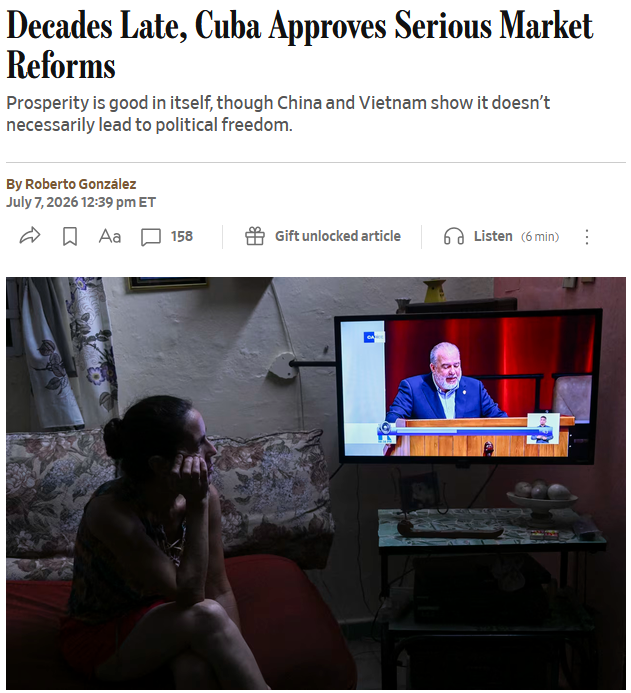
Roberto González (Wall Street Journal, 7/7/26) presents the fact that “lights are out across much of the island”—as a result of direct intervention by the US government to destroy Cuba’s energy system—as proof that “the market works.”
In the Wall Street Journal (7/7/26), Roberto González declared, “For more than six decades, Cuba has been one of the few places on Earth where the disastrous economic policies of the socialist experiment persisted.” Yet in Subalternity vs. Hegemony: Cuba’s Outstanding Achievements in Science and Biotechnology, 1959–2014 (Springer, 2016), the scholars Angelo Baracca and Rosella Franconi noted that
the Cuban government had an unusual level of commitment to scientific and technological development, and a long-term vision to support health biotechnology, despite difficult economic conditions.
Through the “crusade the [Cuban] government has carried out in favor of more education and scientific research,” the country had developed “innovative, world-class products,” Barracca and Franconi noted. By 2018, Cuba held 1,200 international biopharmaceutical patents, and sold medicine and equipment to more than 50 countries (Institute for New Economic Thinking, 3/5/18). But there’s no room for such non-disasters in Gonzalez’s narrative.
It’s easy to tell that none of these commentators sincerely wanted Cubans to overcome the challenges they’re facing. If they did, they’d call for the simplest way to quickly enable the country to build on its past successes. That, to state the painfully obvious, is to end both Trump’s energy blockade and the longer-term embargo.
Instead, they stuck to a cruel, reactionary script: simultaneously gloss over the misery that the US is subjecting Cuba to, and all the good that Cuba has done for itself and the world, to create the impression that Cuba needs to be liberated by its US torturers.
From FAIR via This RSS Feed.