

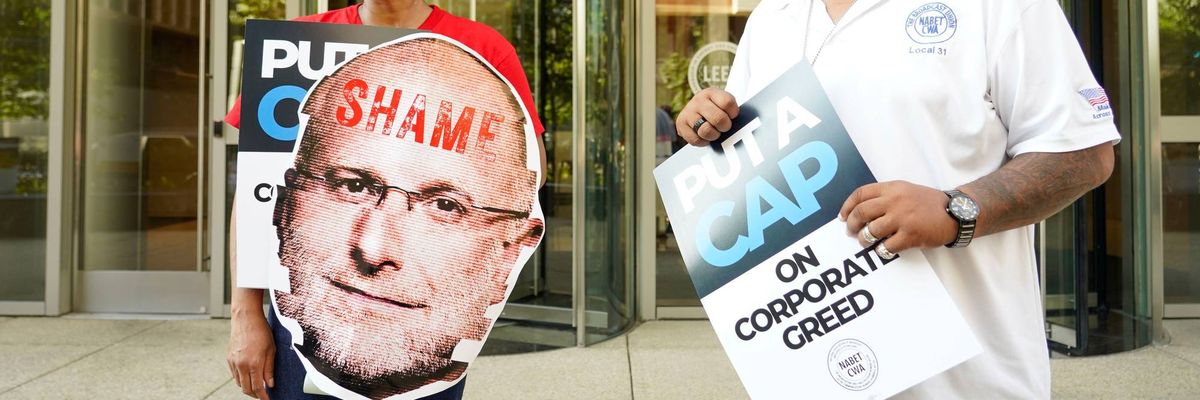
A press freedom group says it plans to take the GOP-controlled Federal Communications Commission to court after it voted along party lines on Thursday to enact a rule that could allow a small number of media conglomerates to consolidate even more control over local news stations.
In a 2-1 vote, the FCC eliminated a 22-year-old rule that prohibited a single company from owning stations that reach more than 39% of American households, replacing it with a rule allowing the FCC to make decisions on a case-by-case basis.
FCC chair Brendan Carr said the move was necessary to “restore balance to the broadcast airwaves” and “allow local broadcasters to remain competitive with national ones.”
The FCC’s lone Democrat and dissenting vote, Anna Gomez, argued that the move would not benefit local broadcasters so much as it would benefit the national conglomerates seeking to buy them up.
“The large station groups positioned to grow even larger under this decision are not local broadcasters; they are national companies that own local stations and increasingly dictate what airs on them," Gomez said. "Trading a squeeze from Big Tech for a squeeze from Big Media does nothing to protect the communities this cap was designed to serve.”
In a statement after the ruling, Reporters Without Borders said the FCC had “just abandoned one of the last significant safeguards against excessive concentration of media ownership.”
The change is a big win for media conglomerates like Nexstar Media Group, which is seeking a merger with rival TV company Tegna to reach about 80% of households nationwide. The merger was approved earlier this year by the FCC, but blocked by a federal judge.
It would also allow the Sinclair Broadcast Group, a conglomerate known for forcing “must-run” segments with right-wing talking points into local news coverage from its corporate headquarters, the ability to continue gobbling up local news stations around the country.
Free Press, a media and technology watchdog, said it planned to appeal the FCC’s decision in court, arguing that Carr had exceeded his power by overriding the 39% threshold, which was enshrined in federal law by the 2004 Consolidated Appropriations Act.
“His goal is to spur more media consolidation involving companies Donald Trump views as ideological allies and corporate cronies,” said Matt Wood, the group’s vice president of policy and general counsel.
Carr, a Trump appointee, has previously sought to use the FCC to crack down on the use of the airwaves by Trump’s ideological enemies and consolidate control for his allies.
He has threatened the broadcast licenses of networks that criticize Trump, most infamously pressuring ABC to briefly pull late-night host Jimmy Kimmel off the air last year. He’s also used the FCC’s approval of the Paramount-Skydance merger to enforce ideological conformity at CBS News, which has dramatically altered its coverage and personnel to be more favorable to the administration.
Carr has argued that the FCC has the power to alter the consolidation cap because Congress technically directed the FCC to modify its own regulations to enact the 39% limit.
Gomez has disputed this, noting that when the FCC previously tried to move the cap, Congress “stepped in within months… and made clear the FCC did not have the authority to change it.”
“Changing this limit requires congressional action, but Carr doesn’t care,” Wood said. “He’ll do whatever it takes to clear the way for Trump-aligned billionaires to swallow up stations wherever and whenever they please.”
John Bergmayer, legal director at the public interest group Public Knowledge, argued that removing the cap was not only illegal but “also bad policy.”
“Consolidation does not serve local broadcast audiences or give them more local news and information,” Bergmayer said. “It gives distant corporate headquarters more control of what is aired, and it creates pressure to cut local reporters and air the same programming across many markets.”
Free Press’ filing argues that Carr is not just violating the law but seeking to help Trump "use the commission’s licensing authority to exert total control over the media.”
“Media consolidation and deal approvals,” the filing continues, “are now explicitly a way for President Trump to further consolidate his dictatorial power, through explicit loyalty tests and pledges to use the public airwaves as a propaganda tool against the American public.”
From Common Dreams via This RSS Feed.