

Rising Temperatures Have Made Fire-Conducive Conditions Far More Likely Across Canada.
On Thursday, the World Weather Attribution (WWA) published a study showing that warming caused by human activity has increased fivefold the likelihood that Canada will experience extreme episodes of weather conditions favorable to wildfires.
RELATED:
Extinction of Indigenous Languages and Climate Change Threaten the Amazon
The research, conducted by Canadian and European scientists, concluded that the likelihood of wildfires in the province of Ontario is nearly twice as high as it would be in a world that is 1.4 degrees Celsius cooler.
Thirty-day periods characterized by heat, dryness and other factors that promote the spread of wildfires and make them more difficult to control are now about twice as likely in both Ontario and the Northwest Territories.
Canada had begun the 2026 wildfire season with below-average activity. However, heat, low humidity and thunderstorms caused a rapid increase in wildfire risk during July.
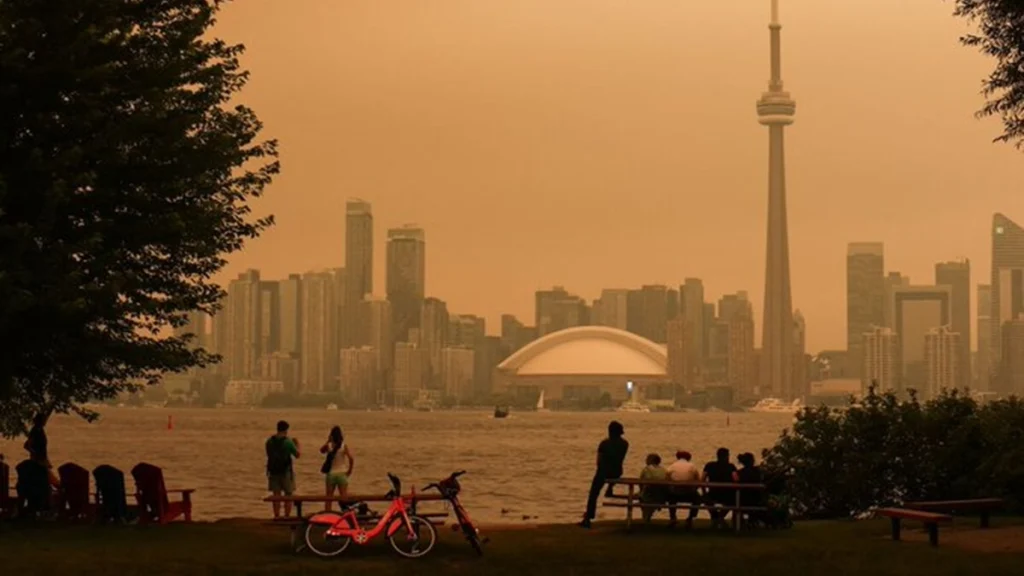
Smoke from Canadian wildfires worsened air quality, prompted the cancellation of public celebrations for the 2026 World Cup in Toronto and affected training sessions ahead of the final in New Jersey, held on July 19.
BTW: Canada is still on fire. Massive forest fire engulfed multiple homes in Vernon, British Columbia, Canada
pic.twitter.com/aKoejh6kbi
—
As of Aug. 3, more than 4,000 wildfires had been recorded and 3.8 million hectares had burned, exceeding the annual average of 2.7 million hectares recorded between 1994 and 2023.
About 94% of the area burned up to that point was consumed in just five weeks, between late June and July. Between July 13 and 17 alone, wildfires burned about 604,000 hectares in Ontario.
The researchers said they were unable to establish a clear relationship between climate change and the drought that had accumulated over the previous 24 months, but warned that rising temperatures are creating conditions more conducive to the rapid spread of wildfires.
The study was published after several exceptionally destructive wildfire seasons. In 2023, Canada experienced its worst year on record, with between 14.6 million and 18.5 million hectares burned, more than double the previous record set in 1995, when about 7.5 million hectares burned. Another 5.3 million hectares burned in 2024, nearly twice the average of the previous 25 years.
WWA warned that extreme wildfire seasons “are here to stay” and called for strengthening early warning systems, coordination among jurisdictions and the capacity to deploy firefighters and aircraft.
Indigenous communities, which are overrepresented among evacuated populations, and wildland firefighters face the greatest physical, psychological and cultural impacts of increasingly frequent, widespread and intense wildfires.
teleSUR/ JF
Source: EFE
From teleSUR English via This RSS Feed.