

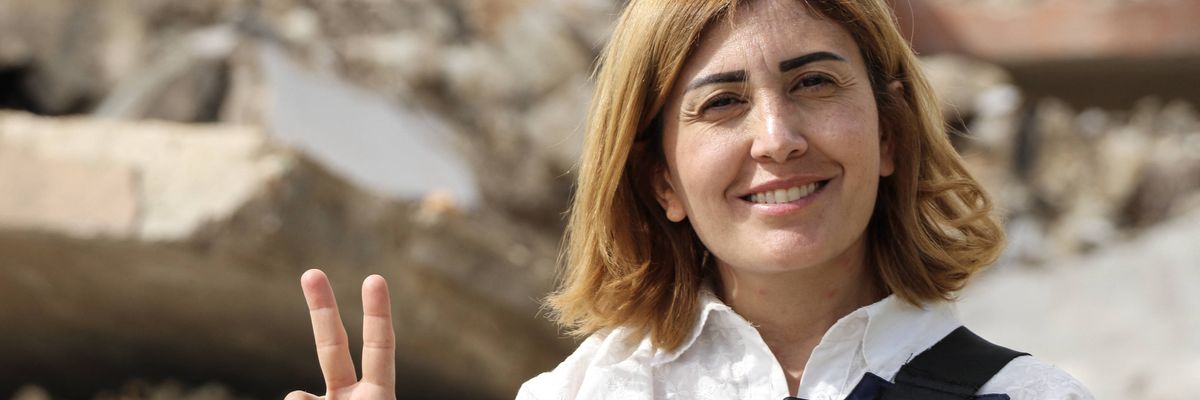
An Amnesty International investigation published Thursday led human rights defenders in Lebanon and around the world to renew their calls for a war crimes probe into an Israeli attack that killed Lebanese journalist Amal Khalil and wounded a colleague earlier this year.
Khalil, a 42-year-old veteran correspondent for the Lebanese newspaper Al-Akhbar, and 21-year-old freelance photographer Zeinab Faraj were reporting in the southern Lebanese village of al-Tiri on April 22 when an IDF drone bombed what Amnesty said was a civilian vehicle traveling in front of them. A second strike then hit the journalists’ car, wounding them.
As Khalil and Faraj sheltered in a nearby building, IDF drones hovered overhead for two hours before the structure was bombed, collapsing it. Lebanese Red Cross personnel coordinated access to the site with Israeli authorities, and once granted permission, rushed to the scene and pulled Faraj—who suffered a fractured skull, severe leg and eye injuries, and a crushed hand—from the rubble. But due to what they called threats of further attack while trying to save the mortally wounded Khalil, the Red Cross workers said they had to withdraw. Recovery operations were delayed for hours.
A medical examiner’s report said that Khalil died of cardiac arrest due to head trauma and severe bleeding hours after rescuers were forced to leave her.
Lebanese Prime Minister Nawaf Salam at the time condemned that attack as “a clear-cut war crime.”
The IDF contends that it declared the area where Khalil was killed off-limits and that it was targeting Hezbollah militants.
“The IDF does not target journalists in any way and works as much as possible to minimize harm that may befall them while maintaining the security of our forces,” a spokesperson said.
However, dozens of journalists have been killed or wounded by Israeli forces in Lebanon, while the figure is in the hundreds in Gaza, where Israel is waging what Amnesty and many others say is a genocide in retaliation for the Hamas-led attack of October 7, 2023. The IDF also attacked and invaded Lebanon—which it has repeatedly done before—to stop Hezbollah from firing rockets at Israel in solidarity with Gaza.
According to Reporters Without Borders, Israel was the world’s leading killer of journalists last year, while the Committee to Protect Journalists (CPJ) said in February that Israel was responsible for two-thirds of all journalist deaths worldwide in 2025.
“The Israeli military says it does not target journalists, but the facts and evidence show that it has repeatedly done so. Amal Khalil and Zainab Faraj are the latest victims in a long series of such attacks,” Ramzi Kaiss, a researcher at Human Rights Watch in Lebanon, said Thursday. “The evidence is clear that the Israeli military knew or should have known that Faraj and Khalil were civilians, but attacked them anyway, and then prevented paramedics from rescuing them for hours."
“Israeli forces’ continued killing of journalists shows a brazen willingness to commit atrocities without any fear of consequences," Kaiss added.
Amnesty argues that the IDF strike on the building where the journalists were sheltering, and the subsequent delay in allowing first responders to rescue them, should be investigated as a war crime.
“Amnesty International’s investigation paints a harrowing picture of a direct attack on two civilians while they had sought refuge from Israeli attacks," Amnesty Middle East and North Africa regional director Heba Morayef said Thursday in a statement.
“After the first strike had eliminated the military-stated target, and with two drones flying low overhead, the Israeli military knew or should have known that two civilian women were sheltering in that building,” she continued. “Despite this, they proceeded with what we have reasonable grounds to believe amounted to a direct attack on civilians, demonstrating a shocking disregard for international humanitarian law (IHL).”
“The fact that the two journalists were in what Israel has designated a no-return zone does not make them lawful targets," Morayef added. "All parties to a conflict have a clear obligation to distinguish between civilians and military targets at all times and to direct their attacks only at military objectives. There can be no justification for targeting civilians who sought shelter in search of safety. This attack must be promptly, independently, and impartially investigated as a war crime.”
CPJ regional director Sara Qudah said Thursday that “Amnesty International’s findings paint, yet again, a deeply disturbing picture of a systemic failure of legal mechanisms designed precisely to protect civilians—including journalists.”
“Amal’s killing can’t be allowed to become yet another unresolved case of a journalist killed by Israeli forces with complete impunity,” Qudah stressed. “This repeated failure to conduct transparent investigations into attacks on journalists has reinforced a climate of impunity and hollowed out the protections granted to the press under IHL.”
From Common Dreams via This RSS Feed.