

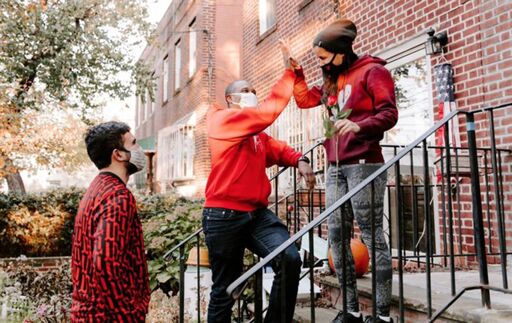
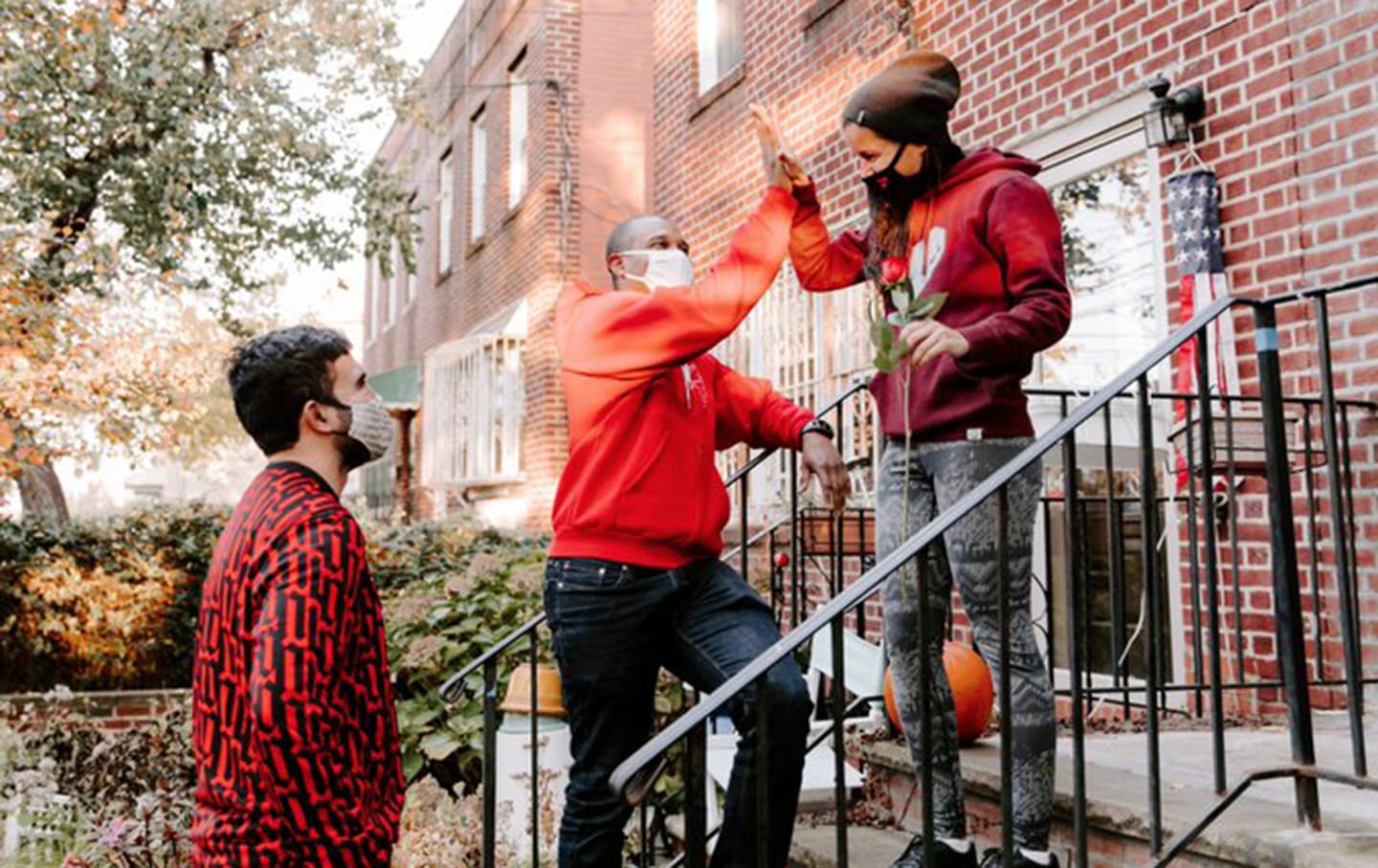
The sudden string of DSA victories at the ballot box has sent the Democratic Party bigwigs and their cable TV friends into a delightful fit of hysteria. Former DNC chair Jaime Harrison and ex-Maoist turned CNN pundit Van Jones are shrieking about the “army of on-the-ground organizers” knocking at their doors. Equally, DSA members across factional lines are taking advantage of the political shift to spread the gospel of field.
There’s no question that DSA’s historically impressive canvassing operations on both a national and local level were a decisive factor. The NY-7 race, between DSA candidate Claire Valdez and WFP darling Antonio Reynoso, proved without a doubt that a small team of professionals cannot withstand DSA’s ideologically driven horde of volunteers willing to spend hours having real conversations with strangers. While this moment is worth celebrating, this slate of DSA electoral victories is also the result of the historic collapse of traditional political machines. DSA’s field operation, which remains stuck in a “mobilizing” over an “organizing” model, cannot scale infinitely. We underestimate the ability of the ruling class to respond to new and creative threats to its power to our peril.
The Death of a Machine
In a nutshell, a political machine is a network of community institutions—like churches, social clubs and trade unions—that a political boss mobilizes for votes in return for patronage from the candidate’s office. The machine is successful when voters are mobilized through institutions that have deep roots in a community, organized by individuals with intimate and long-term relationships with the people being mobilized. This is in stark contrast with much of DSA’s canvassing operations, where most interactions are one-off conversations at the door. Canvassers may not necessarily be, and usually aren’t, from the community they canvass.
The failure of so many machine politicians to protect their seats exposes how much these machines have atrophied after decades of neoliberalism. Local politicians’ complicity in gutting public programs, rising unemployment, and, most ironically, displacing their own voters through gentrification has hemorrhaged the popular base of support for these long-thought-invincible political bosses. The extent of this self-cannibalization was on full display as 11-year state Assemblymember Erik Dilan and 9-year Congressman and head of the Congressional Hispanic Caucus Adriano Espaillat, both endorsed by DC 37, the largest public sector union in the city, succumbed to DSA-endorsed candidates Christian Celeste Tate and Darializa Avila Chevalier.
The chapter successfully framed Dilan and Espaillat as do-nothing politicians, while the incumbents’ hysterical cries about “white gentrifiers taking over” fell on deaf ears as both politicians had a long and public track record of collaboration with real estate agencies to price out the Black and brown families that have lived there for generations. To a lesser extent, the same could be said for Reynoso, who cried about “rich voters in Williamsburg” (his own childhood home) even as he oversaw the neighborhood’s gentrification as Brooklyn Borough President.
But exploiting neoliberalism’s crisis of political legitimacy, which is historically rooted and not a permanent condition of our political fabric, won’t be enough for DSA to grow into a local or national majority that can hold onto power. NYC-DSA’s initial breakthrough came in 2020, a year when traditional civil society still had yet to recover from the COVID-19 pandemic. Amidst another historic victory, turnout this year has dropped dramatically from 2025. While it’s unfair to compare a midterm primary with a citywide, salaciously polarizing, and exhausting mayoral election, Zohran’s win was the result of historically high voter turnout and depended on forming a popular front with the progressive non-profit sphere and the traditional union bureaucracy. As much as the influence of these powerbrokers has deteriorated, they still command sizable bases of members who represent strategic sections of the public and private workforce. The machines are weak, but they are not dead.
One could argue that the 2026 primaries show we no longer need to depend on these fair-weather allies. The NY-7 race pitted a WFP candidate that received what many assumed were the most strategic endorsements for that district (an extremely popular incumbent, most of the major trade unions, and non-profits with deep roots in the community) against a DSA-endorsee. This race was a structure test for how far NYC-DSA can rely on its own power.
But the old political order’s shocking inability to mobilize its voters in this year’s election should be as much a cause for concern as a reason to celebrate. We can’t bet solely on machine decline to expand our sphere of influence. If the crisis becomes truly existential for the Democratic Party leadership, we will see the resurrection of the sclerotic machine apparatus and political patronage on a new basis. This would be a serious threat considering DSA’s own relationship with voters is both young and fragile.
Where the machine is still somewhat healthy, we see the limitations of DSA’s operation. While doing poll site visibility for Conrad Blackburn in Harlem, I noticed that canvassers for Jordan Wright—a scion of the Wright political dynasty—were often block captains and individuals well known in their neighborhoods. Conrad was the only NYC-DSA candidate to lose his race by an impressively slim 8-point margin, due in part to $900,000 worth of superPAC spending, the most against any statewide NYC-DSA candidate. But even these obstacles can’t be detached from the resilience of a Harlem political machine that includes the Manhattan Democratic Party Chair (the incumbent’s father), who pulled all his connections with big money donors, local churches, block clubs, endorsements from most of the Black electeds in the district, as well as scaring off left-progressive politicians from endorsing Conrad.
We must keep in mind that the political tide for many candidates, both in the polls and in volunteer turnout, shifted after coordinated endorsements from Zohran and AOC. Even Claire, who received a rare day-one Zohran endorsement, benefited heavily from the mayor personally campaigning on her behalf. Darializa’s campaign was buoyed by similar support in the critical last days of her primary, which almost certainly secured her victory. Many factors led to the DSA landslide, but it is undeniable that a popular mayor, still in his honeymoon period, pushed many of our candidates over the finish line. This isn’t a card we can rely on for the long term.
A Socialist Political Machine?
Within NYC-DSA, chapter leadership is using the election results to validate their strategy of electing insurgent candidates to win bargaining power for closed-door negotiations in the halls of power, best represented by the Tax the Rich campaign. But there is also a push within the chapter to take advantage of our electoral victories to deepen relationships between our new electeds, working-class voters, and DSA. Suggestions have included using post-primary canvasses as fact-finding missions for constituent services, and deepening collaboration between electeds and NYC-DSA Working Groups. Many of our newly elected state and federal socialists in office are now publicly promoting Break the Chain, the chapter’s ambitious arms embargo campaign.
Whatever happens, organizing a popular constituency for socialism will require more than growing our army of canvassers. It will also involve more than building a “Tammandani Hall,” where voters remain loyal through a feedback loop of positive legislation and magnetic political personalities. Building a socialist political machine (in the traditional sense) will be frustrated by the political compromises required to pass legislation and expand funding for community services. The goal is not to replicate the machines of old, but to consolidate our project into an alternative society. We need a network of party-led organizations with deep and personal roots in the community for workers to engage in class struggle on a mass scale and connect socialist ideas to their daily lives.
Comrades abroad give us a glimpse of what this long-term vision might look like. In Belgium, Workers Party (PTB) parliamentarians donate their wages to set up free clinics, which have been used successfully to build new party organizations and mobilize patients against neoliberal reforms to Belgium’s healthcare system. In Spain, Barcelona En Comu took advantage of its electoral victories to set up neighborhood assemblies and issue-based commissions to guide electeds in community-driven policy. In Venezuela’s National Popular Consultations, the federal government set aside funding for appropriation by local assemblies (comunas). Commune members deliberated between competing proposals and canvassed the surrounding neighborhood with the assistance of the national electoral authority. These experiments demonstrate the possibility of moving beyond the limits of participatory budgeting towards popular democracy.
DSA may not be able to immediately adopt something so ambitious, but these case studies offer a framework for utilizing our electeds’ public platform and resources to build up democratic organizations, united around the politics of a distinct and militant socialist bloc.
On a smaller scale, we can also take inspiration from KC Tenants, who organized door-by-door food distribution to canvass residents about eviction threats and the federal government’s drastic cuts to food stamps. In light of the ongoing struggle against the demolition of public housing in NYC, a project like this could be vital for NYCHA tenants, particularly in Darializa’s NY-13, home to some of the highest density public housing in the city. NYCHA residents are also a constituency that has historically leaned towards establishment incumbents. One could imagine that a coalition of DSA electeds’ constituent services and the chapter Tenant Organizing Working Group could make a powerful dent in meeting the needs of NYCHA tenants and winning them to socialism.
The purpose here is not simply to offer much-needed aid or even bump up recruitment for DSA and other orgs, but to politicize the community. DSA members discussing NYCHA privatization or semi-privatization with tenants could be elevated by our electeds acting as public tribunes for the tenant movement—whether it’s speaking at anti-demolition rallies or proposing legislation to refund and expand fully public housing. And the importance of this approach doesn’t end with public housing either. In April, DSA councilmember Chi Ossé was thrown to the ground and arrested by the NYPD for protesting against deed theft against Black homeowners in Bed-Stuy. The goal of tying deep community organizing to political office serves to heighten the difference between our political platform and the neoliberal consensus, and to connect the immediate needs of the people with the goal of democratic socialism.
Many long-term residents remain suspicious of outside canvassers for understandably practical reasons, worn down by decades of cynical promises from politicians. I was particularly inspired by a Darializa field lead who listened patiently to a NYCHA tenant’s grievances and responded with immediate assistance—in this case connecting a mother to a youth employment program for her daughter—which broke through the barrier of distrust by proving we were not another set of political salesmen, and instead part of a genuine project to collectively improve the state of the world. When this trust is established, the people we need to win over open up to our political vision.
Other candidates in our slate experimented with approaches that went beyond the typical canvassing pitch. Conrad volunteers connected residents to tenant assistance hotlines and committed to canvassing NYCHA tenants up to election day. This strategy contributed to his campaign recruiting the highest proportion of non-DSA volunteers, creating a new army of Black and brown socialists in Harlem. Christian Celeste Tate (who won by the highest margin among NYC-DSA statewide candidates) spread DSA’s reach outside the borders of the commie corridor through close collaboration with North Brooklyn DSA’s Community Solidarity Committee, hosting Know Your Rights trainings and fundraisers for the East New York Community Land Trust. These campaigns show that moving beyond typical door-knocking operations can help build a durable base for socialism.
Whether DSA will plant deep roots or dissipate after this new era of ascendance will be determined by the work we do between elections. Individual efforts need to be linked up into a coherent and permanent strategy that builds buy-in for our program in apartment complexes, workplaces, and community spaces across the city. This requires that NYC-DSA prioritize more than electoral and legislative campaigns. Proposals to this effect have come and gone, but any strategic coherence to bind them together has yet to emerge. Whatever the circumstances, overcoming a transient canvassing operation requires a long-term strategy focused on building deep relationships with the sections of the working class beyond our sphere of influence, built around an uncompromising and distinctly socialist political platform.
Light & Air / Marxist Unity Group
Liked what you read? Subscribe to stay plugged in.
From Marxist Unity Group via This RSS Feed.