

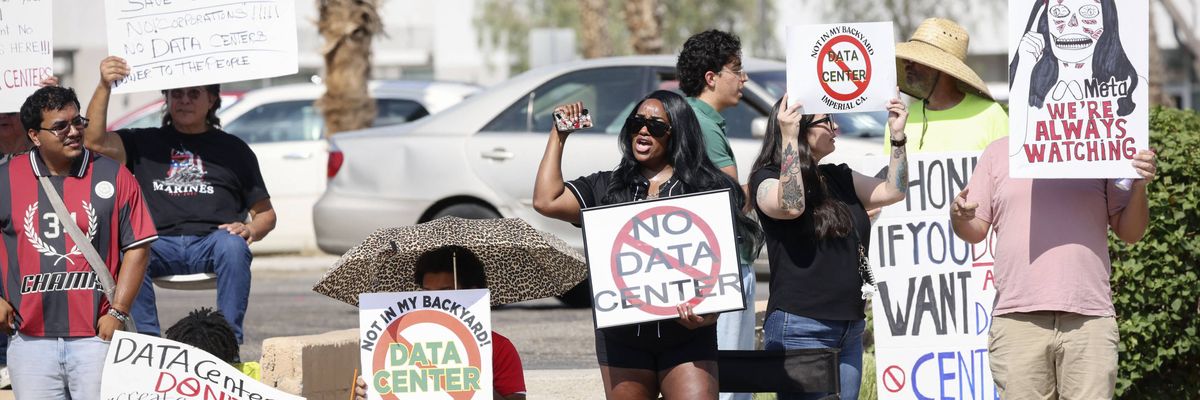
The congressman from Silicon Valley, Rep. Ro Khanna, is introducing one of the first comprehensive federal frameworks to give seething communities the right to fight back against Big Tech and its breakneck expansion of artificial intelligence data centers.
Khanna (D-Calif.), who announced the plan on Thursday, referred to it as a “Data Center Bill of Rights” and said it will aim to give communities “the right to oppose data centers instead of having them shoved down their throats by state governments.”
Opposition to data centers has become a central plank in some progressive campaigns that have seen success in recent months, most recently the Democratic primary victories of Senate candidate Abdul El-Sayed and House candidate William Lawrence in Michigan.
They and other candidates have called for moratoriums on the construction of these facilities, which have come with soaring utility costs, dwindling water supplies, and pollution.
A nonbinding resolution introduced by Khanna earlier this week emphasized that developers have often made deals with state and local governments under a shroud of secrecy, with nondisclosure agreements that hide information about the ownership and potential costs of data centers until it’s too late for the public to fight back.
Among other provisions, the resolution calls for Congress to give communities the right to:
- Ban the construction of data centers within 2,500 feet of homes, schools, childcare facilities, hospitals, or nursing homes;
- Reject any proposed data center through a transparent community process;
- Prohibit or regulate data centers without being overridden by the state government;
- Receive independent assessments on a center’s electricity and water demands, pollution dangers, and potential effects on utility bills, rents, and housing availability;
- Demand that centers do not raise electricity rates for households and businesses; and
- Require that data center owners pay their fair share of taxes and that any exemptions come with strong labor standards and transparency.
Khanna’s proposal comes as he says the developers seeking to hyperscale data center development are “losing the country.”
A Gallup poll from May found that more than 7 in 10 Americans would either somewhat or strongly oppose the construction of a data center near them.
And while the Trump administration has pushed hard for rapid development, opposition is bipartisan. Three-quarters of Democrats say they don’t want the facilities in their communities, but so do nearly two-thirds of Republicans.
Khanna’s resolution is one of many legislative pushes by Democrats on Capitol Hill to regulate data centers, an issue on which they are eager to build credibility ahead of this November’s midterms.
Also on Thursday, Sen. Ron Wyden (Ore.), the top Democrat on the Senate Finance Committee, proposed an excise tax on data centers and to stop them from benefiting from tax-advantaged “opportunity zones,” which Republicans extended last year.
Other proposals have gone further than Khanna’s. Sen. Bernie Sanders (I-Vt.) and Rep. Alexandria Ocasio-Cortez (D-NY) introduced legislation earlier this year for a nationwide moratorium on new data centers until national safeguards can be put in place.
From Common Dreams via This RSS Feed.