

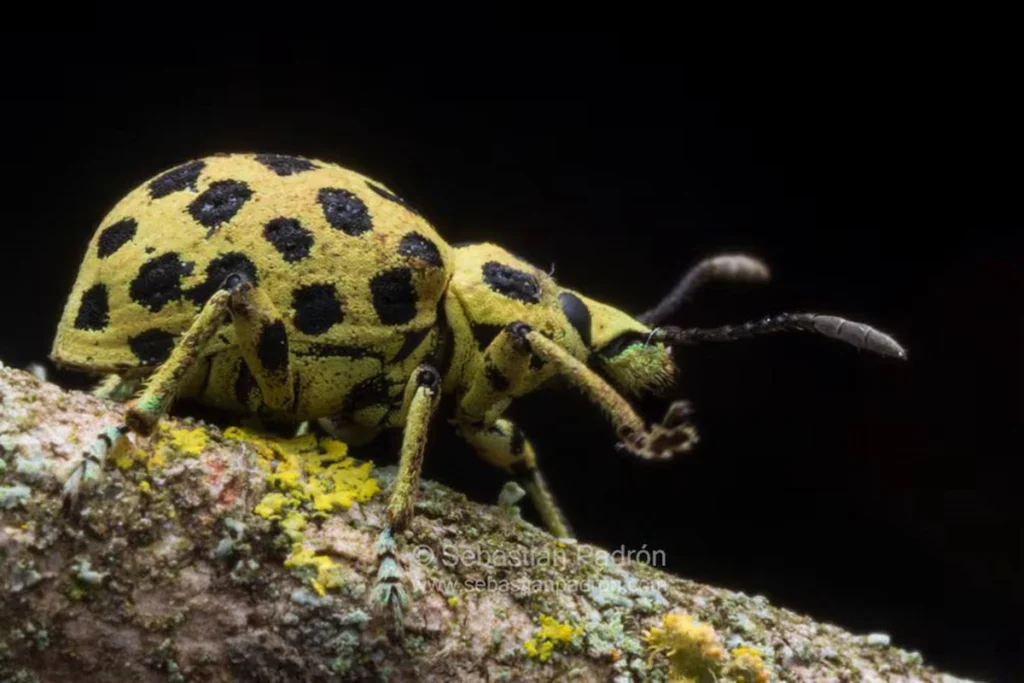
During fieldwork, a pair was observed mating on a cacao leaf in Esmeraldas.
A study documented the presence of the weevil genus Cydianerus in Ecuador for the first time, after identifying the species Cydianerus ornatus, a brightly colored beetle whose distribution ranges from the humid Choco region to the Amazon and the dry forests of southern Ecuador.
RELATED:
Ecuador’s Waorani Communities Reject Block 22 Oil Project
The University of Azuay conducted the research, along with the National Institute of Biodiversity (INABIO) and the Hidden Treasure Reserve Foundation, combining fieldwork, review of scientific collections, and citizen science observations on iNaturalist.
One of the most significant contributions is the first description of the external anatomy of the male Cydianerus ornatus, with clear differences compared to the females in size, coloration, and facial shape, key information for future taxonomic research.
During fieldwork, a pair was observed mating on a cacao leaf in Esmeraldas, although it cannot yet be confirmed that cacao is a host plant for this species.
#Tendencia Ecuador fortalece la conservación de bosques: nueva reforma permitirá atraer fondos internacionales bajo control estatal
Con 82 votos, la Asamblea Nacional aprobó la reforma al Código Orgánico del Ambiente, una normativa que busca abrir nuevas oportunidades de… pic.twitter.com/PYqQ0pLMPE
— La Data (@ladataec) August 4, 2026
The text reads, “Ecuador strengthens forest conservation: new reform will allow attracting international funds under state control. With 82 votes, the National Assembly approved the reform to the Organic Environmental Code, a legislation that seeks to open new funding opportunities for forest conservation and environmental projects in Ecuador.”
The study also highlights the role of private reserves in biodiversity conservation, as two-thirds of the confirmed records come from protected areas managed by conservation organizations.
For researchers, this finding demonstrates how much remains to be discovered about insect diversity in Ecuador and the need to increase scientific exploration efforts.
INABIO emphasized that this discovery not only expands taxonomic knowledge but also provides elements for designing more effective conservation strategies in the country.
#FromTheSouth News Bits | Official data shows Ecuador recorded more than 39 hundred disappearances in the first half of 2026, amid growing criticism of government security strategies. pic.twitter.com/BlCB7nYxP6
— teleSUR English (@telesurenglish) August 4, 2026
teleSUR: JP
Source: EFE
From teleSUR English via This RSS Feed.