

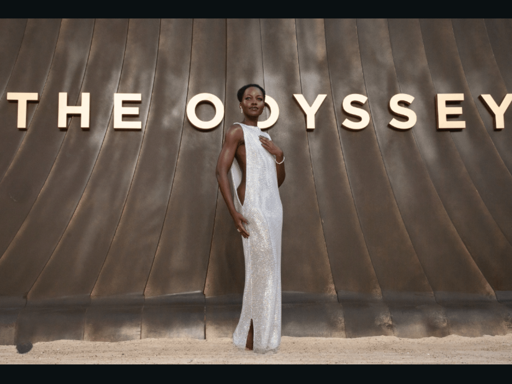

The furore surrounding the film the Odyssey exposes, again, how right-wing media discourse, tinged with overt racism, can be weaponised to fuel culture wars. Furthermore, it is used to score political points.
Amid the cacophony of praise surrounding Christopher Nolan’s Hollywood retelling of the Homer epic, it’s easy to forget that the controversy erupted long before its release. Not long after casting was made public, Nolan’s film was drawn into a wider right-wing cultural war battleground. The official trailer received the highest number of dislikes of any Nolan release. Even Elon Musk jumped on the bandwagon, bringing his familiar inflammatory culture-war commentary to the ‘discussion’ (because at this point and we expect nothing less).
The media pile-on
Before audiences had even seen the film, Nolan’s the Odyssey had been subject to a media pile-on.
Content farms and multimillion-dollar news networks churned out derogatory coverage. They confidently predicted the film would flop, however, inconveniently for them, the Odyssey has since become Nolan’s highest-grossing film.
This was predictably met with denial from some of the same pundits who helped manufacture the very outrage. Their rage-bait content exposes a fundamental misunderstanding of film history. In addition, it reveals a lack of knowledge about the Odyssey and Greek mythology. In other words, this is culture-war bluster masquerading as meaningful engagement. Much of the shallow discourse rests on the view of the Odyssey as a sacred text. They suggest it can be corrupted through reinterpretation.
This view refuses to acknowledge that Nolan’s Odyssey itself is a retelling. Yet it’s this belief that, ‘reinterpretation represents erasure’, which has driven much of the outrage so far. The expectation that adaptations must remain “untouched” fundamentally misunderstands the Odyssey’s legacy.
The Critical Drinker subreddit is having a meltdown over THE ODYSSEY having an 8.4 on IMDb.
If Rotten Tomatoes and IMDb are invalid, what’s next? Letterboxd?
pic.twitter.com/8qoSQbve5r
— Duhlorean (@Duhlorean98) July 19, 2026
Or. The reality is we live in this time, and not in Ancient Greece, and Homer himself wrote his story 400 to 500 years after the Trojan War. Homer’s work isn’t a documentary. He didn’t know Agamemnon, he didn’t know a single person in his story. He wrote it thematic to…
— JR — (@JRGhaddar) August 2, 2026
The right-wing race card
The backlash also revealed clear racism overtones. Lupita Nyong’o’s casting as Helen of Troy, a mythical character from Ancient Greek literature, was met with vitriolic backlash.
Critics disguised their racist objections behind claims that the actress wasn’t “attractive enough.” Meanwhile, others nakedly expressed their racist “offence” at the decision to cast a Black woman.
Helen of Troy actress Lupita Nyong’o promotes ‘The Odyssey’ with bizarre Instagram dance video.
In Greek mythology, Helen of Troy is described as ‘the most beautiful woman in the world’ and ‘the face that launched a thousand ships.’ pic.twitter.com/QsnyM1XDl1
— Oli London (@OliLondonTV) July 25, 2026
The casting of trans actor Elliot Page was another target of the backlash. Rampant misinformation falsely claimed he had been cast as Achilles at the time. In reality, he was actually cast as Sinon, a Greek soldier.
Others took aim at Travis Scott’s casting, while critics argued — often without basis — that Nolan’s inclusion of minority actors erased Greek culture and betrayed the “original text”.
As discussed earlier, the Odyssey has been shaped by generations of storytellers before being attributed to the enigmatic Homer. As such, the story cannot be understood as the work of a single author.
‘Defenders of representation’ get it wrong
Although the film’s casting decisions have been rightly defended against racist backlash, the wider conversation exposed another limitation of shallow media discourse.
As the Canary has previously reported, during the pre-release period, revelations emerged that several scenes had been filmed in occupied Western Sahara without the input or permission of the Sahrawi people. Despite Sahrawi communities expressing their hurt, condemning the theft of their land, and calling for a boycott, their concerns were drowned out. The far louder debate surrounding ‘casting’ continues to dominate the conversation.
Parts of “The Odyssey” were filmed in occupied Western Sahara, defying requests from the Sahawari people.
Advocates are now calling for a boycott of the film and what they say is its complicity with Morocco’s occupation and cultural genocide. pic.twitter.com/DEGSItsdS8
— Democracy Now! (@democracynow) July 17, 2026
Notwithstanding progressive commentators positioning themselves as ‘defenders of representation’ against the right-wing, much of the attention remained trapped in a manufactured debate, leaving little space for the marginalised communities actually affected by Hollywood’s practices. Ultimately, profit over people remains the order of the day.
This demonstrates not only the limits of progressive Hollywood discourse, but how media attention is often directed towards shallow culture-war debates instead of meaningful political conversation.
Therefore, Christopher Nolan’s the Odyssey reveals the wider harm of these controversies — a media ecosystem that rewards profitable outrage. Rather than amplifying culture-war outrage, any counter-discourse must examine Hollywood’s deeper harms, its colonial history, and the voices it continues to overlook.
Featured image via the Odyssey movie / Instagram
From Canary via This RSS Feed.