

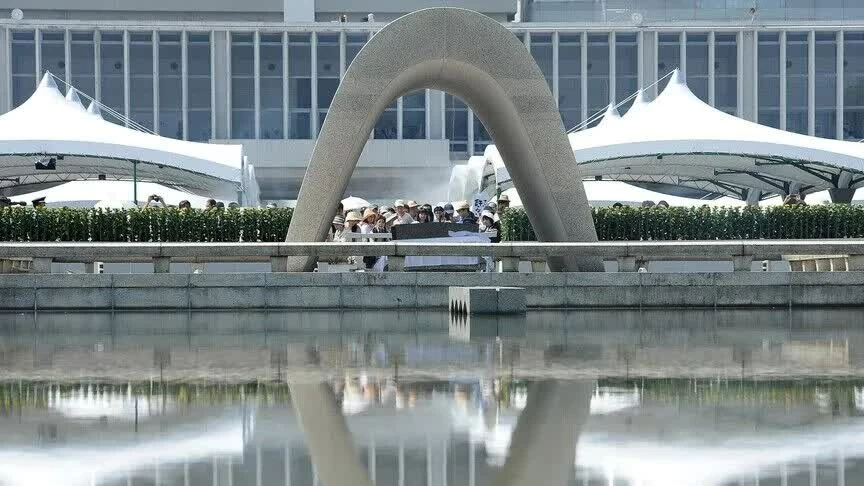
Ceremony in Hiroshima draws 50,000 people as officials warn against nuclear deterrence and urge efforts to prevent future wars.
Japan marked the 81st anniversary of the atomic bombing of Hiroshima on Thursday with renewed calls to eliminate nuclear weapons, as the city’s mayor warned that continued reliance on nuclear deterrence and military force could lead to another Hiroshima or Nagasaki.
RELATED: The Japanese Urge PM Takaichi to Uphold Non-Nuclear Principles
About 50,000 people gathered at Hiroshima Peace Memorial Park for the commemoration, including representatives from around 120 countries and regions, among them the United States and Iran. At 8:15 a.m.—the exact moment a U.S. B-29 bomber dropped the atomic bomb on the city on Aug. 6, 1945—participants observed a minute of silence as the Peace Bell rang.
In his Peace Declaration, Hiroshima Mayor Kazumi Matsui criticized the world’s major powers for pursuing armed conflicts while continuing to justify the possession of nuclear weapons under the doctrine of deterrence.
被爆から81年となる本日、広島市原爆死没者慰霊式並びに平和祈念式に参列し、原子爆弾の投下により犠牲となられた多くの方々の御霊に対し、謹んで哀悼の誠をささげました。
原子爆弾による惨禍、多くの方々の筆舌に尽くしがたい苦しみは、二度と繰り返されてはなりません。… pic.twitter.com/8Z8sssQBWI
— 高市早苗 (@takaichi_sanae) August 6, 2026
Text Reads: On this day, marking 81 years since the bombing, I attended the Hiroshima Peace Memorial Ceremony for the Atomic Bomb Victims and offered my heartfelt condolences to the souls of the many who perished due to the dropping of the atomic bomb. The catastrophe caused by the atomic bomb and the indescribable suffering of so many must never be repeated. While calling for the maintenance and strengthening of the NPT regime to lead international efforts toward realizing a “world without nuclear weapons,” we will continue with realistic and practical initiatives under the “Hiroshima Action Plan.” For the hibakusha, we will advance “comprehensive support measures” spanning health, medical care, and welfare, and we will repeatedly ensure that the necessary support reaches each and every individual. In my remarks, I also touched on the fact that, for the first time this year, young people selected through an open call participated alongside the hibakusha in recording the names of the deceased in the registry offered at the Atomic Bomb Memorial Cenotaph. I express my profound respect for how the memory of Hiroshima and the aspirations for peace are firmly being passed on to the next generation. For my part, I too will fulfill my responsibility to bequeath to future generations a society where people can live in safety and peace of mind. After the ceremony, I visited the Hiroshima Peace Memorial Museum and, in a meeting to hear requests from representatives of the hibakusha, listened to their wishes regarding nuclear weapons abolition, support measures for survivors, and other matters. I also paid a visit to the Hiroshima Atomic Bomb Survivors Nursing Home Kanda-yama Yasuragi-en. Taking these accounts into consideration, we will redouble our efforts toward nuclear abolition, while sincerely advancing “support measures” for the hibakusha and initiatives to “pass on the catastrophe of the atomic bomb across generations and borders.”
“Policymakers of the world, civil society demands the immediate abolition of nuclear weapons. How much longer do you intend to disappoint us? Surely you understand that any use of nuclear weapons would inflict catastrophic damage on humanity, and that nuclear non-proliferation and disarmament can only be addressed through multilateral efforts. Leaders of nuclear-weapon states, you bear primary responsibility for nuclear disarmament. You must surely recognize the imperative to lead by example,” Matsui said.
He said too many political leaders still view nuclear deterrence as a realistic security strategy, warning that the approach only delays progress toward disarmament.
“Too many political leaders still regard nuclear deterrence as a realistic approach and legitimize violence, which only pushes a world free of nuclear weapons further out of reach,” he said.
Matsui also urged people around the world to learn from history and take action to ensure the tragedy is never repeated.
The ceremony took place amid debate over Japan’s defense policy. Prime Minister Sanae Takaichi attended the commemoration for the first time since taking office and said her government would continue pursuing “a realistic approach” toward a world in which nuclear weapons are never used. She said the effort would remain within the framework of the United Nations treaty aimed at preventing nuclear proliferation.
“Japan upholds the Three Non-Nuclear Principles and, as the only nation to have suffered atomic bombings during wartime, will persevere in pursuing a world free of nuclear weapons. That is our mission,” Takaichi said.
She acknowledged that the international security environment had become increasingly challenging, noting that the recent Nuclear Non-Proliferation Treaty Review Conference underscored how difficult the goal remains.
“The path toward a world without nuclear weapons is far from smooth. Yet that is exactly why we must keep moving forward,” she said.
Hours before the official ceremony began, many visitors made their way to Hiroshima Peace Memorial Park to pay tribute to the victims and reflect on the importance of preserving the memory of the atomic bombing.
The daughter of an atomic bomb survivor said she now feels responsible for keeping her mother’s story alive.
“My mother, who survived the atomic bombing, has also passed away. When she was alive, I listened to her stories intently. The number of survivors continues to dwindle. So I think we, as their children, must pass on the story of what happened with the atomic bomb and keep speaking about the importance of world peace for the future,” she said.
Another attendee, the son of a survivor, said: “Today is a special day, so we came here to think again about peace. I pray for world peace for children.”
A high school student also stressed the importance of preserving survivors’ testimonies.
“Because the number of survivors is decreasing, I think it is important for more young people like us to listen to their stories so we can pass on their experiences to future generations,” the student said.

Photo: AP
About 91,000 atomic bomb survivors were still alive at the end of March, with an average age of more than 86 years.
The U.S. atomic bombing of Hiroshima on Aug. 6, 1945, destroyed much of the city and killed 140,000 people. Three days later, a second atomic bomb was dropped on Nagasaki, where 70,000 people died.
From teleSUR English via This RSS Feed.