

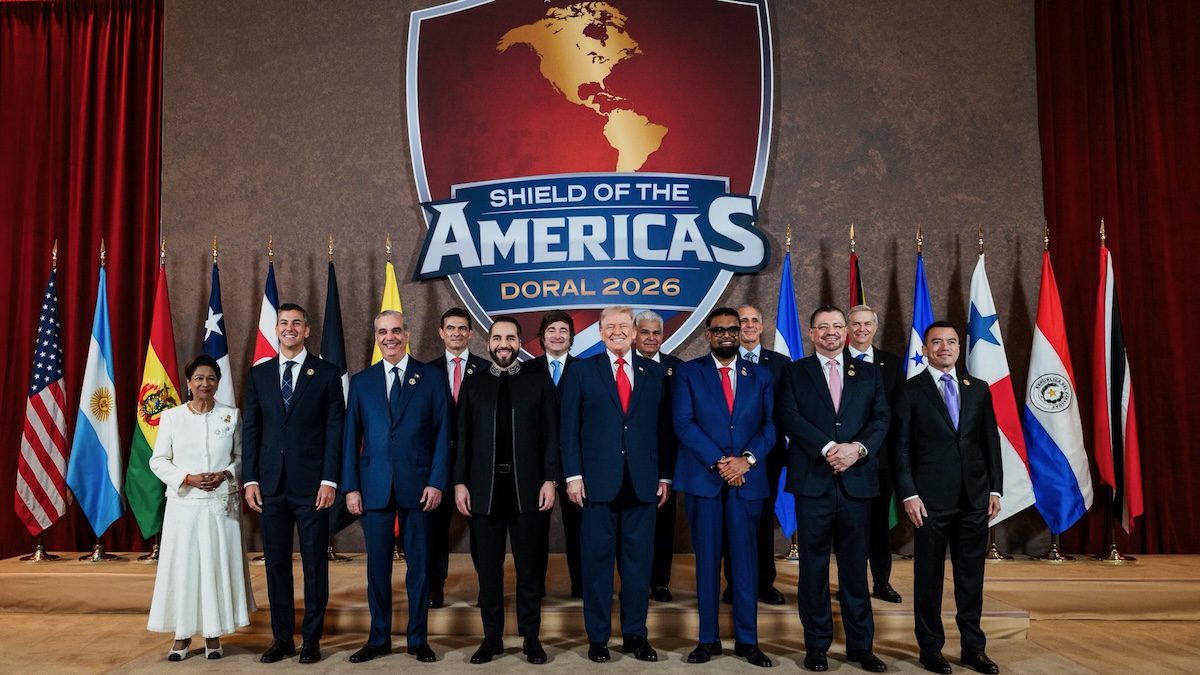
The rise of the right and the “new right” in Latin America is undeniable. A wave of candidates with very similar personality traits (controversial, bombastic, and often millionaires) have already secured key victories. They are offering security, maximum-security prisons, greater military cooperation with the United States and its allies, and the revival of the most rampant form of neoliberalism in a region that already experienced this model in the late 20th and early 21st centuries.
In the wake of the neoliberal emergence in the late 20th and early 21st centuries, a wave of center-left and left-wing governments achieved resounding electoral victories, ushering in a cycle known as progressive or post-neoliberal, which combined Keynesian economic reforms, social democratic public policy, and legislation aligned with left-wing liberalism. Venezuela, Bolivia, Ecuador, Chile, Brazil, Argentina, Uruguay, and Paraguay took a clear turn toward the center-left, promoting regional integration and infrastructure development.
Following this cycle, in some of these countries, the ruling progressive parties managed to remain in power thanks to new electoral victories, but, little by little, the right learned to regroup and revitalize a narrative that blamed progressivism, the left, and “statism” for rising insecurity, corruption, and an alleged lack of freedom – all of which, it claimed, the regulatory economic laws had previously eliminated from society.
The change was not immediate. In some countries, the right won and then progressivism returned (as in the case of Lula following Bolsonaro’s far-right administration) while in others, progressives achieved victories that were later cut short, as in the case of Castillo in Peru, or failed to win a new election after a single term in office, as in the case of Petro’s Historic Pact in Colombia.
Read more: Petro delivers his final speech as President of Colombia
Be that as it may, currently in South America, virtually the entire political map has been painted in the colors of the right and the far right. Fujimori in Peru, Kast in Chile, Paz in Bolivia, Milei in Argentina, Noboa in Ecuador, Peña in Paraguay, and soon De la Espriella in Colombia. These figures are all part of an ideological and political bloc linked to Washington’s geopolitical strategy and its neoliberal political agenda for Latin America. Venezuela, following the January 3 attack, is deeply influenced by the United States. Only Uruguay and Brazil remain on the progressive side, and that could change depending on the upcoming elections in Brazil on October 4.
To understand the reasons behind this shift to the right, BreakThrough News spoke with Miguel Ruiz, a professor at the Central University of Ecuador, who stated that several factors are at play. He clarified that while there were victories for the right and the far right, they were not by wide margins (in some cases, they were very narrow) indicating that the contest between political forces remains open.
He also pointed out the direct influence of the United States on the outcome of the elections: “It is undeniable that a large part of those victories have resulted from open support from the US government and some of the most right-wing power brokers in the United States who are working in favor of those candidates. Trump himself has taken it upon himself to threaten, intimidate, and even openly blackmail Latin American citizens by warning that he would withdraw support from the people if the candidates he was backing did not win – or at the very least, withdraw support from Latin America’s fragile economies. Regardless of the demagoguery that may be present in that rhetoric, it appears that this fear has taken hold, at least among a portion of the Latin American population.”
He also emphasized the increasingly important role Israel is playing: “Not only the United States, but also Israel has stepped in as a political actor in the region through fake news and open support for some of these candidates, using the logistical and rhetorical resources at their disposal. In other words, with the support of the media, these victories have also resulted from campaigns filled with lies, fake news, and manipulation. And other factors may not be as visible but run deeper, such as the support of certain neo-Pentecostal churches that have openly backed these candidates in countries where they wield significant influence.”
Ruiz also highlighted the important role played by the ruling social classes in the elections: “Many of these [right-wing] candidates have had the backing of local oligarchies. Some of them even belong directly to those oligarchies, as in the case of Chile; or at the very least, they have formed alliances with oligarchic sectors – not only national but also international.”
Finally, he noted that the appeal of many progressive parties has waned somewhat: “I also think it’s important to point out that in some cases these victories have resulted not only from manipulation, fear, and the money that’s been spent, but also from the fact that people who once voted for progressive or left-wing governments no longer do so today. And that may also have to do with a certain level of disillusionment with past administrations. In other words, progressive governments have fallen short – perhaps – of some of the population’s expectations.”
New or old right-wing movements?
Professor Ruiz also emphasized that we must not overlook the importance of the old right-wing parties in the formation of new governments. Thus, he stated, we must ask ourselves whether the so-called “new right” is not, in reality, largely a continuation of the old right: “I don’t think we can categorically speak of a [new] right that isn’t connected in some way to previous right-wing movements, even though there are new political figures, perhaps with new, packaged narratives and new presentations. However, we must also not overlook the fact that [these new figures] have received varying degrees of support from the old right-wing forces that are reinventing themselves, forming alliances with these new figures, and that, in some cases (such as in Chile) for example, members of these right-wing groups are once again running under new parties – though this does not mean that these same figures have not already been part of the old right-wing movements and the old oligarchies.”
However, he did highlight certain rhetorical trends among the new right-wing politicians that seem novel: “Perhaps the most novel aspect – what might set them apart from the old right-wing rhetoric – is that they are more openly radical in their rhetoric and more virulent, more violent. I believe that the element of xenophobia has been gaining ground in their rhetoric; they are also very strongly opposed to gender equality, and so on, and they are gaining ground rhetorically.”
Read more: The shield of Monroism: The Angry Tide and the neo-colonial order in Latin America
The United States and the New Latin American Right
Regarding relations between the new governments and the Trump administration, the professor at the Central University said: “What we’re seeing is not only greater support from the United States – and particularly from the Trump presidency – for their candidates, but also that they largely share with Trump a worldview, a political outlook, and a vision of how power is exercised. And I’m not referring only to their authoritarian tendencies, but also to the ties that these sectors of the new right are forging in an increasingly organic way with those capital groups and power brokers who have backed Trumpism, especially from the top.”
“And no, I’m not referring to Trumpism from below – the Trumpism of the American working class that supports Trump – but rather to the oligarchic groups, especially the tech oligarchy, as well as certain other factions of capital that have supported and benefited from Trumpist policies. We see that these are the ones operating through various mechanisms of funding, media support, and strategic agreements – as in the case of Peter Thiel of Palantir. From these positions of power, they are simultaneously backing Trumpism in the United States and governments like Milei’s, for example,” Ruiz said.
He also referred to the clear connection between current right-wing governments and Tel Aviv: “Another point of convergence lies in something I’ve already mentioned to some extent, which is the increasingly prominent role being granted to the Israeli government, particularly Prime Minister Netanyahu, in its regional interference – as in the cases of Honduras or Colombia, where, quite clearly, just as with the candidacy of Bolsonaro’s son, Flávio Bolsonaro, in Brazil, the doors have been opened for the Israeli government to exert greater influence over Latin American electoral processes. And there, too, there is a convergence with Trumpism.”
From BT News via This RSS Feed.