

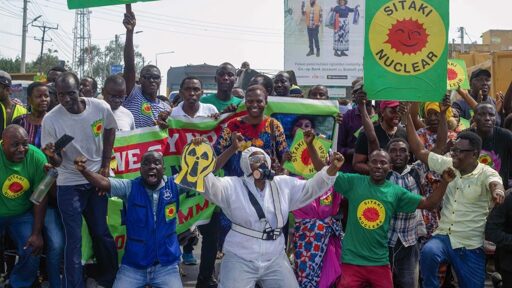

Opposition to Kenya’s proposed nuclear power plant in Siaya County has intensified after community activists and residents protesting the project were arrested and investigated under terrorism-related allegations, prompting accusations of state repression from civil society organizations and progressive groups.
The controversy centers on the government’s plan to construct what officials describe as Kenya’s first commercial nuclear power plant in Central Sakwa, Siaya County, on the shores of Lake Victoria. The project is estimated to cost approximately KSh500 billion.
However, the proposal has triggered months of resistance from local communities, who argue that the government has failed to conduct meaningful public participation and has not adequately addressed concerns over environmental safety, and the potential impact on livelihoods dependent on Lake Victoria.
Community condemns government response
In a statement released on August 2, the Friends of Siaya Anti-Nuclear Plant (FSANP) condemned what it described as an escalating campaign to silence community opposition.
According to the interim committee, residents believe consultation meetings have largely served to justify decisions that had already been made rather than providing an opportunity for meaningful engagement.
“FSANP maintains that NuPEA’s engagement has been the antithesis of Free, Prior and Informed Consent: top-down, opaque, conducted in inaccessible formats and treating community input as a procedural afterthought … The forums held by NuPEA have been characterized by communities as exercises in defending pre-made decisions rather than debating them.”
FSANP also alleges that authorities have increasingly relied on arrests, surveillance and criminal investigations against individuals opposing the project. The group says at least 18 community members have been arrested following demonstrations held in May 2026 against the proposed nuclear facility.
Terrorism allegations against activists
Among those arrested is community organizer James Odhiambo Lawi, who was detained on July 30, a day after FSANP submitted an Access to Information request seeking the disclosure of environmental assessments, seismic studies, resettlement plans, and other project documents.
According to the organization, Lawi appeared before the Bondo Law Courts under Miscellaneous Criminal, where investigators sought to pursue terrorism-related suspicions. The court set bond at KSh180,000, but FSANP says Lawi remained in custody because his family had been unable to raise the amount. The organization also expressed concern over his health, stating that he requires regular medical treatment while in detention.
The group adds that using terrorism-related investigations against environmental activists amounts to intimidation rather than legitimate law enforcement.
“The use of terrorism charges against a peace activist demanding transparency is not law enforcement; it is state-sanctioned intimidation designed to drain us emotionally and financially,” Ombok said.
“James is not a terrorist. He is a community organizer who had the courage to ask questions about a project that NuPEA’s own 2023 Strategic Environmental and Social Assessment ruled out on geological grounds. His arrest is the price of that courage.”
Access to information concerns
A major source of contention has also been access to project information. FSANP says Kenya’s Commission on Administrative Justice acknowledged its request for project documents and reminded NuPEA of its obligations under the Access to Information Act, 2016. Nevertheless, the organization maintains that several critical documents, including environmental impact assessments, resettlement plans, and seismic risk studies have not been made publicly available.
“This opacity violates both the Access to Information Act and Article 35 of the Constitution of Kenya, 2010. It is compounded by the fact that NuPEA’s own scientists had explicitly ruled out the Lake Victoria region, including Siaya, due to the instability of the East African Rift System, active volcanic hazards and the risk of lake tsunamis. A senior NuPEA engineer admitted in March 2026 that the re-prioritization of Siaya was driven by ‘the political side of it,’ revealing a dangerous subordination of scientific criteria to political expediency.”
Threat to livelihood of the community
Activists also argue that locating a nuclear power station near Lake Victoria could pose long-term environmental risks affecting the livelihood of the community.
Lake Victoria supports hundreds of thousands of fishing households and is a vital freshwater resource shared by Kenya, Uganda, and Tanzania, while also feeding the Nile Basin. And any major industrial development around the lake requires extensive regional consultation because of its potential transboundary implications.
“Lake Victoria is already under severe ecological stress. Declining fish stocks, pollution from artisanal gold mining in neighboring Migori County, and invasive species have pushed the lake to the brink. Introducing a nuclear facility into this fragile ecosystem and one that requires 15-25% more water for cooling than a coal-fired plant, poses existential threats to the communities that depend on it. None of the downstream riparian nations were consulted,” the statement argues.
Kenyan communists join in solidarity
The Communist Party Marxist–Kenya (CPM-K) also condemned the government’s handling of the protests, including the alleged killing of one protester, describing events in Central Sakwa as a broader test of Kenya’s constitutional democracy.
“We therefore welcome the decision by the Friends of Siaya Anti Nuclear Plant (FSANP) to invoke Article 35 of the Constitution and the Access to Information Act by formally requesting disclosure of project documentation. Public institutions should respond fully and within the timelines prescribed by law.”
The party argued that peaceful public participation was being met with repression rather than dialogue.
“No democratic society can claim to uphold constitutional governance when peaceful public participation is answered with bullets, mass arrests and terrorism-related investigations,” the party said in a statement issued on July 30.
CPM-K said the dispute had become more than a disagreement over a development project.
“The unfolding events in Central Sakwa are no longer simply a dispute over a development project. They have become a national question concerning democracy, constitutional governance and the relationship between the Kenyan state and the people.” The statement added that “CPMK supports scientific and technological advancement that serves the interests of the people. However, no development project, regardless of its stated objectives, can be insulated from democratic scrutiny.”
The party argued that citizens should not face criminal investigations for participating in public affairs.
“The Constitution of Kenya guarantees every citizen the right to participate in public affairs, to access information, to assemble peacefully, to express opinions freely and to enjoy a clean and healthy environment. These rights are not concessions from the state; they are constitutional guarantees that bind every public institution.”
It added, “No community should be punished for insisting that the Constitution be respected.”
Solidarity continues to grow in support of the activists who have been arrested, with calls for their immediate release and respect for their fundamental rights. The FSANP has further demanded an independent and transparent environmental and social impact assessment of the proposed nuclear project to ensure that the concerns of affected communities are fully addressed.
From BT News via This RSS Feed.