


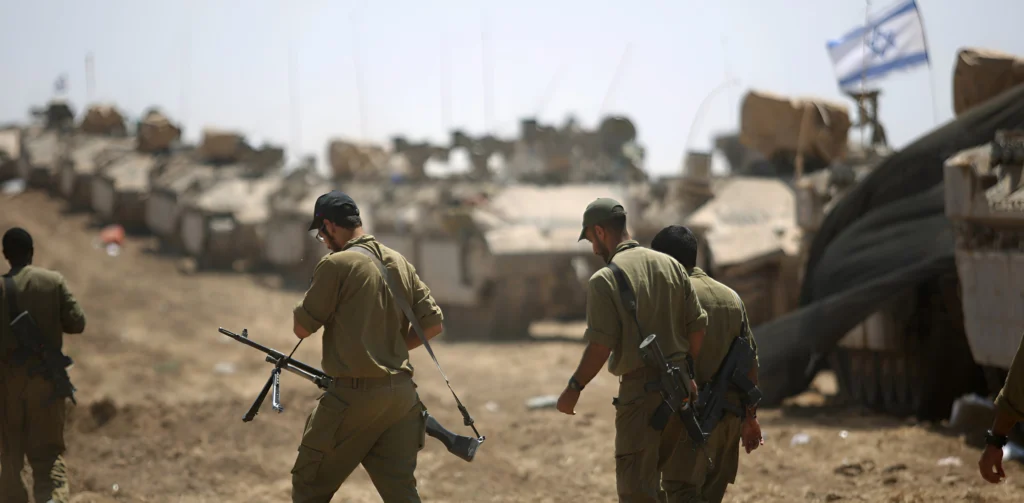
Despite repeated UN resolutions and ICJ advisory opinions, third-state economic engagement continues to enable the Israeli occupation.
Israeli settlement activity in the Occupied Palestinian Territory represents a structured policy of territorial acquisition and demographic restructuring.
The ongoing expansion of Israeli settlements relies on a dual administration: a civilian government body that provides infrastructure, subsidies, and protection for Israeli citizens, operating alongside a military apparatus that governs the native Palestinian population under martial law.
RELATED: Gaza Holds Historic Mass Funeral for 112 Family Members Killed by Israel
This administrative regime systematically dispossesses both Muslim and Christian Palestinian communities through land confiscation, zoning restrictions, and forced displacement. By embedding civilian settlements deep within the West Bank and East Jerusalem, the policy creates irreversible geographic facts on the ground.
The scale of this spatial transformation is documented through extensive reporting by Human Rights institutions, non-governmental organizations, and international bodies that trace the systematic conversion of Palestinian agricultural and residential land into sovereign Israeli civilian zones.
Historical Roots: Origins, Timelines, and Strategic Intent
The legal and operational foundations of Israeli modern land theft trace back to the establishment of the State of Israel in 1948. During the Nakba, over 700,000 Palestinians were displaced, and more than 500 villages were depopulated.
To institutionalize state control over these areas, the Israeli Knesset passed the Absentee Property Law of 1950. This statute transferred the land, homes, and farms of expelled Palestinians to the Custodian of Absentee Property, preventing displaced refugees from reclaiming their assets and reallocating the property for state-managed Jewish settlement.
The territorial scope of this policy expanded dramatically following the June 1967 War (Naksa), when Israel militarily occupied the West Bank, East Jerusalem, and the Gaza Strip. Official planning began immediately:
- The Allon Plan (1967): Formulated by Defense Minister Yigal Allon, this initiative aimed to annex strategic perimeter zones, primarily the Jordan Valley and a wide corridor surrounding Jerusalem.
- The Drobles Plan (1978): Written by Matityahu Drobles of the World Zionist Organization, this strategy marked a pivot from border defense to demographic saturation. The plan called for building civilian settlement clusters directly between Palestinian population centers to cut off urban growth and make the creation of an independent Palestinian state physically impossible.
The driver of settlement expansion shifted over time. Early developments were guided by Labor Party governments emphasizing military buffer zones. Following the 1977 election of the Likud Party, state policy combined with ideological organizations such as Gush Emunim. Settler groups viewed control over the West Bank (referred to in Israeli public discourse as “Judea and Samaria“) as a historical and religious mandate.
To accelerate demographic growth, successive Israeli governments introduced state-subsidized housing, tax breaks, and infrastructure investments. These incentives drew large numbers of secular and low-income citizens across the Green Line into modern suburban settlements.
Israeli occupation army Central Command chief Avi Bluth issued 15 land seizure orders for Palestinian land in Area A of the occupied West Bank to build a road connecting the illegal settlements of Noa and Emek Dotan south of Jenin.
This marks the first time Israel has used… pic.twitter.com/2RLy8P39F2
— Quds News Network (@QudsNen) August 1, 2026
The Destruction of Christian Palestinian Lands and the Ring around Jerusalem
Israel’s settlement construction around East Jerusalem specifically targets the southern envelope connecting Jerusalem to the historic Christian-majority hubs of Bethlehem, Beit Jala, and Beit Sahour. By converting agricultural valleys and forested hilltops into fortified civilian neighborhoods, state planners have systematically severed the historical, economic, and cultural links between these two major urban centers.
The establishment of the Gilo settlement in 1971 and its neighboring complex Har Gilo illustrates this process. Built primarily on expropriated land belonging to the Christian-majority municipality of Beit Jala and the rural village of Al-Walaja, these developments stripped local families of ancestral olive groves, terraced vineyards, and residential zoning rights.
Similarly, the construction of Har Homa on the forested hilltop of Jabal Abu Ghneim, initiated in 1997 under Prime Minister Benjamin Netanyahu, completed the southern arc of settlements isolating East Jerusalem from the Bethlehem governorate. The project expropriated private property held by Bethlehem and Beit Sahour families, turning a shared regional ecosystem into a gated suburban enclave.
A prominent example of ongoing dispossession occurs in the Cremisan Valley, a key agricultural zone for Christian Palestinians near Beit Jala. Home to historic Salesian religious orders, a local winery, and an elementary school, the valley faced extensive spatial disruption when the Israeli military routed the Annexation Wall through the area. The barrier path separated local farmers from their cultivated land, transferring thousands of dunams of agricultural territory into state control for surrounding settlement infrastructure.
The mechanics of land acquisition rely on several legal instruments adapted from Ottoman, British Mandatory, and Jordanian property codes. State land declarations allow authorities to reclassify unregistered or uncultivated land as public property under an updated interpretation of the 1858 Ottoman Land Code.
Additionally, state planners designate Palestinian farmland as military firing zones or national parks, which prohibits native people’s construction before the land is reallocated for civilian settlement. Finally, discriminatory building permits result in the denial of over 95 percent of Palestinian construction applications in Area C, followed by military demolition orders executed against unpermitted housing and agricultural structures.
International Law, Legality, and Jurisprudence
The legal framework governing occupied Palestinian territory relies on International Humanitarian Law, specifically the Hague Regulations of 1907 and the Fourth Geneva Convention of 1949.
Article 49, Paragraph 6 of the Fourth Geneva Convention explicitly prohibits an occupying power from transferring parts of its own civilian population into the territory it occupies. Furthermore, the Hague Regulations restrict an occupying authority from confiscating private property or altering the local legal and demographic status quo unless strictly required by military necessity.
Global international bodies consistently maintain that Israeli settlement practices violate international law. United Nations Security Council Resolutions 446 (1979), 478 (1980), and 2334 (2016) confirm that Israeli civilian settlements built in Palestinian territory occupied since 1967, including East Jerusalem, carry no legal validity and constitute flagrant breaches of international law.
Furthermore, in its 2004 advisory opinion on the Annexation Wall, the International Court of Justice determined that settlement infrastructure and associated wall routes violated basic provisions of International Humanitarian Law.
In a landmark July 2024 Advisory Opinion, the court explicitly concluded that Israel’s continued presence in the Occupied Palestinian Territory is unlawful, that its settlement policies breach Article 49 of the Geneva Conventions, and that all UN member states are obligated to refrain from recognizing or aiding the illegal situation.
“Israeli bulldozers are currently constructing bypass roads … located on land that has been confiscated.”
Israel began clearing land in the Khirbet Srouj area near Jenin, where it previously announced plans to build a new illegal settlement. pic.twitter.com/7ELUhJQaCF
— Middle East Eye (@MiddleEastEye) April 27, 2026
Accelerated Annexation, Settler Violence, and Enclave Fragmentation
Israel´s settlement expansion has accelerated rapidly, marked by administrative restructuring that integrates occupied territory directly into Israeli state institutions.
Under current governance arrangements, significant administrative authority over the West Bank, including planning, land allocation, and building permits in Area C, has been transferred from military commanders to civilian ministries.
This institutional shift facilitates the systematic legalization of unapproved outposts and streamlines housing approvals, bringing Area C under closer administrative control and effectively executing de facto annexation.
Data compiled by the United Nations Office for the Coordination of Humanitarian Affairs (UN OCHA) and European monitoring organizations document record levels of settlement activity.
Tens of thousands of housing units have been advanced through official planning councils across the West Bank and East Jerusalem, alongside the retroactive authorization of dozens of illegal outposts.
This structural expansion is accompanied by a severe rise in state-sanctioned settler violence. Armed settler groups, frequently operating under the protection of military units, regularly target rural Palestinian herding and farming communities, burning crops, destroying water cisterns, and physically forcing whole Bedouin hamlets from their lands.
The cumulative result of these policies is the severe spatial fragmentation of the Palestinian population, often referred to as “Bantustanization.” A network of over 700 permanent physical obstacles, including fixed military checkpoints, road blockades, the Annexation Wall, and a segregated highway system closed to local license plates, restricts movement between major urban centers.
Systemic Accountability and the Imperative for Global Action
The historical trajectory and present mechanics of Israeli settlement policy confirm that the enterprise is a planned settler-colonial project that relies on the systematic expropriation of land, the displacement of Palestinian Muslim and Christian communities, and the creation of an entrenched dual legal system designed to reduce Palestine.
Decades of diplomatic dialogue and unfulfilled international resolutions have failed to halt this expansion. While bodies such as the UN Security Council and the International Court of Justice have repeatedly declared settlements illegal, the absence of enforcement mechanisms and continued third-state economic and diplomatic engagement have permitted settlement infrastructure to expand across Area C and East Jerusalem.
The July 2024 ICJ Advisory Opinion reaffirmed that Israel’s continued presence in the Occupied Palestinian Territory is unlawful and established a clear legal duty for all states to cease aiding or recognizing the occupation.
Thousands of Palestinians gathered in Gaza City’s Al-Sabra neighborhood for a mass funeral for 112 members of the Abu Sharia and Al-Hasayna families.
Their bodies were recovered from the rubble nearly three years after an Israeli strike. As grieving relatives laid their loved… pic.twitter.com/uuh8668Jrk
— teleSUR English (@telesurenglish) August 4, 2026
Sources: TeleSUR – Al Jazeera – Al Mayadeen – TRT World – UN News – Let’s Talk Palestine – BBC – Palestine – Brasil de Fato – Le Monde Diplomatique – Press TV – Xinhua
From teleSUR English via This RSS Feed.
International Law is ANTI SEMETIC!
-John Fetterman!
