

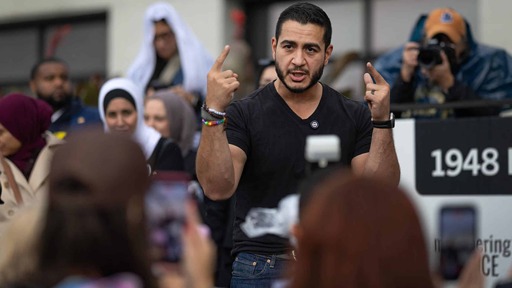
The 2026 primary elections have been shaped by a wave of successful campaigns by democratic socialist and progressive Democrats. While these campaigns have largely been defined by an economically populist line, many have been influenced by Israel’s genocide against Gaza and growing opposition to unconditional U.S. aid to Israel. We saw this in New York and, to a lesser extent, California. And now, we’ve seen it play out in Michigan as Abdul El-Sayed, a supporter of the Uncommitted Movement and a major critic of Israel, narrowly won his Senate primary race against Haley Stevens.
El-Sayed’s campaign garnered national attention as he squared off with Stevens, a four-term Democrat. The question of Zionism was a major issue in the campaign, with AIPAC spending over 35 million dollars on ads attacking El-Sayed. Those ads, as well as Stevens’s own campaign, painted El-Sayed asresponsible for Trump’s electoral victory because of his support of the Uncommitted Movement, even though he endorsed Kamala Harris in the 2024 presidential elections.
Far from running away from his opposition against Israel’s genocidal war against Gaza, El-Sayed has made his opposition to Zionism a key point of his campaign, along with his support for the demand to abolish ICE, universal healthcare, and get corporate money out of politics.
Stevens also used populist rhetoric about fighting Republicans and the rich, yet one of the biggest achievements touted by her campaign was her role in helping with the auto bailout, which was a massive giveaway to major corporations who used the 2008 financial crisis to create a two-tier system in the auto industry that wiped away many of the traditional benefits of the union for tens of thousands of workers.
Stevens has made clear that she is a centrist politician, but has tried to be an outspoken opponent against ICE, although she did not call for abolishing the agency. Instead, she said it needs more oversight. Her position shows the power of the immigrant rights movement and its opposition against Trump’s draconian deployment of ICE, particularly in Los Angeles, Chicago, and Minneapolis.
While El-Sayed is the clear progressive between the two candidates, his campaign has made it clear that he, too, supports capitalism, and he has staked out centrist positions — like his opposition to defunding the police — to made his campaign more palatable to centrists in the general election.
Although it doesn’t seem like his more centrist positions did him even favors or won him any votes, especially since his campaign’s momentum was based on his more radical positions against the genocide in Gaza and for abolishing ICE.
Why the Uncommitted Movement Carried So Much Weight
Due to the demographics of Michigan and Detroit, turning out Black voters is an important goal for Democrats, especially if they hope to beat Republicans in the general election. Centrist Democrats have always sought to place the blame for Harris’s uninspiring 2024 presidential campaign on these voters. Many mainstream Black leaders in Michigan have used Harris’s defeat to justify their own unwillingness to mobilize against Trump’s attacks.
Of course, the general discontent of Black voters with the Democratic Party is noticeable, and some Black political commentators are trying to engage with that, too, in a contradictory way. For example, Adolph Mongo wrote an op-ed encouraging Black voters to sit out the U.S. Senate race altogether. He attacked El-Sayed from the right for his support of the Uncommitted movement, but attacked Stevens from the left for her vote to commemorate Charlie Kirk.
The logic is that the Uncommitted Movement went against the interests of Black Michiganders because it adversely affected Harris’s campaign; in reality, it was Harris’s and the establishment of the Democratic Party’s commitment to the neoliberal status quo and its attacks on working people, coupled with its facilitation of a genocide in Palestine that paved the way for Trump’s victory.
Pitting the interests of all Black people against the Palestine movement only obfuscates who our true enemies are in an attempt to rejuvenate the Democratic Party.
In short, the centrist Democrats and their lackeys among Black centrist leaders hope to drive a wedge between progressive Democratic candidates and Black voters. Stevens used El-Sayed’s support for the Uncommitted Movement as a cudgel against his attempt to win Black voters in Detroit. Meanwhile, she hoped that tying herself to Obama and presenting herself as someone who actively campaigned for Harris would help her win Black votes. She did outperform El-Sayed in Wayne County, the most populated county in Michigan, where Detroit is located, and where Black people make up 36 percent of the population. Though it should be pointed out that El-Sayed received endorsements from several Black pastors and Black elected officials in Detroit and throughout the state.
Unfortunately, the effort to divide Black voters from progressive candidates has also created a demobilizing effect on Black people, even on issues that directly affect them, like police brutality or Trump’s deployment of the National Guard in majority Black cities like Washington, D.C. and Memphis, Tennessee. This speaks to the fundamentally reactionary nature of the Democratic Party, and shows why it is a party that actively divides the struggles of the working class and oppressed.
El-Sayed himself, who in the last months of his campaign tried to make more overtures to centrist Democratic voters, uses the same logic, tying the aspirations of working people for real change to the ballot box and support for a capitalist party that upholds a system that attacks working and oppressed people.
We Need a Campaign that Strengthens the Movement, Not Demobilizes It
The close primary results show that making the race about Abdul El-Sayed’s support for the Uncommitted Movement and opposition to genocide in Gaza wasn’t a winning strategy for Haley Stevens. His victory speaks to the growing anti-imperialist sentiment of young voters, and the breakage of the Zionist consensus that allowed Israel to receive unlimited and unquestioned support from the general population. This is a positive development that shows that there is space for radical, anti-imperialist politics.
El-Sayed’s victory also speaks to the divide within the Democratic Party and how its pro-capitalist and pro-imperialist nature makes it hostile to progressive candidates running on a campaign that could unite the working class and oppressed around radical demands. This fundamental feature of the Democratic Party is the reason why it cannot be a vehicle for activists, workers, and community members who have organized and participated in the many rallies, demonstrations, and activities that are part of the broader movement against Trump and the Right.
The campaigns of progressive Democrats have not served as vehicles for maintaining and expanding the movement on the streets. Oftentimes, they have contributed to the demobilization of the movement and disrupted the momentum to establish grassroots organizations and assemblies based in schools, communities, and work places. This is an important issue that points to the limits of a strategy strictly based on electoralism.
Trump’s political defeats happened on the streets of Minneapolis when tends of thousands of community members, workers, and youth decided to push back against ICE’s brutal and violent offensive. That movement has claimed important victories, and has exposed the real nature of Trump’s anti-immigrant agenda. That is why it is a mistake to hedge all our bets in the election campaign of Democratic politicians, especially when those politicians have not played a key role in mobilizing people against ICE.
The post The Michigan Senate Democratic Primary Was a Referendum on the Uncommitted Movement appeared first on Left Voice.
From Left Voice via This RSS Feed.