


Kalle BenallieICT
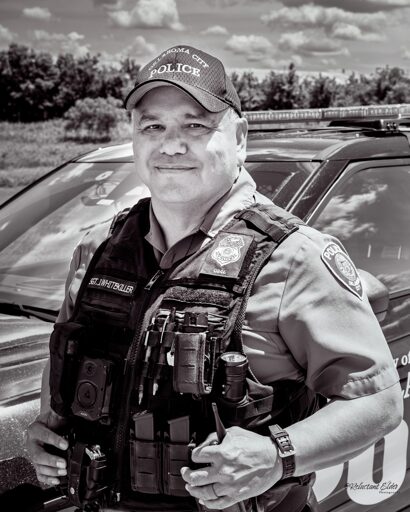
Jon “Kip” Whitekiller always wanted to be a police officer because he wanted to catch bullies. He would for 36 years before retiring in July.
“It was fun and it’s very rewarding, very very fun job.” the 59-year-old said. “I thought I’d probably get shot before I’d make it anywhere near 36 years.”
Whitekiller — Seminole Nation of Oklahoma, Creek and Cherokee — entered the police academy in March 1990 when he was 23 years old.
He was raised in a violent household and didn’t like bullies. Growing up, he watched cop shows like “Starsky & Hutch,” “Miami Vice,” and “SWAT.”
Along with his older brother, Whitekiller was raised by his grandparents after his mom died in a car crash when he was 15.
“But we were wild, wild, wild. So the alcoholism started at fifteen, so now my dreams of being a police officer even got further back because I thought I was gonna go to prison,” Whitekiller said.
He then went to Oklahoma State University for civil engineering and then switched to public management while working at a gas station on the side. One of his co-workers, Mike Barnes, asked if he wanted to come to a job fair in Oklahoma City as multiple police forces were going to be there.
They found out that a majority of the police departments only take college graduates and the Oklahoma City police department accepted a GED. Whitekiller drove them to the recruiting office and they met Janice Bowen, who gave Mike an application.
As they were leaving she asked Whitekiller if he wanted one too.
“It was like an angel,” Whitekiller said. “She looked at me, she said, ‘Son, would you like one?’ It’s like that closet door opened, like boom. I said, ‘You want me to be a cop?’ And she says, ‘Might as well take everybody.’ I said, ‘Well, I’ll take one, let me have it.’”
His recruiter Byron Boshellencouraged him even though he doubted himself.
“I thought I’m a little bit of a criminal, done some bad things, but never went to jail, never went to prison, never hurt nobody, never stole anything. Everything I’ve done, I’ve done to myself,” he said.
Whitekiller says he had a lot of father figures growing up, most significantly were his grandpa Richard Bemo and his two brothers who served in World War II. They would talk about their time in the military and that inspired him growing up to be like them.
“I could have gotten into the military but I think there was a desire to prove myself as a man,” Whitekiller said.

Chili Fish (left), his brother Frazier Fish and Whitekiller’s grandfather Richard Bemo (right). (Photo courtesy of Jon Whitekiller)
He also credits his grandfather’s grandfather, Chili Fish, who was a Seminole Lighthorse captain and policed Oklahoma territory. President Herbert Hoover named him chief of the Oklahoma Seminoles for a day to sign “business” paperwork.
Chili Fish refused the appointment in protest of the closing of the Seminole Boarding School and the policies of Charles J. Rhoads, then commissioner of Indian Affairs.
“As I grew older I learned to appreciate Chili Fish more as a man and a tribal leader,” Whitekiller said.
He first began his career as a patrol officer for a few years but was then asked to join the narcotics unit because of his youthful appearance. Dressed undercover, he would make purchases from various drug dealers.
“I’m obviously a dark skinned Indian kid, we’re in Oklahoma City, I could buy off the Blacks, I could buy off the whites, I could buy off the Mexicans, I could buy off the bikers. Sometimes they won’t sell to certain races and stuff. I could cross borders and that,” he said.
It was a dangerous experience now when Whitekiller looks back on it. He would be out all night making connections and seeing people he arrested in public later.
His wife Shelly, who was his girlfriend at the time, gave him an ultimatum after encountering a man he arrested a few days before at the mall. Mall security had to escort them to their car because Whitekiller didn’t have his gun.
He went back to patrol, got married and had two children. He said they saved him as he was drinking and had high ambitions in the narcotics unit.
“That’s kinda when it dawned on me: this is what I’m gonna be doing for the rest of my life. No desire to do federal work. I worked around them guys. No desire to go to a different agency or anything like that. I was totally invested in the Oklahoma City Police Department. They were good to me. They gave me a job,” Whitekiller said.
As a patrol officer he worked in car accidents, cats stuck in a tree and 911 calls for shootouts, tornadoes and the Oklahoma City Bombing.
“I tell everybody I get just as much satisfaction as changing a flat on a little old lady’s car than I do catching an arm robber because they really appreciate it,” he said.
Oklahoma City Bombing
On the morning of April 19, 1995, Whitekiller was playing with his daughter and the house shook. They lived a few miles from downtown and at first, Whitekiller thought the trash truck hit their car or their house.
“I go outside and trash is still out there and nothing around. I go back in, our TV just happened to be on. And immediately they flashed a scene of downtown Oklahoma City and the smoke coming up,” he said.
He turned on his police radio and heard older officers screaming and yelling about the situation. Whitekiller immediately put his uniform on and headed downtown.
When he arrived there was glass everywhere and most of the survivors were out of the building. His division commander told him to come back for his night shift as it was now a crime scene.
Later that evening he was told to guard the morgue at the scene.
Afterwards Whitekiller said that the crime went down. He thinks everyone was in shock, even the criminals, but it made them a better police department.
“Every facet of Oklahoma City was affected by it. That’s where the Social Security Administration office was. People trying to get their social security cards, benefits, stuff like that. It’s a federal building. Everybody knew somebody down there or somebody worked down there,” he said.
He then worked in the fugitive task force for the U.S. Marshal Service.
“A couple of years right after the bombing I got to hunt bad guys. That’s when I had the most fun. I had a lot of fun. It was just a good time. We traveled around and with a Marshal’s commission. I always told myself I’m an Indian territory Marshal,” he said.
After being in patrol for over 15 years, he went into detective work for the assault unit and then into the domestic violence unit. He said it was eye-opening for him to understand more how his mom dealt with violence.
“That’s where I came full circle. A lot of satisfaction in domestic violence. Putting bad people in jail, just working cases,” he said. “It was satisfying for me cause I got to do some of that work and do a little detective work.”
After four years he decided to change back to patrol because he didn’t like what he was doing and the politics of the downtown headquarters. He said returning back to patrol was like coming home and he utilized his detective skills and narcotics unit experience.
“I just poured my little heart into patrolling my little corner of Oklahoma City and arresting as many bad people as I can,” Whitekiller said.
However, Whitekiller said his body started feeling the effects and he was discovering more injuries he didn’t know he had.
“I hope my experiences and the stuff that I passed on to young guys, I hope they learn a few things. Not all people are bad people. You don’t get jaded, just people have bad days,” he said.
He said during his career, fellow officers were respectful of his Native culture and would ask questions. People would be curious about his last name and he would remind them that they’re in Oklahoma, which has 38 federally recognized tribes.
His advice for anyone that wants to join the police force is to take that step and stay out of trouble.
“You gotta work the system a little bit, get where you wanna go. And don’t be afraid to take chances. The world’s about chances, man,” Whitekiller said.
He added that if you’re Native that you can use that to your advantage, especially to connect with other Native people.
“Or just the knowledge of a Kiowa name or a Comanche name, a Cheyenne Arapaho name, just that advantage of knowing those names, where what tribe they come from as a police officer. You’ll know a lot about that culture. We’re in freaking Oklahoma City. There’s so many Indians in town,” he said.
Whitekiller said he arrested a relative one time as well. He recognized his name as his aunt was his cousin. He asked if he wanted him to call her and he said no.
“I’ve always made it a point. We’re on I-40, I mean a lot of Indians come through Oklahoma City. See them at the gas stations and stuff. ‘Where you going?’ usually it’s powwow somewhere. They’ll hit up and help out if I can, give a card, say, get a flat tire, holler,” he said.
He also appreciates seeing Native officers like recently meeting a Navajo tribal police officer at a gas station who was attending a firearms instructor school and passing through Oklahoma City.
Retirement life
His son, Cole, served in the Marine Corps for eight years and now works in law enforcement in Salt Lake City, Utah. Whitekiller said he didn’t want him to join at first because he knows how it changes you and the difficulties it has like making hard decisions and being around dead bodies. His daughter, Katelyn, is a delivery nurse and is married to a Marine Corps pilot.
He hopes to go to more powwows, see his family, visit his children and his two grandchildren: Gus and Archie.
“I know it sounds crazy, but I miss going to stomp dances. I miss going to functions, seeing my aunts and uncles, all my relatives doing their thing. I have time to do that now,” he said. “We’ll hang out and they can tell me stories about my mama and my grandma and grandpa that I hadn’t heard yet. I’m older now. They can tell me.”
He also wants to be a grandpa that his grandpa was to him.
“Wanna give them the coffee, I wanna tell them the stories. I wanna sit with their dad and talk about what he’s done and my son and talk about what they’ve done and let the boys listen,” he said.
His wife wants him to write a book.
“I just want them to read a little bit about what I did and that’s all I care about. They’re the only ones I care about if they say I’ve had a worthy life, then I’ve had a worthy life,” Whitekiller said.
As of now, he’s adjusting to not working and being comfortable with not having a job since he was 16.
“We’ll see what happens. I have no idea what this retirement’s gonna be. That’s what’s scary. I’m anxious,” Whitekiller said.
The post Retiring from the line of duty appeared first on ICT.
From ICT via This RSS Feed.