

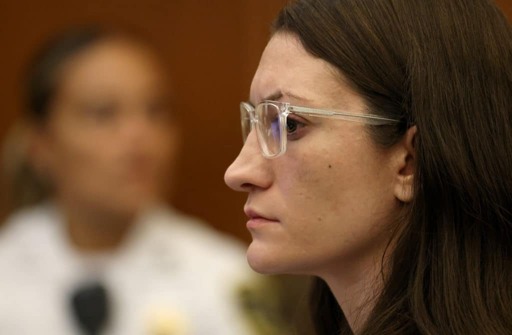
Massachusetts nurse and young mother Lindsay Clancy began receiving medical treatment for postpartum anxiety in late 2022. Between then and January 2023, she sought out care from a psychiatrist, a therapist, and two nurse practitioners. Clancy was initially diagnosed with chronic generalized anxiety disorder and with adjustment disorder with depressed mood. She was prescribed various medications, but her symptoms continued to get worse, leading to additional diagnoses of postpartum bipolar disorder and mania.
She checked herself into a day program for patients experiencing postpartum depression at Women & Infants Hospital in North Dartmouth, Massachusetts. In mid-December, she visited the emergency room at Massachusetts General Hospital in Boston for “persistent thoughts of suicide.” in January, she checked herself into a psychiatric care program due to thoughts of harming herself, but was discharged just days later. Throughout this entire ordeal, she was placed on 13 different medications, but her symptoms continued to worsen until she took the lives of her three children and attempted to take her own on January 24, 2023.
Clancy is now on trial for murder, but it’s clear that capitalism — a system that puts profit over health care — is the guilty party.
The Medical System Puts Profit over People
Clancy did everything she could to address her postpartum mental health crisis. Postpartum psychosis is a rare, but very serious psychiatric emergency that can occur after pregnancy, causing delusions, hallucinations, and a mixture of mood symptoms. Clancy wrote in her journal that she was hearing a voice telling her that she should die and that she had to “take the children with her,” or else they’d suffer while she was gone.
So how exactly did the medical system fail Clancy? Clancy was clearly experiencing a break from reality and sought out care in every way she could, both in an outpatient and inpatient setting. But as a wrongful death lawsuit by Clancy’s husband claims, many of Clancy’s appointments with her psychiatrist were short video visits.
This is important: it is much harder to assess someone’s mood, body language, and wellbeing via Telehealth visit. These appointments are becoming more typical in the increasingly corporatized medical landscape: by driving down the time each provider spends with a patient and increasing the number of patients they see daily, healthcare settings claim they are “expanding access” to those who need it. In reality, they are increasing the number of appointments they can bill for. It does not matter to the capitalist healthcare system whether the care was adequate, only that it was paid for.
Clancy was prescribed a dozen medications for her symptoms, many of which can negatively interact with each other. She had few, if any, blood tests to examine levels of medications in her body and very little followup. After Clancy checked herself into Women & Infants Hospital, they determined her issues were due to overmedication and misdiagnosis. They reached out to one of her nurse practitioners to discuss her care, but they never heard back.
It was not until after the death of her children and her attempted suicide that Clancy was diagnosed with postpartum psychosis. And now, prosecutors want to charge her with murder? The blame for this tragedy is that the medical system under capitalism prioritized quick, inadequate visits above meaningful and integrated medical care.
Medicine under capitalism atomizes people’s treatment. Anyone who has seen a doctor has likely felt the impersonal, rushed nature of the visit. The faster healthcare workers get patients in and out of clinic settings, the better the hospital’s bottom line. And it’s not just healthcare settings that drive this structure — in many cases, insurance companies will only reimburse for short medical visits. This further drives healthcare settings to limit the amount of time providers can spend with patients, creating an assembly-line system where healthcare workers are reduced to tools for efficiently extracting monetary value from bodies damaged by our economic system. We saw much of this play out, with tragic results, in Clancy’s case.
Women’s Health and the Worship of Motherhood
Anyone with the details of Lindsay Clancy’s postpartum medical treatment can identify that something was deeply wrong. She reported time and time again that she was a danger to herself and others, experienced hallucinations telling her to harm her children and take her own life, and begged for help for months. Yet, she is being charged with premeditated murder for failure to prevent the gruesome outcome of the mental health crisis for which she desperately sought care.
What more could she have done when, at every turn, the medical system failed her?
Still, the court of public opinion is not unanimous. Social media comments about her case are filled with people saying “Psychosis or not, she strangled three kids,” or “Mental health aside, as a mother, I would NEVER hurt my children.” This points to another systemic problem contributing to the vilification of Lindsay Clancy: the worship of motherhood and the invalidation of women’s pain.
An enduring expectation placed on women, even young girls, is that they will become moms. Every woman without children can attest to the pressure to have them. Motherhood is often framed as the highest expression of womanhood: the core of a woman’s identity, and all roads should lead a woman back to children and their care.
This expectation is so deeply ingrained that, in the Clancy’s case, some argue that motherhood should have been such a fundamental part of her identity that it overrode psychosis. The idea is that a mother should be nothing more than a mother, not even a person with medical needs. Any situation wherein this is not the case, including a total break from reality, which is what Clancy was experiencing, is seen as a malicious rejection or silencing of the voice that is expected to be loudest in a woman’s head: that of a mother, whose sole job is childcare.
Contrast this idea with the accepted norm of fatherhood. Fathers can have separate lives outside of rearing children, and the responsibilities of fatherhood are weighed against the other aspects of a father’s life. Why, for example, is Clancy’s husband not facing charges of negligence in this case? He knew about the severity of his wife’s condition, how serious her intrusive thoughts were, and that she was a danger to herself and others. And yet, he left her alone with the children.
Because he is the father, though, the children’s lives and safety are seen as just one part of a list of responsibilities he has, not the central part of his identity. Even in a situation where the children’s father knew the danger he was potentially leaving them in, the fault lies solely with the mother.
Beyond the expectation that women put children before themselves, there is also a persistent belief that the problems women face are never truly that serious. Women’s reports of pain and suffering are taken far less seriously in a medical setting than the complaints of men, and medical problems that afflict those assigned female at birth are deeply under-researched, including an enormous lack of understanding of postpartum mental health problems. Women are also more likely to be overmedicated, exacerbating existing symptoms or complications from treatment, and they are more likely to be prematurely discharged from care despite ongoing problems. Meanwhile, the medical system does not help her, so she must bear the weight alone, oftentimes after being told that the problem she’s experiencing isn’t serious.
Here, we find women in a double-bind: their care is worse because their problems are perceived as insignificant, and their untreated health problems must now be further diminished in her own mind to make room for the top priority: mothering.
These two systemic problems — lack of adequate medical care for women and the expectation that motherhood trumps all — ultimately lay the foundation for the case against Clancy. The argument that she is responsible for first-degree murder despite her mental health crisis is predicated on the idea that mothers are always at fault for what happens to their children, because their motherly instincts should have prevented harm, regardless of circumstance, and because their problems are never truly that serious to begin with. In this circumstance, what can only be described as an extreme medical emergency is still being framed as a side-note in a story about a woman who “failed” at being a mom.
“Social murder”: Capitalism Is to Blame
In a world where women’s pain is taken seriously, where the medical system values the care and recovery of every patient more than profit, and where mothers are given the resources and social help they need to navigate life with children, Lindsay Clancy’s children would still be alive. Back in 1845, Friedrich Engels wrote that the capitalist system permits conditions to exist that lead to death, calling these deaths “social murder.” Clancy’s case is a prime example of this.
The capitalist system isolates us. It tells us that our problems are individual and that we should just try harder to overcome them. It tells women that they can “have it all” if they just work hard enough, keeping up a career and the responsibilities of maintaining the nuclear family they’re expected to have (and if you can’t manage, that’s on you!). It tells them that their own problems should be put aside to fulfill their duty of having children — after all, capitalism needs women to keep having kids, lest the system run low on future workers to exploit. It pressures medical providers to move patients in and out of the clinic doors quickly, billing as many visits as possible. It places profit above all else: above healthcare, above women’s wellbeing, and above the lives of children.
The capitalists laid the groundwork for Lindsay Clancy’s mental health crisis to reach its tragic peak. Now, this system has the blood of three children on its hands and, instead of grappling with this fact, is trying to blame their suffering mother.
Let’s be clear: in the case against Lindsay Clancy, the only guilty party is capitalism.
The post In the Trial of Lindsay Clancy, Capitalism Is the Guilty Party appeared first on Left Voice.
From Left Voice via This RSS Feed.