

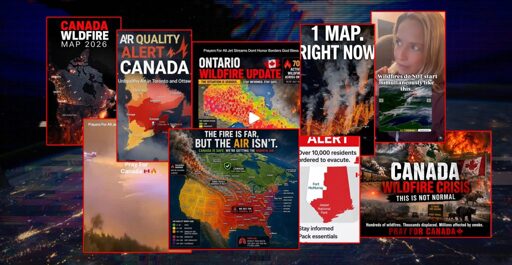
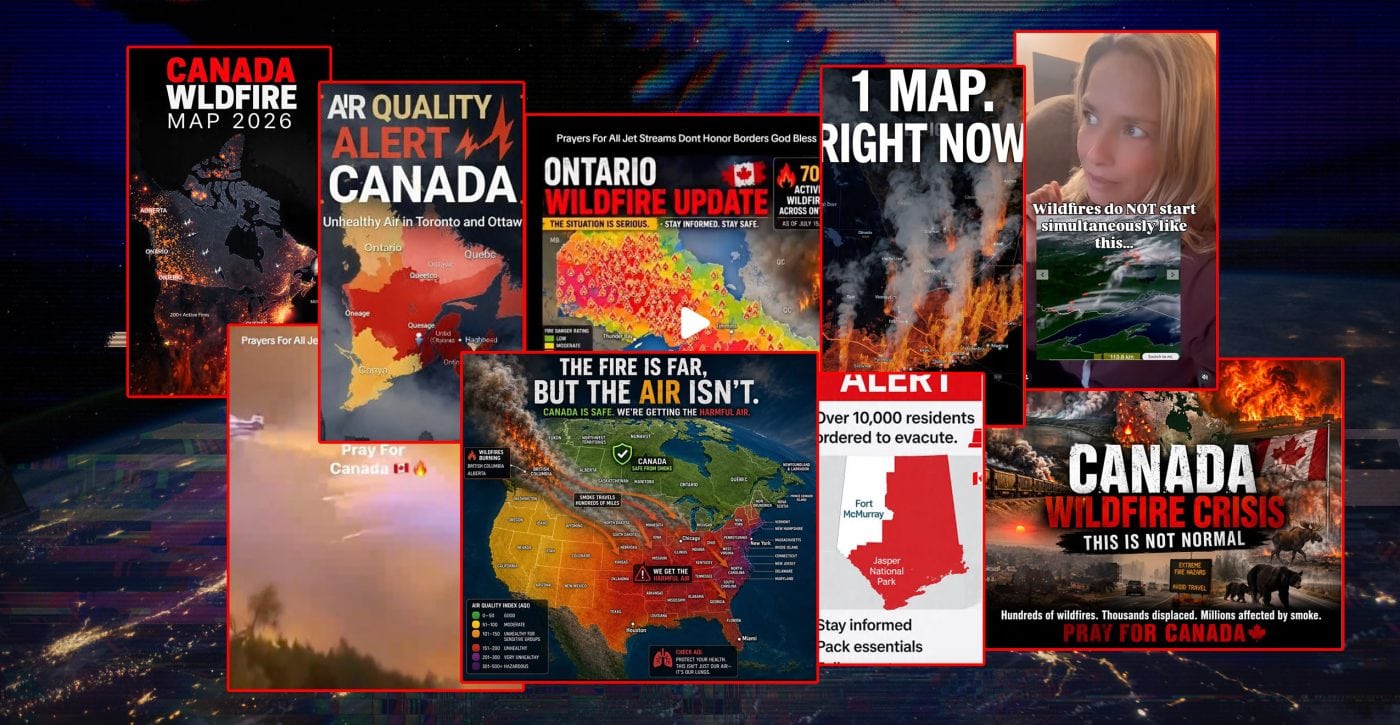
Illustration: Shawn Parkinson / The Narwhal. Screenshots: Instagram
Summary
- The 2026 wildfire season in Canada, which has been particularly severe in Ontario, has prompted significant interest on social media platforms like Instagram and TikTok.
- Many of these posts contain misinformation, including AI-generated maps with incorrect details on the locations or severity of fires across Canada, or conspiracy theories linking wildfires to lasers, 15-minute city initiatives or eco-terrorism.
- Many posts focus on mismanagement and place blame on Canadian governments, which complicates valid critiques of wildfire response and funding with destabilizing misinformation.
Ontario is grappling with one of the worst wildfire seasons in recorded history, which has put thousands of people, especially those in the province’s north, at risk. Last month, two Indigenous communities — Namaygoosisagagun First Nation and Whitewater Lake First Nation — were burned to the ground. The scale of the crisis has made headlines around the world, and prompted a blaze of posts on social media.
But many of those posts contain misinformation, both AI-generated and hand-crafted: maps that purport to show Ontario wildfires labelled with communities that don’t exist; false information about air quality and evacuation alerts; captions with conspiracy theories about 15-minute cities and arson.
Look closely and you might see clues about what’s real and what isn’t. One viral AI-generated graphic purports to show the location of Ontario wildfires, but directs people to a non-existent Ontario government website. Another, claiming 10,000 people in Alberta were under evacuation orders as of July 16 (not true), includes a map where Jasper National Park appears to cover most of the province. One map puts Ontario on the west coast, Quebec over the southern United States and Alberta up around Alaska — and includes a province called “Onjebio”, where the wildfire situation looks pretty bad.
But just as often, it’s hard to tell fact from fiction. And it’s getting harder: in May, Statistics Canada reported 43 per cent of Canadians find it more difficult to distinguish between facts and misinformation online, compared to three years ago. Those with less trust in news media reported even more difficulty.
Each year, it seems, the onset of wildfire season in Canada is accompanied by the onset of wildfire misinformation season on social media. As AI-generated content becomes more ubiquitous — and often tougher to spot — across social media, it presents new challenges to Canadians looking for trustworthy information about unfolding crises across the country. Wildfires are getting worse because of climate change. But what’s driving the escalation of misinformation?
2023 marked a shift in online wildfire misinformation
Gwen Roley, a digital verification journalist covering Canada for the international outlet Agence France-Presse, recently reported on some of the AI-generated maps spreading across social media platforms. “The labels on it were really wonky, and the symbols for the wildfires didn’t make sense,” she says. Roley has covered wildfire misinformation extensively, and there are certain trends that pop each year — “eco-terrorists, directed energy weapons,” also known as lasers — but this year’s maps struck her as a new trend.
Roley has been debunking wildfire misinformation since 2023 — a “really superlative year, as we all remember,” she says. In addition to being the worst year for wildfires in Canada so far, there were also devastating fires in Hawaii. “These were almost like never-before-seen events, very scary events, where people are looking for explanations,” she says. In some parts of Canada, wildfires are familiar, even if the scale of recent years is not. But when wildfires rage in New Brunswick or the Northwest Territories or Hawaii, they may prompt more fear — and more speculation — than usual. When something that feels extraordinary happens, people are inclined to look for extraordinary explanations: even back in 1954, residents of Bellingham, Wash., became convinced hydrogen bomb tests or space rays were responsible for a sudden rash of damage to car windshields.
Climate change denial, likewise, is not a new phenomenon. Chris Russill is an associate professor in the school of journalism and communication at Carleton University, where he’s also an academic director of Re.Climate, a centre focused on public engagement and climate communication. He says denial or skepticism of climate science dates back decades.
But he agrees 2023 was an inflection point for wildfire misinformation online. Some of that was because of what was happening in the real world, such as the impact of Canadian fires on American air quality.
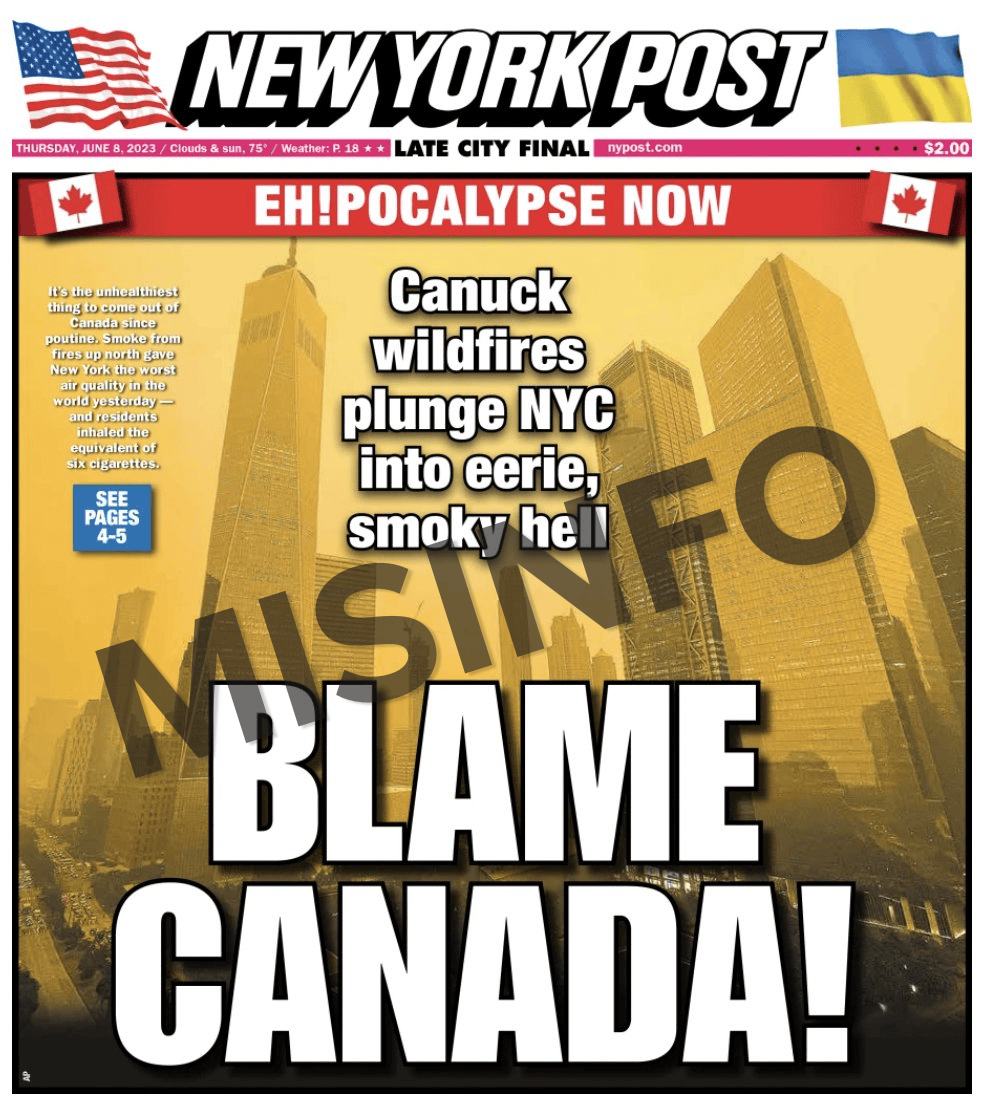
A June 2023 cover of the New York Post, published while many American cities were choked with wildfire smoke from Canada. Gwen Roley, a digital verification journalist for Agence France-Presse, and Chris Russill, who studies climate communication, say the record-breaking wildfires that year triggered an onslaught of misinformation online. Image: New York Post.
But many were linked to shifts happening on major social media platforms: “Elon Musk had just bought Twitter,” he recalls. The Canadian government had passed the Online News Act, an attempt to make foreign social platforms pay to share news. Instead, Russill remembers, “Meta was refusing to negotiate with journalists around the News Act and stripped out Canadian journalism [from its platforms Facebook and Instagram].” It was also the first wildfire season since the widespread adoption of generative artificial intelligence; within two months of its release in November 2022, ChatGPT had more than 100 million monthly active users.
That chain of events is definitely still reverberating today: though Canadian news has been banned by Meta since 2023, a majority of Canadian users still don’t know that, according to a June 2026 report by the Media Ecosystem Observatory at McGill University. Of 1,518 Canadians surveyed for the report, only one in four Instagram users knew that news outlets in Canada could not publish on Meta platforms. Many people believe they’re seeing news on Facebook and Instagram when what they’re seeing is misinformation and conspiracy theories. And users searching Google for wildfire updates are shown AI-generated summaries, which launched in Canada in October 2024, and may contain inaccuracies. (Over the August long weekend, a Narwhal editor looking for air quality information at a lake in the B.C. Interior was shown a summary that incorrectly stated the lake was closed — information pulled from social media posts about two different places that were closed.)
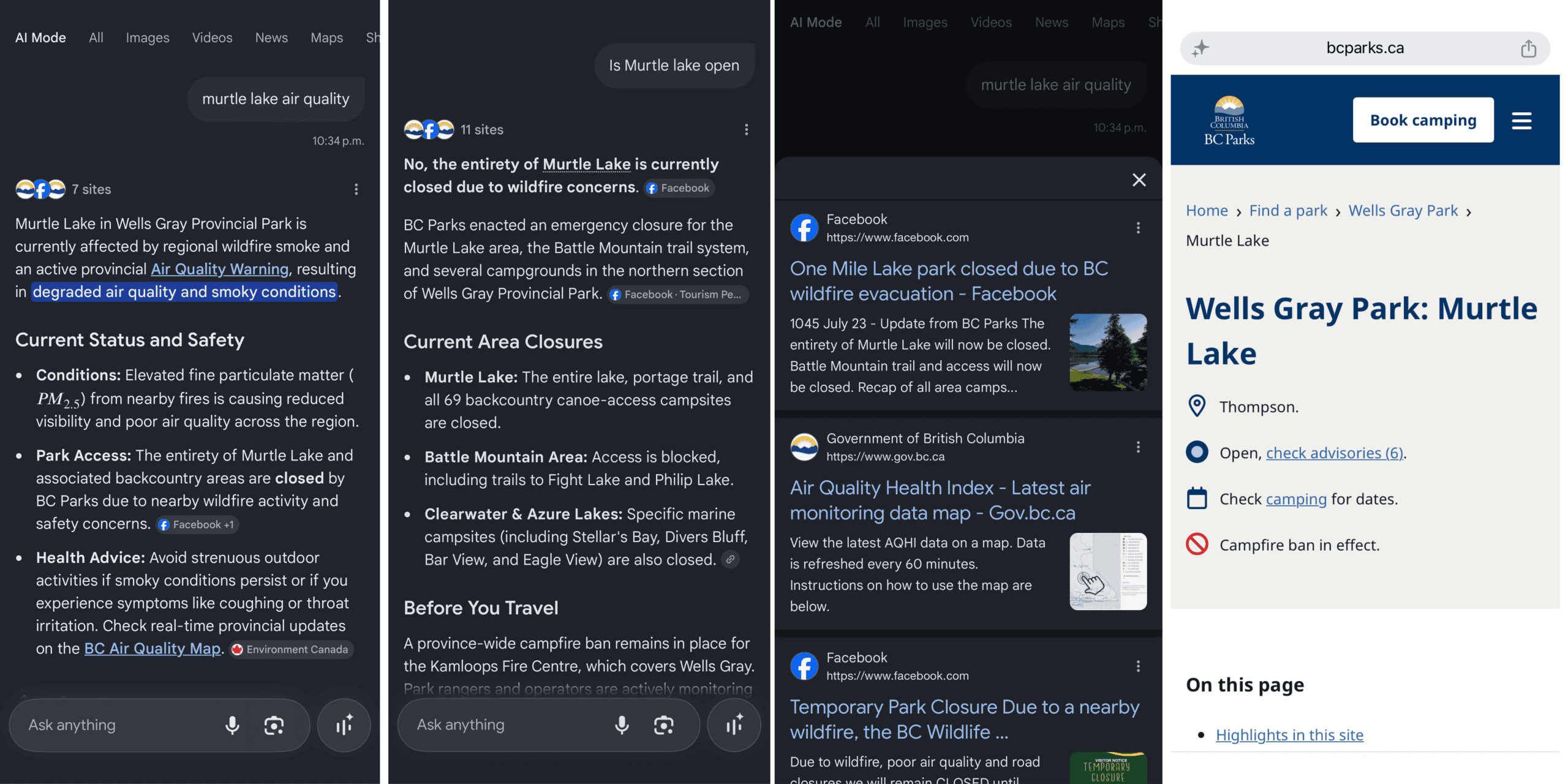
Google AI search results provided to Narwhal director of audience Arik Ligeti over the August long weekend. When he searched “is Murtle Lake open,” Google stated the lake was closed due to wildfire concerns. However, the cited links were pulling from social media posts about two other B.C. closures — One Mile Lake near Pemberton, and the BC Wildlife Park in Kamloops. The BC Parks website confirmed Murtle Lake is, in fact, open. Screenshots: Supplied by Arik Ligeti
Russill also attributes the 2023 sea change to the post-pandemic atmosphere of suspicion. “There was a more adversarial, conspiratorial way that climate was being dragged into other culture-war type issues that were becoming more and more salient through the [COVID-19] period,” he says.
This year, once again, Canadian wildfire smoke is impacting the United States, triggering posts from President Donald Trump on his Truth Social platform and AI-generated graphics that distort the impact of smoke on Americans.
Who benefits from wildfire misinformation on social media?
As much as they complain about it, Russill says American politicians are also finding an opportunity in the effects of wildfire smoke on air quality.
“The U.S. politicians, MAGA politicians, definitely have an interest in leveraging narratives — misinformation, conspiracies, false and misleading content — around wildfires to pursue a narrative they have about Canada as a bad neighbour, and leveraging that for trade and security,” he says. In a post on July 17, Trump threatened that the “cost of this pollution must of necessity be added to the TARIFFS Canada is currently paying.”
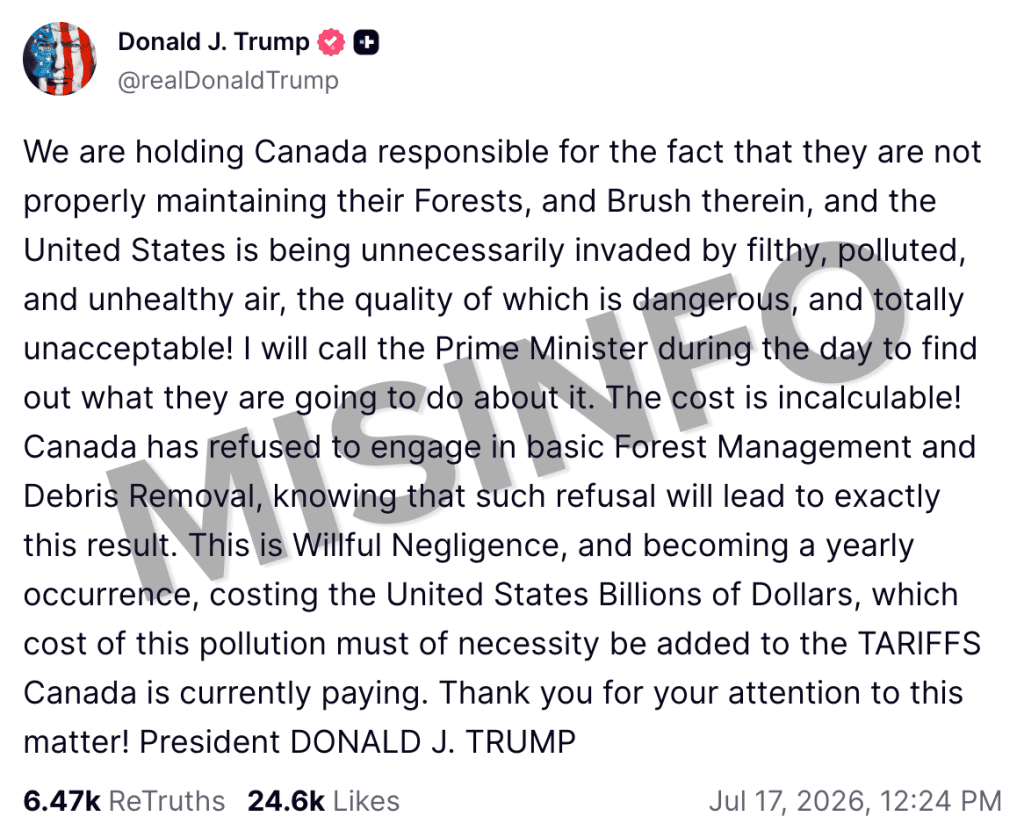
On Truth Social, which is owned by Donald Trump’s media company Trump Media & Technology Group, the U.S. president has blamed the Canadian government’s mismanagement for wildfires, and threatened to increase tariffs as a result. Screenshot: Truth Social
Researchers call this “participatory disinformation,” in which political leaders and influencers seed disinformation across platforms, and it’s then amplified and reproduced by ordinary users, in this case shaping online narratives about extreme weather events. (Disinformation is distinguished from misinformation by the intentions of the person sharing it. While people may unintentionally share misinformation, disinformation is false information shared on purpose.)
The McGill report on Canadian news notes, “When journalism loses visibility on social media, it is not replaced by nothing — it is replaced by content that serves a different function.” Conspiracy theories and images that distort the reality of wildfires get engagement, and a real crisis presents a fertile opportunity for content generation.
Ad revenue from Google and other ad exchanges is another motivating factor, the Media Ecosystem Observatory also reported in June: the push behind a coordinated, international network of Facebook accounts pushing “news slop” — AI-fabricated stories — onto Canadian users.
It’s easy for everyday users to get caught up in spreading untruths, too. Across social media, engagement is currency, which may provide an incentive to use the most dramatic or striking images without checking — or caring — about accuracy. “You can find a real map that you can very easily take a screenshot of that is using real data,” Roley says. But the real maps aren’t as dramatic as the AI-generated ones, “where it looks like all of Ontario has been burnt to a crisp, or one of the videos I saw where it looks like the wildfires are visible from space.” And lingering on those images — even if we’re skeptical of them — rewards the algorithm.
As Russill points out, it’s “faster, easier and cheaper than ever before to generate fake and misleading content with AI.” It’s also easy to see what does well with your audience, and react accordingly, he says. “Like, let’s make the smoke bigger. Let’s put a fleeing polar bear in there. Who knows, right?” Some people may be diehard believers in climate conspiracies, and others might be deliberately seeding disinformation, but some are almost certainly agnostic to the culture wars; they just want the engagement.
Whether users want to gain followers or further a political agenda, Russill says, they have “almost nothing to lose.” While AI posts may be flagged and removed on some platforms, it’s easy to replace them. “In these moments like wildfire evacuations and emergencies, this surges forward because it’s a real high engagement opportunity,” he says.
This happened in 2025, he adds, prompting the BC Wildfire Service to warn of AI-generated images circulating on social media. And it’s happening this year, too.
From climate change denial to ‘mismanagement’: the narrative online has shifted
Misinformation typically downplays or denies the role of climate change in worsening wildfires, and displaces it onto other, implausible explanations. A few years ago, it was space lasers and 15-minute cities.
But no part of the world’s media ecosystem is free of Trump’s influence, including reporting on wildfires. After the 2025 wildfires in Los Angeles, which killed 31 people, the president blamed mismanagement of California forests. (Experts attributed the disaster to climate change, prolonged drought and southern California’s high winds, which spread the fire rapidly.)
“So the impacts people were seeing were a result of government mismanagement, not climate, not other types of things,” Russill says. The same argument is now being directed at Canada; in July, a Michigan senator posted on X, “Unless you want to become the 51st state, learn to manage your forests.” Such a task would be impossible in Canada, which has 369 million hectares of forest — covering more than a third of its landmass — 260 million of which is boreal forest in the sparsely populated north. Much of these forests have never been “managed,” but are experiencing more severe and frequent wildfires because the planet is getting hotter, a crisis that cannot be solved with rakes.
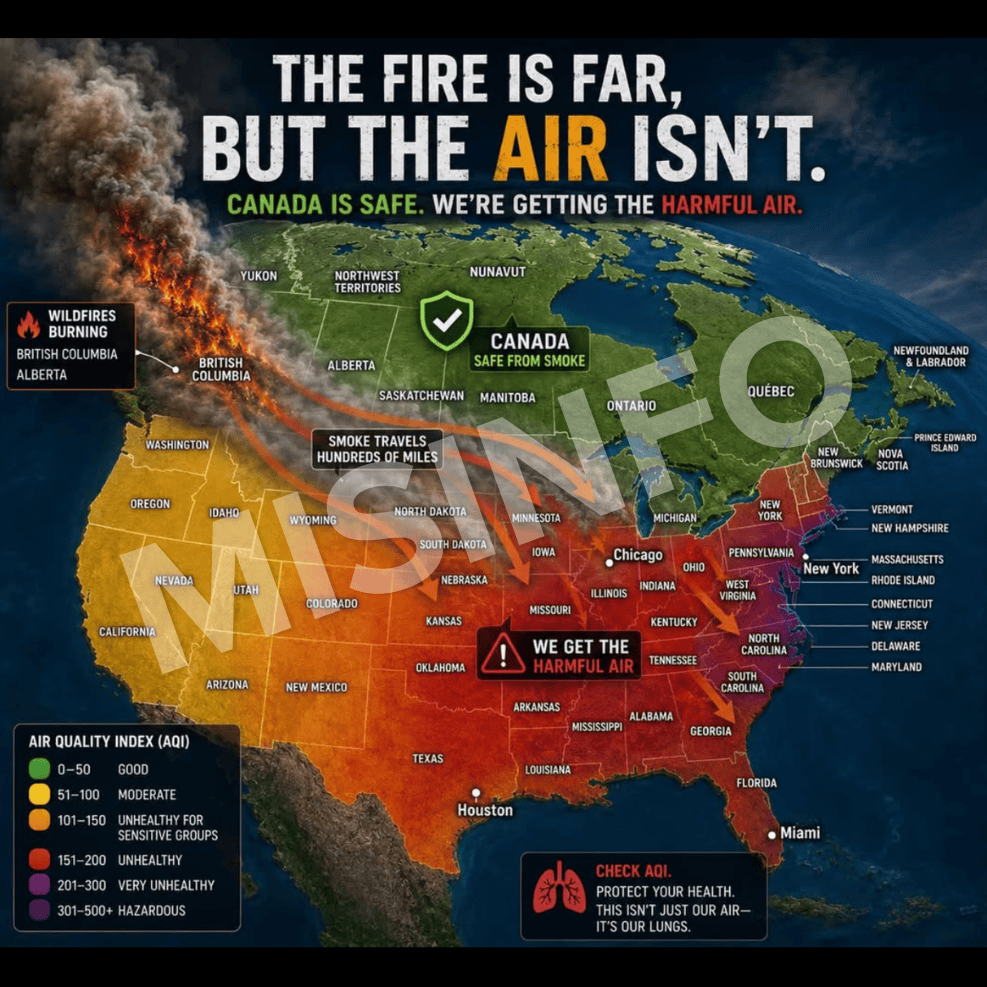
One of many AI-generated maps proliferating on social media this year, many of which contain misinformation. This map, posted July 18, appears to show wildfire smoke travelling from B.C. to the east coast of the United States. In another notable departure from reality, Ontario appears to have no wildfires or smoke. Screenshot: Instagram
In part, this is a problem of our own making. In 2023, Alberta Premier Danielle Smith dodged a question about climate change and wildfire by pivoting to arsonists. And she’s not the only Canadian leader minimizing the severity of the climate crisis, while pushing more fossil fuel investments. “As politicians everywhere have gotten more quiet about climate, it becomes more difficult for people to understand why these [wildfire] situations are becoming much more unmanageable,” Russill says.
The question of government responsibility is legitimate, he adds. There are valid criticisms of the Ontario government’s response to recent wildfires, or its habitual underfunding of emergency wildfire response. But in a news ecosystem rife with disinformation, it can be hard to balance valid criticism with simply undermining Canadian authorities. “It’s being leveraged as a frame in which to challenge and create distrust of authorities during these moments of crises in a more substantive way,” he says.
Wildfire misinformation can bring real-world risk to Canadian firefighters — and everyone else
AI-generated images are annoying and possibly being weaponized to destabilize democracy. What researchers don’t know yet is if they are also putting individual lives at risk.
“One of the things I would be curious to know is how it’s impacting people’s understanding of wildfires,” Roley says. “Like, is someone fleeing from their home because they saw this AI-generated map? I have no idea.”
Wildfire agencies are now also spending precious time and resources combatting misinformation or pushing back on AI-generated images — especially when it targets them. Russill says that degrades trust that is already wearing thin. “In B.C., you know, BC Wildfire is not trusted by every rural community that experiences wildfire, so they already have that issue to deal with.” The effect of untruths and conspiracy theories on public trust is just one of the mental health stresses faced by frontline firefighters.
Russill adds people might also be overly reliant on AI overviews to check for news on evacuation orders, park access or campfire guidelines. “But I think more likely it’s inducing a sort of widespread cynicism or distrust or confidence in people.”
Online misinformation is a problem without a simple solution. Providing facts is important, but there is a depressingly robust body of research suggesting they’re not enough to change peoples’ minds or strongly-held beliefs.
“Certainly around moments of crisis like this, [providing fact checks] can introduce friction into the ways people are engaging with content,” Russill says. “Maybe they share a little less. Maybe they reset and ground-truth on something that’s happening, as opposed to letting their feelings start to overwhelm them.”
Wildfires are still at their worst during hot, dry seasons; misinformation can burn all year long. At least for now, you can still limit your exposure to one of those risks by closing an app.
The Narwhal’s reporters are telling environment stories you won’t read about anywhere else. Stay in the loop by signing up for our free weekly dose of independent journalism.
From The Narwhal | News on Climate Change, Environmental Issues in Canada via This RSS Feed.