

Bullets:
China’s massive industrial sectors and population centers in the East of the country are heavily dependent on renewable energy in West China.
The “East Data West Compute” program for Chinese AI is similarly reliant on cheap power and computing capacity, generated in China’s far west.
But the sprawling solar and wind farms face a constant battle against China’s desert sand.
The Taklamakan Desert is the world’s second-largest “shifting sand desert”, and is also home to some of the world’s largest solar and wind farms.
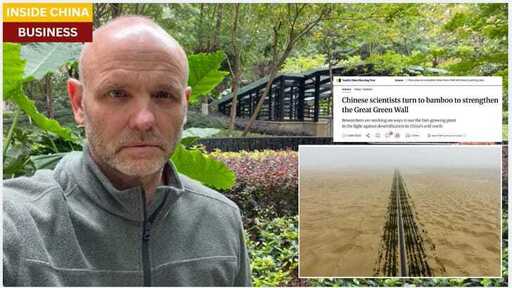
Chinese engineers are experimenting with bamboo and other grasses, to reclaim the areas surrounding the energy and road projects.
Inside China / Business is a reader-supported publication. To receive new posts and support my work, consider becoming a free or paid subscriber.
Report:
Good morning.
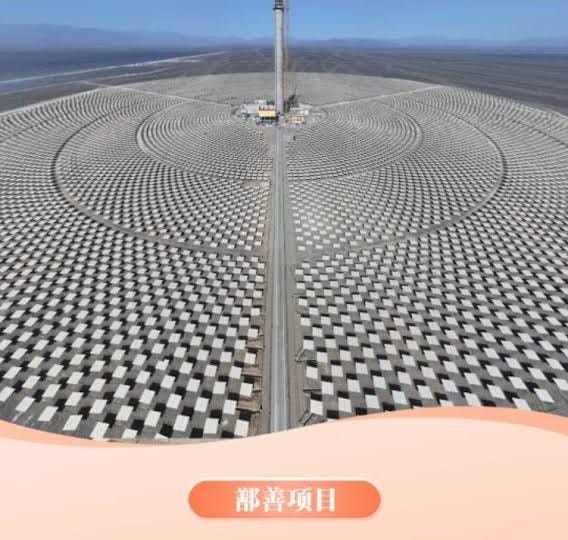
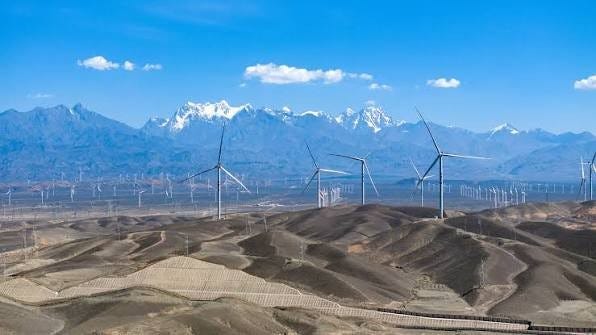
Over the past two decades, China has invested hundreds of billions of dollars in power generation, in West China. The biggest hydropower project in history is underway in Xizang. And massive solar and wind projects are already in place in Xinjiang, with more of those coming:
Most of that energy, generated by water and solar and wind in West China, is used by consumers in East China. The Chinese have built the world’s longest and most advanced Ultra-High-Voltage transmission network for that one express purpose: to carry all that power from West China, to where most Chinese live and work:
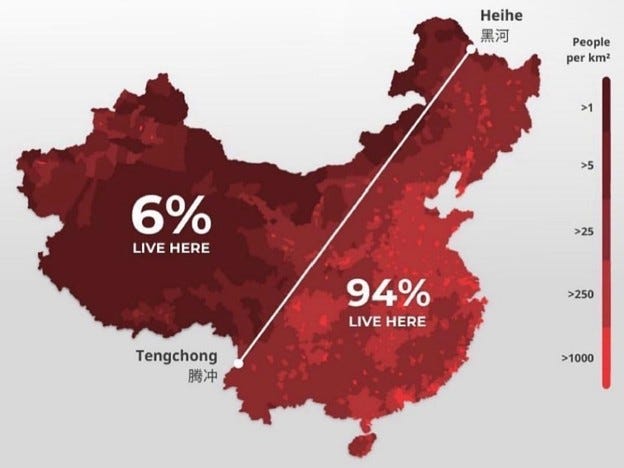
All that power is produced at industrial scale, and China now enjoys some of the lowest electricity prices in the world, and is adding much more power generation capacity every year than is demanded. In other words, China produces vast volumes of surplus electricity, and that means falling costs to households, and to factories:
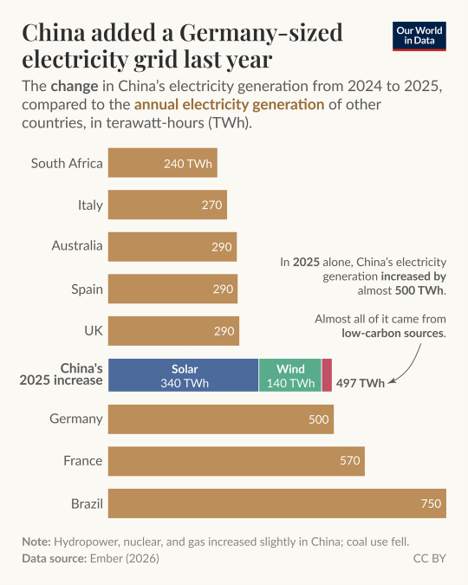
It also allowed China to build an entirely new industry, called “token outbound”—it’s a trillion-dollar industry that involves AI users across the world running their queries through computer servers here in China. The compute is performed there, in the desert, and the results sent back to the users, who are outside China. That cheap power generates value that is worth many times more than the cost to generate the data output, and adds to China’s trade surpluses.
So right now, hundreds of millions of Chinese households, and hundreds of thousands of Chinese factories, are dependent on low-cost power from West China to live and work. What’s coming is perhaps billions of AI users across the world, who are also reliant on those same facilities, there in West China, to do their work.
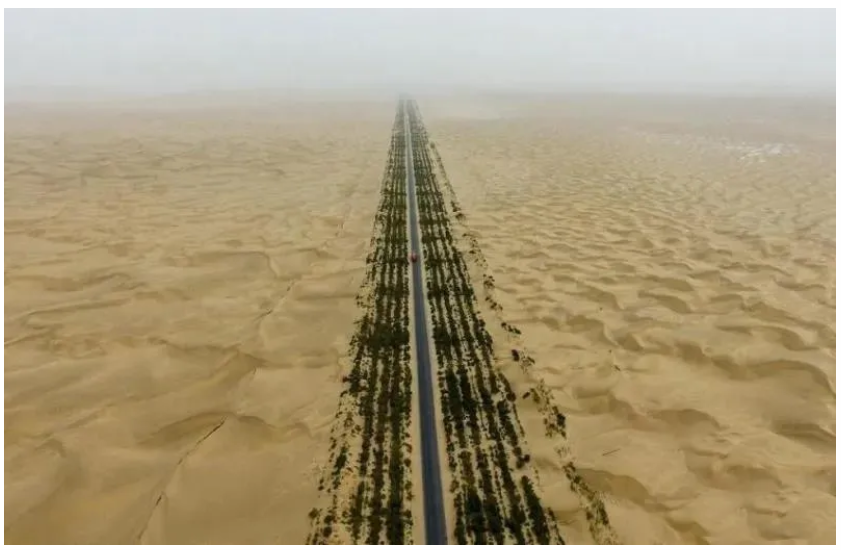
A lot of people in a lot of places, then, are invested in finding a solution to this problem, right there. The sand dunes in China’s deserts are always shifting, and desert sand represents a serious threat to the efficiency of all those renewable energy projects. The deserts are windy—which is good—but the windblown sand wears out the turbine blades and gear boxes. Efficiencies drop by between 2 and 20%.
Solar plants face the same problem, as desert sand settles on the panels and blocks out sunlight. There is a brand-new industry, of using drones to clean solar panels, but most of those approaches involve using water, and that results in another desert-specific problem—it costs too much to get the water out of the ground or hauled to the sites, to make it worth the trouble. That’s to say that using drones to clean buildings, or solar farms, is a multi-billion-dollar industry in the making, but not in the deserts where the costs of hauling the water around exceeds the value of the cleaning itself.
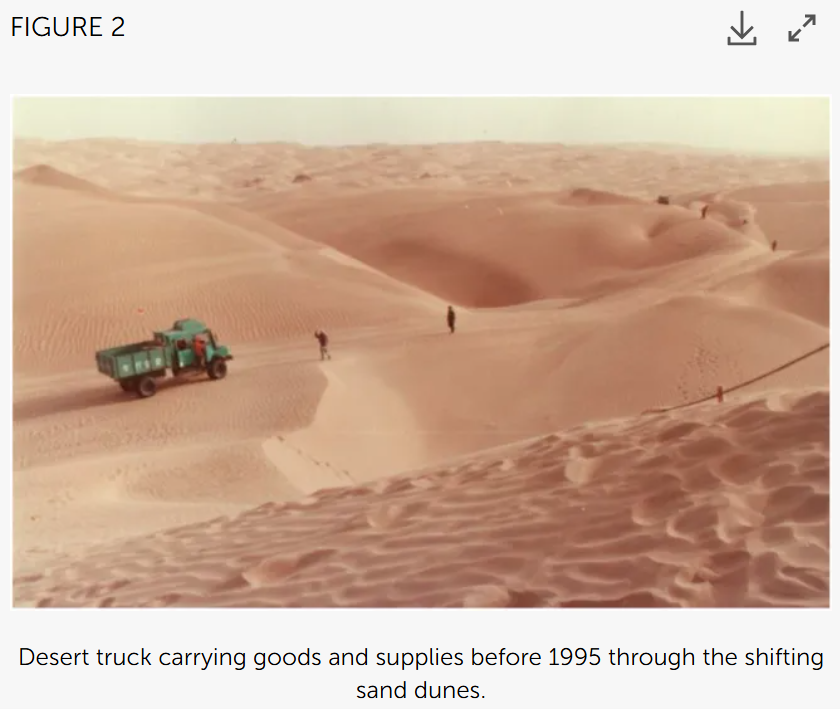
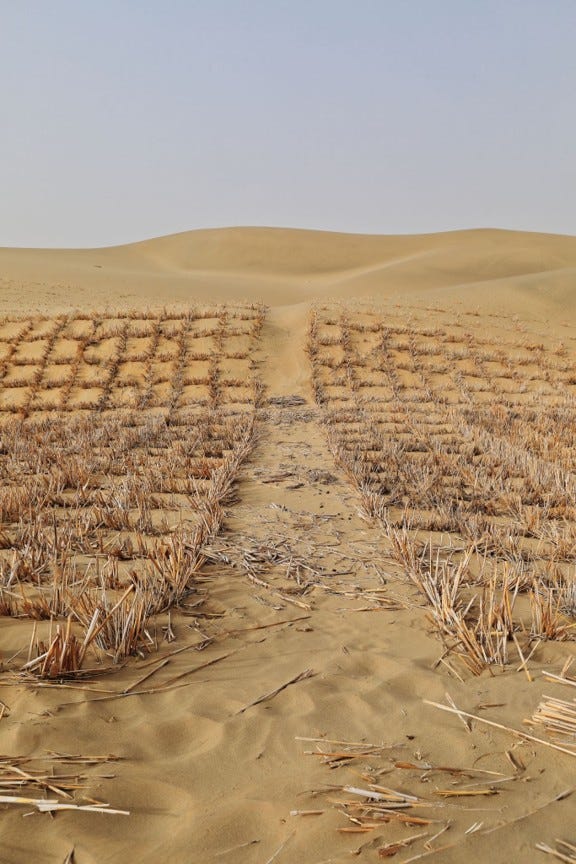
Chinese engineers have been working on this problem for a while. It started with the construction of a highway though those deserts, that experts said was impossible. Building the highway through the Taklamakan Desert was hard enough, then came the 24/7/365 battle to keep the sand from completely covering the road. The solution for that project was the construction of a huge crisscross pattern of reed and nylon fencing. Fifty-seven square kilometers is 57 million square meters, over 21 square miles. The reed and straw checkboards were “cheap, convenient, and effective”.
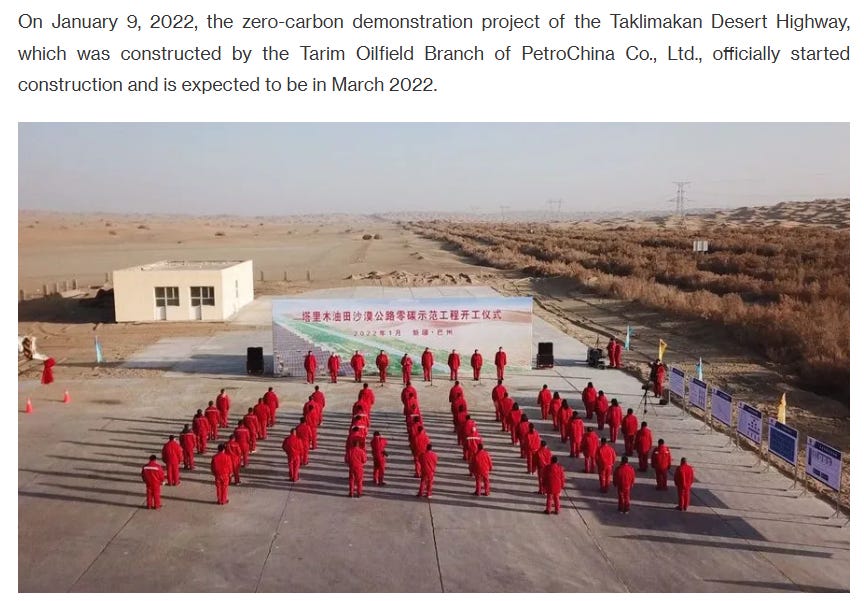
Beginning in 2022, a new initiative to upgrade those defenses was begun, and in that photo, above, we see the challenge. The protective barriers are only waist-high, at the most, and just a couple of hundred meters away is desert that stretches forever. What might work for a narrow strip of concrete with heavy trucks moving back and forth isn’t maybe going to work for a solar or wind farm that is the size of an entire city.

After 30 years of data on the artificial shelterbelt, researchers found ecological and financial benefits, cost savings in transportation, and local improvements to the Xinjiang economy. But the maintenance costs were high, those straw and reed defenses were a draw on water tables, and all they did was slow, but not stop, the shifting sand dunes. The analysts concluded that solar power should be used to handle the water, and more shelterbelt areas need to be developed, and more often.
And it’s that final part that has Chinese scientists trying bamboo, instead. The straw and reed checkerboard defenses are widely used, and they do work, somewhat effectively, for desert roads. But they are also brittle, and fall apart in just a few years:
Plastic fencing is one possibility—the great thing about plastic is that it lasts forever; the bad thing about plastic is that it lasts forever. And under the new five-year conservation plan, the Great Green Wall will be strengthened in the most ecologically friendly ways possible.
Bamboo is a natural first choice, if they can get it to work. Bamboo is strong, flexible, and it lasts a long time. The idea here is NOT to grow bamboo forests in the desert—young bamboo needs watering a few times a week, and established bamboo needs deep watering at least once a week. For now the scientists are replacing those reed checkerboards with bamboo ones. Simply doing that means the checkerboards last three times longer, and that means lower maintenance costs, and it follows that China can lay a lot more of them.
China has more bamboo forests than anyone, and an advanced bamboo production industry, so it would mean a lot of new business for Chinese bamboo plantations and farmers if they can make the project work in the North and West, and across the thousands of square miles of area surrounding the solar and wind farms.
Be Good.
Resources and links:
China starts building world’s biggest hydropower dam
https://www.theguardian.com/world/2025/jul/21/china-starts-building-world-biggest-hydropower-dam-yarlung-tsangpo-river-tibet
China Generated More Electricity in 2024 Than the U.S., EU, & India Combined
https://www.voronoiapp.com/energy/-China-Generated-More-Electricity-in-2024-Than-the-US-EU--India-Combined-5260
“Experts” wrong again: Global tech companies renting China’s excess data centers
China’s Ambitious Plan to Build the World’s Biggest Supergrid
https://spectrum.ieee.org/chinas-ambitious-plan-to-build-the-worlds-biggest-supergrid
Effect of Windblown Sand Particles on Aerodynamic Efficiency of Wind Turbines in Desert Environments: A 3D Eulerian-Lagrangian Approach
https://www.jafmonline.net/article/_2826.html
Controlling blown sand along the highway crossing the Taklimakan Desert
https://www.sciencedirect.com/science/article/abs/pii/S0140196304000072
Tarim Oilfield desert highway project
https://www.seetao.com/details/133285.html
Ecologic Service, Economic Benefits, and Sustainability of the Man-Made Ecosystem in the Taklamakan Desert
https://www.frontiersin.org/journals/environmental-science/articles/10.3389/fenvs.2022.813932/full
Check out China’s first carbon-free desert highway
https://english.ts.cn/system/2024/07/16/036919387.shtml
Large-scale replanting completed for ecological shelterbelt along Tarim Desert Highway
https://www.cnpc.com.cn/en/nr2026/202605/e08548e9bb9f43f7bb22dcad1b930f60.shtml
Case Study: A Desert-based PV Power Plant in Northern China
https://www.wissonrobotics.com/en/Drone-Cleaning-Solar-Farm-Maintenance.html
Investigating impacts of erosion on wind turbine blades
https://www.aip.org/scilights/investigating-impacts-of-erosion-on-wind-turbine-blades
Chinese scientists turn to bamboo to strengthen the Great Green Wall
https://www.scmp.com/news/china/science/article/3361945/chinese-scientists-turn-bamboo-strengthen-great-green-wall
Could Bamboo Be China’s Secret Weapon Against Desertification?
https://modernmechanics24.com/post/china-uses-bamboo-fight-desertification/
China’s ‘green great wall’ in Inner Mongolia traps 3 more deserts
https://www.scmp.com/news/china/science/article/3317376/chinas-green-great-wall-inner-mongolia-traps-three-more-deserts
World’s Largest Solar Farm Goes Online, Covering an Area the Size of New York City
https://esgnews.com/worlds-largest-solar-farm-goes-online-covering-an-area-the-size-of-new-york-city/
Inside China / Business is a reader-supported publication. To receive new posts and support my work, consider becoming a free or paid subscriber.
From Inside China / Business via This RSS Feed.