

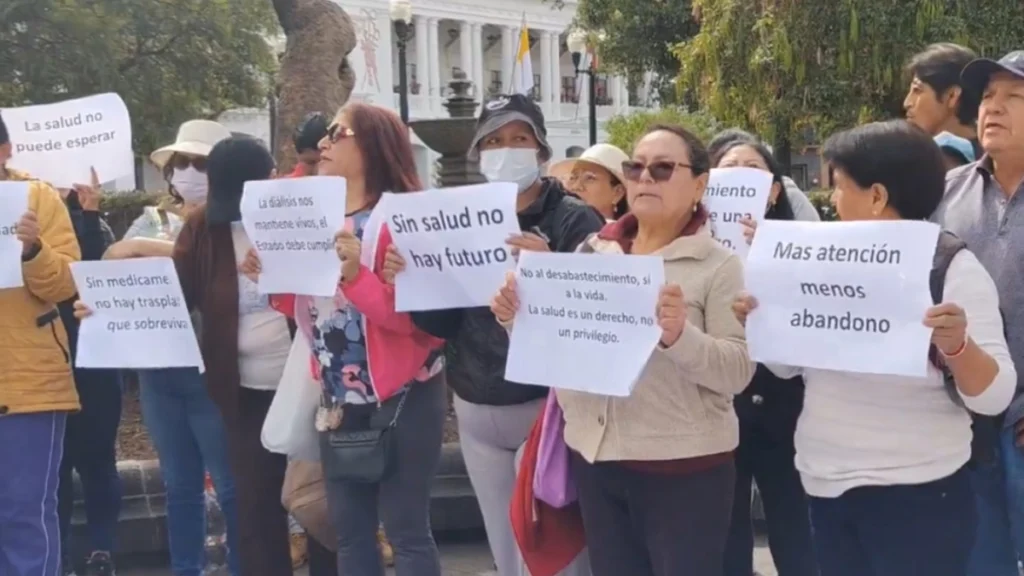
Kidney patients and their families gathered outside the Carondelet Palace in Quito on Tuesday to protest the neglect of the public health system, denouncing that around 4,000 people with kidney disease have died over the past two years due to shortages of supplies and medications, while demanding quality treatments and compliance with constitutional health guarantees.
Patients’ spokesman Kevin Valdés characterized the situation as a humanitarian crisis driven by state inaction, stating that the problem has surpassed economic concerns and moved into “inhumanity,” with no political will from the Executive, which he said has completely abandoned patients. He reported that nationwide hospitals are operating at 54% supply capacity, well below the 80 to 90 percent range recommended by the World Health Organization.
Valdés also warned that transplant patients are rejecting organs due to a lack of immunosuppressant drugs, forcing them back onto dialysis machines and adding to the more than 20,800 patients already dependent on that treatment. He further criticized the state’s distribution of generic medications, arguing that changes in bioequivalence can trigger organ rejection.
RELATED: Ecuador Accused of Racial Profiling as Activists Recount Police Brutality
Regarding government engagement, Valdés denounced a lack of institutional openness from President Daniel Noboa and health authorities, though the president later mentioned a roadmap with India for medicine procurement. The crisis is linked to cumulative budget cuts of $421 million between 2023 and 2025, with budget execution at just 45% in the last year.
Legislator Eliana Correa warned that various centers are operating with supplies below 50% and face salary debts of up to two years, while food services for patients in major cities have been interrupted, with medical staff covering those costs out of their own pockets.
Pacientes renales llegaron a Carondelet para exigir medicinas y tratamientos que les permitan seguir viviendo. Mientras afuera clamaban “queremos vivir”, desde el Palacio de Gobierno el poder respondió con música a todo volumen para intentar opacar sus voces.@teleSURtv pic.twitter.com/PPxNP9JbnU
— Elena Rodríguez Yánez (@ElenaDeQuito) August 5, 2026
The Ministry of Public Health is also experiencing structural instability following the appointment of Juan Carlos Aveiga Parra, the eighth minister in the current administration. The previous seven ministers averaged nearly four months in office, with Manuel Antonio Naranjo holding the position longest at 233 days between June 2024 and February 2025. Aveiga assumed the role from the medical directorship of the Alcívar Hospital amid legal questions raised by lawyer Jaime Chuchuca regarding alleged disqualifications tied to divesting business shares hours before his appointment.
From teleSUR English via This RSS Feed.