

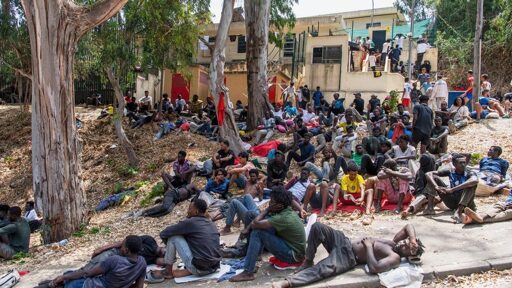

At least 88 people died during a mass crossing from Morocco into Ceuta, a North Africa territory administered by Spain, late last week. According to local reports, over 65,000 people entered Ceuta on July 30-31. The event was weaponized by far-right and right-wing groups worldwide to criticize Prime Minister Pedro Sánchez’s administration, while progressives warned such events are bound to increase under the European Union’s increasingly dehumanized approach to migration.
Last week’s images show thousands of people stranded in Ceuta, many having arrived without any belongings. Grassroots organizations providing support to migrants in the area emphasized that people were left for hours without access to water or food as Spanish authorities scrambled to coordinate a response. Instead, local residents organized to ensure access to essential supplies, No Name Kitchen reported on social media.
Right-wing groups claimed the mass crossing was the result of the Sánchez administration’s migration policy, which they described as lax, arguing it lays the groundwork for an “invasion” of both Spain and the rest of Europe. Santiago Abascal, leader of the far-right party Vox, repeated these accusations over recent days, stating that Morocco had orchestrated an invasion that the Spanish government was attempting to cover up. He also spoke in favor of border militarization.
While militarization and violent crackdowns stand at the core of the EU’s migration strategy, the Sánchez administration has taken a different approach, recently facilitating regularization for thousands of undocumented migrants. While this has not meant a clean break with harmful EU policy frameworks, it signaled a potential alternative course – much needed in a region whose major economies could become entirely right-wing dominated in upcoming elections.
Read more: Insurgent left candidate may spoil far right’s plans in 2027 French presidential election
Vox’s narrative was echoed by far-right organizations across the region, while Italian Prime Minister Giorgia Meloni announced a temporary reintroduction of stricter travel checks from Spain. Meloni’s administration has spearheaded the EU’s most recent migration governance framework, which includes curbs to the right to asylum and establishing “return hubs” in third countries for “irregular” migrants. These concepts were recently introduced at the bloc level through legislation related to the EU Pact on Migration and Asylum. Recent reports signal Italian authorities will push for their expansion following the events in Ceuta.
Notably, the right also used the mass crossing to claim that migration to Europe is increasingly being used as a tool of “geopolitical coercion,” insisting the only solution is to introduce even harsher policies. In an opinion piece published Tuesday, Greek Prime Minister Kyriakos Mitsotakis went as far as to call for a mechanism that would allow EU members to “temporarily” suspend asylum applications for those who arrive in mass migration waves deemed to be coordinated with the intention of exerting pressure on Europe. “This is not a departure from Europe’s values but a necessary adaptation to new realities,” Mitsotakis wrote – and he was essentially not lying, seeing that this would be a logical step forward in the policy direction endorsed by EU members.
Read more: EU’s new migration framework foreshadows dehumanization and human rights violation
Gleeful reactions came from outside Europe as well, including from the Trump administration and Israeli authorities. US Vice President JD Vance wrote on social media that “images out of Spain are an unfortunate reminder of the consequences of mass migration and the radical left-wing globalist policies that have enabled the Invasion of the West.” Meanwhile, Israeli National Security Minister Itamar Ben-Gvir wrote that Prime Minister Sánchez should “open the doors of Spain and grant refuge to the residents of Gaza who seek to emigrate.”
The Sánchez administration has been among the few European countries calling out the ongoing genocide in Gaza and mounting resistance to pressure coming from the US, including in the case of its war on Iran. As a result, US President Donald Trump has described the Spanish government as “very bad” on multiple occasions, threatening to sever trade relations. Some analyses have pondered whether US and Israeli involvement in the events in Ceuta expands further than social media posts, especially considering the material relations both established with Morocco.
Read more: ICE killings fuel nationwide protests
In the days following the mass crossing, criticism of Moroccan authorities mounted in the center and left of the European political camp as well, with claims that they made no effort to prevent the events or minimize the ensuing chaos. But while progressive organizations recognized that under the current migration regime Morocco has the space to manipulate migration paths to pressure governments like Spain’s, they insisted on a radically different approach from the one suggested by Mitsotakis.
“It is precisely Europe’s neocolonial migration policy – supported by both the right and the center-left – that has placed this geopolitical weapon in Morocco’s hands,” Italian left party Potere al Popolo emphasized. “European countries are erecting walls and barriers against migrants everywhere, and then they finance and support dictatorships or semi-dictatorships with billions of euros to manage these flows on our behalf.”
“The difference between the right and the center-left is that the former uses this system to spread propaganda while managing it; the center-left manages it quietly,” they added. “This system, however, cannot be reformed; it cannot be managed. It is up to us workers to organize ourselves to tear it down together and build a new system based on international solidarity and equal rights.”
From BT News via This RSS Feed.