

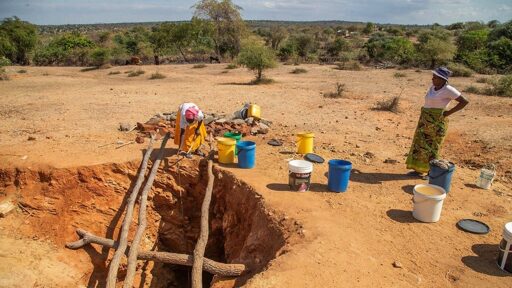

The strongest El Niño in 75 years, brewing in the Pacific Ocean, casts a dark shadow over Africa as crop failures, water shortages, and other disasters loom over the continent that is home to 309 million of the 645 million who suffered hunger globally last year.
Read more: Over half of Africa’s population suffered from food insecurity: UN report
A climate pattern caused by periodic warming of surface water temperatures in the central and eastern equatorial Pacific Ocean, El Niño disrupts atmospheric circulation, causing droughts, floods, and extreme temperatures worldwide. Its impacts are particularly acute as the planet is already warming due to greenhouse emissions.
Meteorologists have forecasted that the moderate El Niño, already at work in the Pacific by July, will peak between November 2026 and February 2027, with a 90% probability that it will develop into what has been termed a “Super El Niño.”
“The 2026/2027 El Niño event is projected to be the strongest since 1950. This is not a distant possibility. It is an imminent risk that demands immediate preparation,” said Moses Vilakati, the African Union (AU) commissioner for Agriculture, Rural Development, Blue Economy and Sustainable Environment (ARBE).
Addressing an extraordinary session of the Specialized Technical Committee on Agriculture, Rural Development, Water and Environment on July 27, he insisted, “The question before us is no longer whether another El Niño will occur. The scientific evidence suggests that it will. Africa needs to be sufficiently prepared to anticipate, mitigate and respond effectively to its impacts.”
The uneven impact across the continent complicates the response. Its impact on Western and Central Africa is unpredictable, and will vary between areas within the region. In Southern Africa, El Niño is associated with a shortage of rain during the principal agricultural season between October and April. The transition from drought-resistant millets and tubers to maize as the main staple food under colonialism has made the region highly vulnerable to crop failure and shortages.
The worst impact is expected on Eastern Africa. El Niño has historically spelt poor harvests due to reduced rainfall in its western parts, including Sudan and South Sudan (two of the hungriest countries in the world) and parts of Ethiopia, Eritrea, and Uganda.

Oxfam distributing clean water to a drought-stricken area in southern Ethiopia during 2011 drought. Photo: Wikimedia Commons
In the eastern part of the Horn of Africa, flash floods and landslides caused by excessive rains and overflowing rivers between October and December threaten to destroy crops, damage homes and infrastructure, and displace communities. The consequences are particularly dire for Somalia, which also remains one of the hungriest countries in the world.
“These climate extremes have profound consequences for agriculture, food security, water resources, energy production, public health, education, infrastructure and ultimately the livelihoods of millions of Africans,” Harsen Nyambe, director for sustainable environment and blue economy at the AU Commission, told the extraordinary session last week.
“Now is the time to act: mitigating risks before impacts are felt, rather than waiting for emergency response after the fact,” insisted the Food and Agriculture Organization (FAO). Along with the World Food Program (WFP), it has issued “a joint Anticipatory Action Appeal seeking USD 202 million to protect 8.8 million people” across 22 countries, including 12 in Africa.
However, heavily dependent on the US for their funds, the agencies are already fund-starved by the administration of President Donald Trump. The WFP reported a 40% slash in its funding from 2024 to 2025.
From BT News via This RSS Feed.