


Darren Thompson
Special to ICT
Indigenous peoples have a long history in both the U.S. and Canadian militaries, even before the creation of the two countries, and acknowledgment of their service is often at the forefront of powwows.
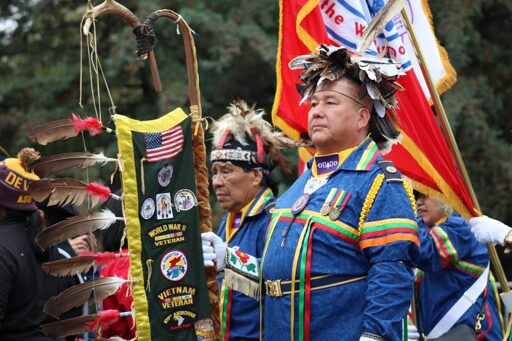
Native veterans are seen at every powwow in North America, leading all dancers into the powwow arena during the Grand Entry and carrying the eagle staff and a variety of flags.
“The significance of the veterans and all their service at a powwow circle emphasizes that we still protect our nations, prove we are willing to take an extra step for our young generation to fight for our legacies as Indigenous people,” said Mitchelene Bigman, an Army veteran from the Apsaalooké Nation with combat experience in the Iraq War in 2003 and 2005, to ICT. “I can only speak for myself, but the honor of the recognition by our people at any powwow especially leading says to me thank you for looking out for us. The title of a warrior is far more than any high rank in the military to me.”

Native American Women Warriors at the White House Tribal Nations Summit in the U.S. Department of Interior in Washington, D.C., on December 5, 2023. (Darren Thompson/ICT)
When all dancers are in the arena, powwow emcees announce the names of each veteran and the flag they’re carrying along with their military branch and if they experienced armed conflict.
Usually the host drum group, or a group of the hosting community’s choosing, will sing a victory and flag song. Depending on the region, the songs will vary, but many flag and victory songs have been sung for generations.
Some victory songs among the Lakota date as far back as the Battle of Greasy Grass, also known as the Battle of Little Bighorn, when the Lakota, Cheyenne and Arapaho defeated the U.S. Army’s 7th Cavalry in southeastern Montana near the Little Bighorn River on June 25-26, 1876.
“Each tribe has songs that are composed for veterans,” said Whitney Rencountre, chief executive officer of Crazy Horse Memorial.
Rencountre is a frequent powwow emcee from the Crow Creek Dakota Reservation in central South Dakota as well as a champion powwow singer.
“Songs are composed starting with victory songs from times such as the Battle of the Greasy Grass to current war times,” he said. “Singers will compose songs for certain war times and or songs for individual veterans. The songs help honor the veterans and their legacy is carried forward for the veterans.”
Historically, men were predominantly recognized as veterans, but Indigenous women have been active in the armed forces for more than a century.
Today, women make up nearly 20 percent of all American Indian and Alaska Native service members, which is significantly higher than in any other ethnic group in the armed forces, according to the Smithsonian American Women’s History Museum.
Now it is common to see women recognized as veterans at powwows including the all-Indigenous women color guards, such as the Native American Women Warriors and the Muscogee Nation Women’s Color Guard.

Veterans from the Muscogee Nation with Native American Women Warriors at the Grand Opening of the National Native American Veterans Memorial in Washington, D.C., on November 10, 2022. (Darren Thompson/ICT)
Credit: (Darren Thompson/Special to ICT)
The Native American Women Warriors is a nonprofit organization that serves as a color guard of many functions throughout Indian Country and aims to support Indigenous women in the military.
“We are a strong sisterhood of Indigenous women who had to face adversity in the military and at home,” said Mitchelene Bigman, one of the founders of Native American Women Warriors. “When we first came out we’re not welcomed right away from some of our tribal people — not even by our fellow older male veterans.”
She said they wanted to shed light on their service and contributions to the wars, to their people and the United States.
“Our veterans have done everything to protect these lands — they were ours first,” said Melissa Doud, a 20-year Army veteran with one tour during the Iraq War. “Veterans in tribal communities are held in the highest regard as protectors and defenders of our people and way of life. That is why we come into powwows first.”
Doud, Lac du Flambeau Band of Lake Superior Chippewa Indians, is currently the tribal veterans liaison for the Wisconsin Department of Veterans Affairs, where she works with veterans from all 11 federally recognized tribes in the state.
She has noticed over the years that veterans and color guards are decreasing.
“A long time ago, there were World War I and World War II, Korean War, Vietnam War Veterans and today, many of them are gone. We just don’t see as many like we used, but Native Americans still enlist and serve more than any other race or ethnic group in the country.”

Dan Lounder, Korean War Veteran and Crow Creek Dakota, with the Native American Women Warriors at Grand Opening of the National Native American Veterans Memorial in Washington, D.C., on November 10, 2022. (Darren Thompson/ICT) Credit: (Darren Thompson/Special to ICT)
The Gourd Dance
Another area where the powwow space has made room for veterans are Gourd Dances.
The Gourd Dance is a traditional victory dance that originated amongst the Kiowa in 1838 and has made a notable revitalization in the last several decades. The dance’s origins stem from when the Kiowa defeated the Arapaho on the Missouri River in Montana and continued with their migration to Oklahoma.
It has always been acknowledged as a warrior’s dance and only performed by men who belonged to the Kiowa Black Leggings Society.
The dance would later be outlawed during the reservation era in 1890, and would later make its first public appearance at Armistice Day in Carnegie, Oklahoma, in 1946, welcoming back many Kiowa and other Native veterans from World War II.
The dance influenced another public celebration at a Fourth of July celebration in Anadarko, Oklahoma, in 1955 and has continued since.
“The wolf who gave the Kgoygoo [Kiowa] this dance instructed us, ‘As long as you take care of the Tdienpaygah [Gourd Dance] the Kiowa people will remain strong,’” said Dennis Zotigh, North American cultural specialist at the Smithsonian’s National Museum of the American Indian. “So, to this day, at the end of each Gourd Dance song we remember the wolf and his teachings — with a wolf howl.” Zotigh is Kiowa, Isanti Dakota, Ohkay Owingeh Pueblo.
The dance is still performed today, and by members of the Kiowa Gourd Dance Society, who are men initiated into the society. Members can be military veterans, people who made significant accomplishments to the community, and people invited by members of the society.
Men part of the dance accompany the singers around one, or multiple big drums, a whip man, and a director. The dancers shake red-painted tin cans or gourds that signify endurance and bravery. Dancers wear blue and red wool blankets along with a decorated bandolier bag.
Women participate outside of the dance arena dancing in place behind the men rather than entering the central arena.
In 2022, the Kiowa Black Leggings Society served as the color guard for the first-ever Native American Heritage Month Celebration at the Pentagon, where members of the U.S. Armed Forces, U.S. Congress, and dignitaries from Indian Country celebrated the history of American Indians and Alaska Natives in the U.S. military.
“As an emcee, I am fascinated watching the rise of three influences in powwows post COVID: the Cree Winter Round Dance, the Northern Traditional Woodland style of dance, and the Gourd Dance,” said Mark Denning, a 40-plus year veteran powwow emcee and dancer from the Menominee Nation of Wisconsin. “My hope is that it experiences more of [a] boost in Northern areas, because my own experience with the dance has been an amazing journey.”
Though Gourd Dances are making a comeback, veterans and color guards are seen less and less, said Doud. “Young veterans seem like they just want to do their time and be done,” she said. “So personally I see a little bit of a decline.”

Native veterans are seen throughout Indian Country leading Grand Entry at every powwow. Pictured: A Native veteran at Grand Entry during the Cherokee National Holiday’s Powwow in Tahlequah, Oklahoma on September 1, 2023. (Darren Thompson/ICT)
On the other hand, while the Gourd Dance originated from the Kiowa, the dance has spread to many southern powwows in Oklahoma, New Mexico, Arizona, Kansas, Louisiana, and California. It is often held between sessions where powwow dancers and drum groups take breaks.
“The Gourd Dance of course is not new, and people that travel powwow circuits around the country have seen the practice of the dance,” Denning said. “It is powerful to see, and more powerful still to be invited to be a part of it. My understanding then and now is [that] our veterans are central to the practice.”
He continued: “Sometimes for our veterans, the only place to express is with other vets, and this dance gives them [the] opportunity to be in the presence of something that can become very special, and a locus of the healing spirit.”
A healing space
More community members agreed that powwows do provide a supportive space for returning service members to transition back into community life and heal from the invisible wounds of war. Many tribal communities host powwows specifically to celebrate Native veterans and their service.
“A lot of veterans had to face challenges in racism, sexism, language, stereotypes, and, yes, combat,” said Bigman of Native American Women Warriors, plus all the other things they wear and carry in their hearts and spirits. “The drums bring us back to our value in our steadfast culture.”
Bigman said that Native women veterans face higher rates of sexual trauma and racial discrimination in the military, and are also not given the same credit as males when they accomplish missions.
“As women veterans, our inner scars are far different and NAWW [Native American Women Warriors] wants to voice that and get the proper help to our Native women veterans,” she said.
Darren Thompson is a multi-media journalist enrolled at the Lac du Flambeau Band of Lake Superior Chippewa in Northern Wisconsin, where he grew up. He covers breaking news, missing and murdered Indigenous people, environmental and social justice, tribal sovereignty, art, music, and film. He can be reached through his website, www.darrenthompson.net.
The post Native veterans are central to the powwow scene appeared first on ICT.
From ICT via This RSS Feed.