

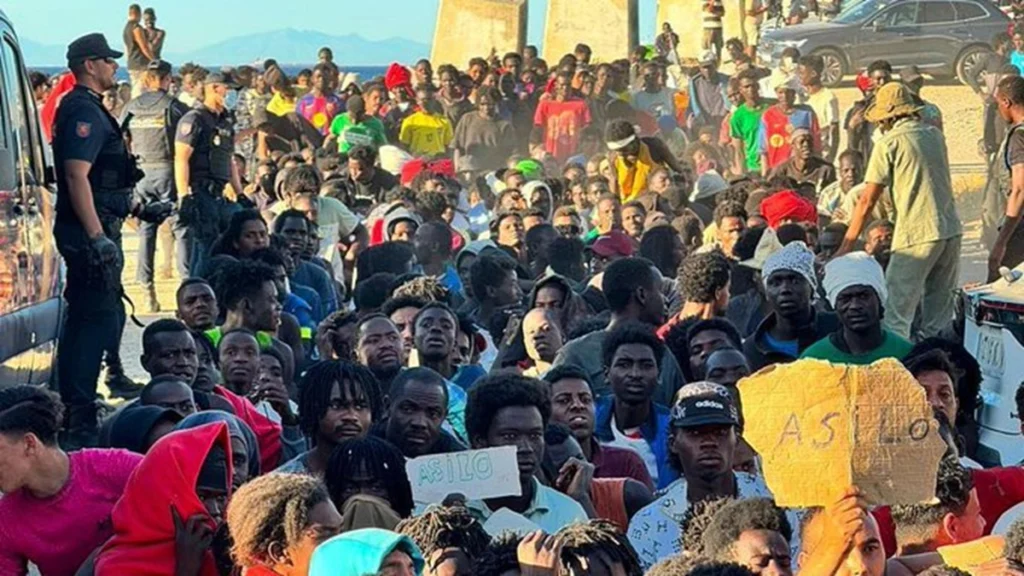
Spanish authorities say remaining cases will be reviewed individually.
On Tuesday, Spanish Interior Minister Fernando Grande-Marlaska said that 70,000 out of the 72,000 people who entered the city of Ceuta have already returned to Morocco.
RELATED:
Spanish Defense Minister Calls on Morocco to Probe Ceuta Migrant Influx
The Spanish government will review the remaining cases of migrants who are still in the North African city so that those who are not entitled to remain in Spain will be returned, he said after a meeting of the European Union’s interior ministers.
At the meeting, authorities from other countries expressed their “firm solidarity” with Spain following the migration crisis in Ceuta and stressed the need to “continue fighting tirelessly” against migrant smuggling networks, as well as to improve prevention capabilities for this type of situation.
Grande-Marlaska explained that the Spanish government is taking steps to “resolve the illegal status” of the remaining people who have not yet returned to Morocco so that those who are not entitled to remain in Spain will be “expelled,” always in “strict compliance” with Spanish and international law and in accordance with the protection of human rights.
By Iqbal Jassat.
While reports on Ceuta have sought to make sense of the reasons why it has become a migration flashpoint, the politics of hate against Spain driven by the US, Israel and Morocco is largely under-reported.https://t.co/Y2HNCB66nr pic.twitter.com/cbItBHyL29
— Media Review Network (@MRN1SA) August 4, 2026
Irregular Arrivals Down 30% So Far This Year
After stating that Spain had received no warning or intelligence reports alerting authorities to a crisis of the magnitude of the one that occurred in Ceuta last week, the interior minister noted that what had been expected was a seasonal increase in irregular arrivals typical of the summer period.
That increase could have been intensified by the possible effect of a ruling by Spain’s Supreme Court regarding the practice known as “hot returns” from Ceuta and Melilla to Morocco, for which the necessary resources had already been reinforced.
Grande-Marlaska said that the measures adopted up to that point had reduced irregular arrivals to Spain by 30% so far in 2026 compared with the previous year.
He also said that authorities had already been working on measures in response to the increase in arrivals during the days leading up to last Thursday’s large-scale influx, as 1,000 people entered the autonomous city in one week, mainly by swimming.
|#Spain | This is not a migration crisis. It is a multi-front war orchestrated by the Mossad and the CIA and executed by Morocco against a nation that refuses to become an imperial vassal.
This is not a wave of migration, it is a carefully orchestrated geopolitical attack. The… https://t.co/LG37fxZWSf pic.twitter.com/wBUxBFc8cq
— Aprajita Nafs Nefes
Ancient Believer (@aprajitanefes) July 31, 2026
10% More Officers in Ceuta Than in 2018
Grande-Marlaska said that the increase of 18,000 officers — bringing the total to 160,000 — since he took office in 2018 means that Ceuta now has 10% more National Police officers and Civil Guard personnel on a permanent basis.
According to the minister, this reinforcement reflects a commitment made by the government over the past eight years and includes other measures such as the installation of a pneumatic barrier and buoys to establish a physical maritime border between Spain and Morocco, as well as other security investments that have been committed and “are already being carried out.”
teleSUR/ JF
Source: EFE
From teleSUR English via This RSS Feed.