

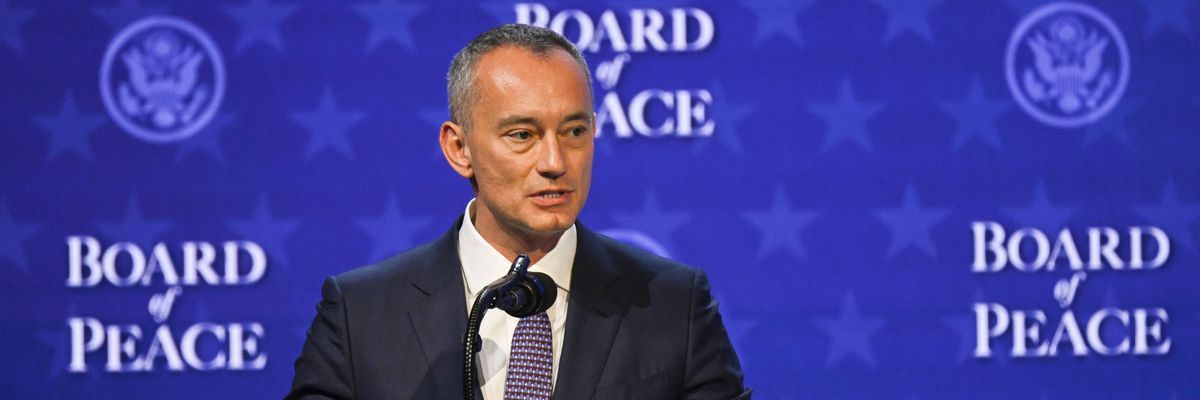
US President Donald Trump’s Gaza Board of Peace appears to be going back on the disarmament deal it reached last week with Hamas in order to meet Israel’s demands, and it may throw the entire process into jeopardy.
A roadmap agreed to last week, which Trump touted as a massive diplomatic breakthrough, stated that Hamas would begin to decommission its arms in tandem with Israel halting its attacks and withdrawing its forces to the so-called “yellow line” agreed to during the first phase of the ceasefire in October 2025.
In the ten months since the deal, Israel has been gradually advancing its forces deeper into Gaza beyond the ceasefire line to the point where it now controls around 60-70% of Gaza, while its more than 2 million inhabitants are crammed into an area that has largely been reduced to rubble.
Last week’s peace roadmap said explicitly that the gradual decommissioning of Hamas’ heavy weapons, arms depots, production facilities, and tunnels “shall be linked to an Israeli withdrawal, in phases.” Trump echoed this last week, stating that the Israel Defense Forces (IDF) would withdraw as disarmament proceeds.
Though Trump claimed Israel was “very happy” with the deal, its leaders have spent days crying foul, stating that withdrawal would only occur after Hamas completely disarms. Meanwhile, Hamas said it would only go along with the disarmament if Israel withdraws at the same time.
In defiance of the agreement’s language calling to honor ceasefire commitments “without delay,” Israel launched attacks across Gaza on Sunday that killed at least 18 Palestinians, the largest daily toll in weeks. Israeli Energy Minister Eli Cohen, a member of Prime Minister Benjamin Netanyahu’s security cabinet, told Israel’s Army Radio that there was no deal for it to halt attacks on Gaza.
The strategy appears to have worked. Following meetings between Netanyahu and the Board of Peace Gaza envoy, Nickolay Mladenov, on Monday, the board released a statement posted to social media that essentially rewrote the original agreement to match Israel’s demands and claimed it had been part of the agreement from the start.
“Contrary to inaccurate reports, we note that the withdrawal of the IDF beyond the Yellow Line will take place only once decommissioning is complete, as Hamas committed to the mediators,” the board said. “This applies to light weapons, heavy weapons, and the tunnels alike.”
Hamas responded by reiterating that it and other armed factions in Gaza “remain committed to what was agreed regarding the implementation of the second phase of the ceasefire agreement, including all parties’ obligations,” and called for “a clear and official response” from Mladenov regarding what was agreed upon.
The new statement from the Board of Peace directly contradicted Mladenov’s flat statement on Thursday that “withdrawal must move in lockstep with decommissioning.”
Muhammad Shehada, a political analyst from Gaza at the European Council on Foreign Relations, said that the Board of Peace was “betraying the very agreement they just made” and “taking Netanyahu’s side fully.”
“The roadmap explicitly said withdrawal must move in lockstep with decommissioning,” he wrote on social media. “It never said withdrawal would happen only after decommissioning is fully completed.”
“The roadmap made a distinction between ‘heavy weapons’ (e.g. tunnels, rockets, RPGs) and ‘personal/light weapons,’ and allowed Palestinian factions to retain light weapons for protection in case Israel reneges,” he added. “Including light weapons now in this tweet is Netanyahu’s way of sabotaging the agreement.”
Tariq Kenney-Shawa, the associate director of editorial for the Institute for Middle East Understanding, said the Board of Peace’s abrupt reversal “shouldn’t surprise anyone.”
“The Board of Peace is just the administrative and fundraising arm of Israel’s occupation of Gaza,” he said. “It exists to facilitate Gaza’s ethnic cleansing and concentration camps in a way that is palatable and profitable for the international community.”
Since the so-called “ceasefire” went into effect last October following two years of genocidal war, Israeli attacks have killed more than 1,200 Palestinians, bringing the official death toll above 73,000. Experts warn the true number of Palestinians who have been killed since Israel began its attacks in October 2023 is likely far higher.
July was the deadliest month for Palestinians this year, with more than 150 Palestinians killed. Israeli leaders have discussed fully “conquering” the strip, controlling it indefinitely, and moving in illegal Israeli settlers.
From Common Dreams via This RSS Feed.
 2·4 hours ago