

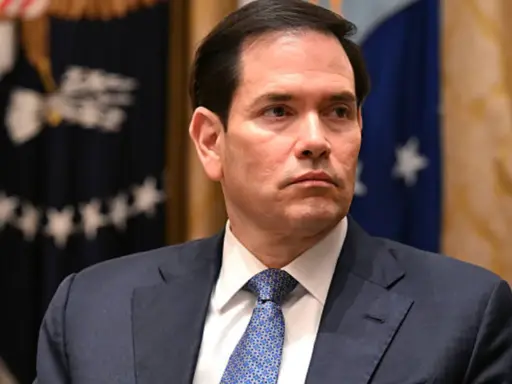

Marco Rubio, Secretary of State for the USA, earlier this year at the Munich Security Conference called for the “return to brutal Western colonialism.” This explicit messaging from the Western ruling elite about its plans for the Global South should be unifying masses in countries like India more than it has.
Notably, protests in India are breaking out against the neo-liberal government everywhere and startlingly have also spread to the urban middle class.
Surbhi Kesar, who teaches at SOAS, called the participation of the “urban aspirational classes” as “striking,” given their unfamiliarity with engagement with public causes and sustained interaction with people from different social locations.
But it reflects that the Indian post-1990s liberalisation-led growth is failing even those who benefited the most from it.
Marco Rubio comments juxtaposed with cockroach protests
The Gen Z protests, led by the ‘Cockroach Janta Party,’ have captured the media limelight. The name comes from India’s Chief Justice, who in May dismissed unemployed youth as “cockroaches” – an insult the protesters have embraced.
However, simmering beneath this surface-level attention has been widespread unrest fueled by unrelenting violence against Muslims and other minorities, the infamous ‘bulldozer raj,’ resource grabbing by government cronies (such as the Adani Group) to benefit US corporations like Google, and ongoing farmers’ protests.
Arundhati Roy, writing from Delhi, captured the moment:
The cockroaches are out and about. The farmers have begun marching to Delhi once more, this time to protest the India-US trade deal – the death warrant the government of India has slavishly agreed to sign on their behalf.
The challenge now is to connect these disparate protests into a unified struggle against this broader recolonization project that Rubio talked about.
Education as unifying factor
The student movement was successful, leading the education minister to resign. But they are still strong in their demands and have the power of mobilizing young people.
The President of the All India Students Association said:
We therefore make a promise: We will remain on the ground and continue to build movements for the revocation of NEP 2020 and against the privatisation and destruction of public education. We will struggle for an equal, socially just, publicly funded and democratic education system; for quality education as a right, not a privilege purchased by those who can afford it.
Education has been a pathway for upward mobility in India. And, Kesar explained that families in India have continued to invest heavily in education, including on professional degrees whose costs can exceed the annual expenditure of poorer households, even while graduate employment has failed to expand at the same pace.
Unemployment, however, now is close to 40% among graduates aged 15–25, and around 20% among those aged 25–29.
The neoliberal corporate capital growth model, which mainly benefits the Western ruling elite is showing its limits to even please the Indian upper classes.
US imperialism
Writing in Middle East Critique, Prabhat Patnaik argues that the recolonization of the Global South, as envisioned by the Trump administration will take the form of unequal trade treaties that impose captive markets on nations like India requiring them to import specific quantities of US goods while offering nothing in return.
According to Patnaik, the U.S.-India trade deal being negotiated is a mechanism of recolonization – reducing India to a “captive market” for U.S. goods through asymmetric tariffs and quantitative import targets, a structure “even worse than the colonial situation” under Britain.
Alongside the unequal treaties will be outright seizure of strategic resources from Venezuela to Iran, all to revive a stagnant American empire at the expense of the Global South’s hard-won sovereignty.
Rubio speech is a blueprint
Rubio made colonization explicit in his speech – this speech should be studied by all organisers of movements in India and other Global South countries to fully understand what it faces and how Western allies view them. .
He invoked “Western civilization” multiple times, a coded summons to a shared imperial project, while simultaneously demonizing immigration from the Global South.
Rubio’s words leave no room for ambiguity: the West seeks “competition for market share,” the “reclaiming” of industrial dominance, the securing of “critical minerals not vulnerable to extortion,” the “restoration” of a “new Western century,”
He dismisses the very existence of non-Western nations as a threat to “the survival of our civilization itself,” describing their people as an “unprecedented wave of mass migration that threatens the cohesion of our societies.”
Rubio criticizes concern for the planet as a “climate cult” that must be appeased no longer.
He lashes out at “strongly worded resolutions” and “abstractions of international law,” boasting instead of “14 bombs dropped with precision from American B-2 bombers” and “American Special Forces” in Iran and Venezuela respectively.
Finally, he openly longs for the era “before 1945” when “the West had been expanding – its missionaries, its pilgrims, its soldiers, its explorers pouring out from its shores to cross oceans, settle new continents, build vast empires extending out across the globe.”
Rubio is openly longing for an era before the political decolonization wave of the 1940s-60s.
Recolonization
According to Patnaik, recolonization that Rubio is seeking serves two purposes simultaneously – it “counters the stagnation of the US economy by increasing the level of activity and employment through a rise in net exports,” and it “reduces the current account deficit of the US and thus contributes toward a strengthening of the dollar.”
Both problems facing US imperialism are thus addressed without disturbing “the hegemony of international finance capital.”
Patnaik is clear that this project will not go unchallenged:
The Global South, however, will not surrender the gains of economic decolonization without a struggle. True, the monopoly bourgeoisie of the South, and even certain segments of the urban middle class that would like its progeny to emigrate to and settle in the metropolis would not join this struggle and might even be complicit in the imperialist project; and they may not only be ‘spared’ the adverse effects of recolonization, but even made beneficiaries of it.
But the peasants, the petty producers, the small capitalists, the workers, and the agricultural laborers, all those who remain committed to the idea of decolonization and who would also be the victims of recolonization, would resist such recolonization.
According to Patnaik, while the monopoly bourgeoisie and certain segments of the urban middle class may be complicit in or even benefit from recolonization, the peasants, petty producers, workers, and agricultural laborers – those who have the most to lose – will resist.
Yet the protests sweeping India today – from students and farmers to the urban unemployed- suggest that even among those Patnaik identifies as potential beneficiaries, the failure of the neoliberal model is generating cracks, making a unified struggle against recolonization not just necessary but increasingly possible.
Featured image via the Canary
By Nandita Lal
From Canary via This RSS Feed.