

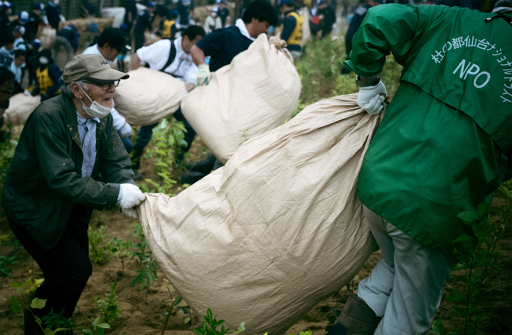
MINAMISOMA, Japan — Kazuo Monma stepped out onto the small stage and looked at the large crowd with a sense of relief. The weather report had called for rain all weekend, and the mayor of Minamisoma, a coastal city in Japan’s Fukushima prefecture, worried that few would show for what had become an annual event for volunteers from across the Tohoku region. Instead, Monma stood in front of more than 1,000 people. The assembled crowd, some from as far away as Kanagawa prefecture, more than 300 kilometers (about 200 miles) to the south, were there to plant more than 12,000 trees along the steep dunes that line Minamisoma’s sandy beaches. “I really do think we should be proud of this moment,” Monma said to the crowd. “This is a place where thousands of people have kept this up for so long.” Minamisoma, like more than a dozen other coastal communities across Japan, is the site of an innovative experiment in disaster resilience. While seawalls have become the dominant way of mitigating the impacts of tsunamis and typhoons, one organization is touting a mix of seawalls and a wall of trees — following a specific species and planting choice — could do a better job at protecting at-risk communities. Fifteen years ago, in March 2011, the northeastern Tohoku region was the site of one of the 21st century’s worst natural disasters. A magnitude 9 earthquake struck 72 km (45 mi) off the coast of Miyagi prefecture. What followed was a tsunami of monumental scale, a devastating…This article was originally published on Mongabay
From Conservation news via This RSS Feed.