

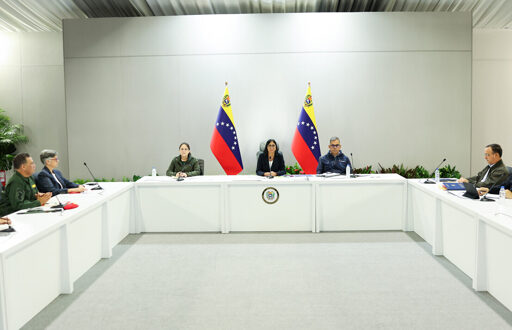
On Sunday, Venezuelan Acting President Delcy Rodríguez held a videoconference with the country’s governors and cabinet members to review progress in restoring the National Electric System (SEN) following the June 24 earthquakes and to order the immediate activation of preventive measures in response to forecasts concerning the climate phenomenon known as “Super Niño.”
During her address, Rodríguez reported that electricity service is being progressively restored in areas affected by the earthquake and warned about the severity of the high temperatures and droughts forecast for Venezuela in the upcoming months.
Rodríguez explained that the earthquakes caused serious damage to transmission lines and the National Electric System’s thermoelectric generation infrastructure. She highlighted the efforts of electricity sector workers to stabilize the system.
“In La Guaira state, we achieved record service restoration in one week. However, we also sustained damage to electrical towers along the Planta Centro-Yaracuy line. The most significant damage occurred at the Termo Carabobo thermoelectric plant, which supplied 600 megawatts to the National Electric System,” she stated.
The acting president reported that 300 of the 600 megawatts previously generated by Termo Carabobo have already been restored in recent days.
“The fluctuations we have experienced in recent hours and days are directly related to the significant loss of those 600 megawatts,” Rodríguez said. “Today, I am pleased to report that we have already recovered 50% and, in the coming weeks, we will be working toward a complete recovery.”
Since the January 3 US bombing of Venezuela, during which President Nicolás Maduro was kidnapped and over 100 people were killed, the country’s electricity service has faced growing criticism due to recurrent power outages in rural areas, as well as in Caracas, which had historically been largely insulated from the most severe deficiencies affecting the national grid.
Venezuela’s sui generis relationship with Washington has allowed the government to sign agreements with major electricity-sector corporations, including General Electric, INSA, and Siemens. However, the earthquakes have added a new layer of complexity to the country’s recovery plans, which remain constrained by illegal US sanctions.
Comprehensive preparations for “Super Niño”
Regarding the global climate crisis and its impact on South America, Rodríguez warned that temperature anomalies over ocean waters have intensified, rising from 1.25°C to 1.94°C above the historical average. She said the increase reflects a broader climate emergency marked by more extreme heat, droughts, floods, and storms, although she did not specify the geographical area, reference period, or dataset used for the comparison.
“When the Paris Agreement was discussed, an increase above 1 degree Celsius was already considered a climate emergency,” she said.
“Imagine where humanity is heading. We are seeing severe flooding in other countries, enormous typhoons, troughs, and avalanches,” Rodríguez added. “It is a truly worrying situation, but it is also one that demands action and the creation of the necessary awareness so that our people understand that we must develop a different ecological and climate consciousness to confront the consequences of the climate emergency.”
In response to this situation, Rodríguez ordered the implementation of four preventive measures.
Regarding thermoelectric generation, she established the objective of making an additional 480 megawatts available, supplementing contracts already signed with companies such as General Electric and INSA to expand generation capacity and strengthen the National Electric System.
Rodríguez also called for preparations to address the potential consequences of a climate emergency associated with “Super Niño.”
“We must prevent fires and establish preventive measures for fire prevention and mitigation,” she said. “We must monitor reservoirs, as I know we are already doing, and preserve our watersheds.”
Regarding food security, Rodríguez requested the activation of the National Economic Council to coordinate with the agroindustrial sector and protect agricultural production.
“We need special plans. We cannot wait for it to arrive. Let us prepare ourselves,” she said.
Saving energy and water
The acting president placed particular emphasis on an energy- and water-saving plan that every citizen can participate in from home. She called for intensified public awareness campaigns concerning the rational use of electricity and water.
“I am going to request what may be the most important plan: a plan to reduce electricity and water consumption,” Rodríguez said. “It is an awareness plan to which every citizen can contribute. What can I do from my home? What can I do from my office to save electricity and water?”
“These are simple actions that do not cost anything and help us develop a much broader civic consciousness, particularly one that is more committed to nature,” she added.
Rodríguez explained that the “Super Niño” phenomenon refers to periods of climate characterized by severe drought and rising temperatures. She once again emphasized the need to prepare for its effects.
“You are already feeling the high temperatures or experiencing rainfall with very strong electrical activity,” she said. “We are already seeing expressions of this phenomenon. Let us prepare. This is the preparation stage, and I ask that the country—that Venezuela—be prepared.”
Call for unity and prevention
Finally, Rodríguez emphasized the importance of timely planning and coordination among the national government, state governments, municipal authorities, and the Bolivarian National Armed Force (FANB) to confront climate-related adversity without resorting to improvisation.
Venezuela’s Delcy Rodríguez Announces Energy Saving Plan For Extreme Heat and Dry Season
“We have demonstrated, in the face of the worst difficulties, that we are capable of uniting and being reborn, and that we are capable of coming together to care for our homeland,” Rodríguez said. “Now, we will unite to care for nature. We cannot go through life improvising. This is about taking preventive action and protecting what we have so that, when it arrives, we are as prepared as possible. Venezuela becomes one great team, and it is our responsibility to work as a team and in national unity.”
(Últimas Noticias) with Orinoco Tribune content
Translation: Orinoco Tribune
OT/JRE/SF
From Orinoco Tribune via This RSS Feed.