

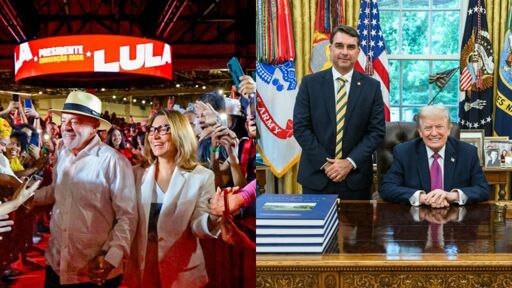

Flávio Bolsonaro, son of former far-right President Jair Bolsonaro (currently convicted of allegedly leading an attempted coup against Lula da Silva in 2022–2023), publicly announced his candidacy in the upcoming presidential elections at the convention of the Liberal Party (PL) on July 25. Argentina’s far-right president, Javier Milei, was in attendance and took the opportunity to hurl insults at Lula, creating a diplomatic impasse that has yet to be fully resolved.
Flávio Bolsonaro has positioned himself as his father’s political and ideological heir, even going so far as to feature an AI-generated video of his father at the PL convention, pledging his support for Flávio. The AI video of Jair Bolsonaro ended the speech declaring: “Brazil has a future, and the future is Flávio Bolsonaro as president.” Legal challenges have been filed against the PL regarding the use of AI and in this case a “deep fake” which is illegal under Brazilian electoral law, the ruling in this case is still pending.
The young Bolsonaro clearly seeks to capitalize on the platform and popularity his father still commands as the most radical antithesis to the center-left governments of the Workers’ Party (PT). The PT governed Brazil from 2003 to 2016 – first under Lula da Silva and then under Dilma Rousseff – and again from 2023 to the present under Lula once more, who returned to the presidency after serving time in prison.
PT projects itself as the safeguard against the far right
In light of this, the PT has decided to reinforce the idea of a contest between two radically different options and has nominated current President Lula da Silva as its presidential candidate for the 2026 elections, hoping to secure his fourth non-consecutive term at the age of 80.
At the convention in São Paulo that launched his candidacy, Lula indirectly responded to criticism about his age, saying, “I have the same energy I had when I was 30, I’m in top shape… I want to fight against old age,… I don’t want to be shuffling along.”
Lula has also appealed to nationalist sentiment to gain support. Brazil is currently embroiled in a trade dispute with Washington, whose president, Donald Trump, has said on several occasions that Jair Bolsonaro is his friend and that he condemns his imprisonment, even going so far as to impose a tariff on Brazilian products in response to that imprisonment.
Thus, Lula da Silva hopes to present himself as the only candidate capable of defending the South American giant against foreign pressure. That is why he has promised a historic investment in defense to safeguard national interests so that “no one invades this country to take the president away. I want to be prepared for peace, not for war,” said the current president, indirectly referring to the U.S. attack on Venezuela on January 3.
“I want to be prepared so that no one dares to take us for fools. Is that clear? That’s why it’s important to know that we need to invest in defense,” Lula said in front of a large Brazilian flag that was unfurled among his supporters amid chants of “Brazil won’t surrender.”
In addition, the PT sought to portray Lula as the candidate of hope, not of revenge. “We are here to make this official, but also to celebrate this historic political movement – the political movement that will re-elect President Lula and Vice President Alckmin, keeping our country on the path of rebuilding public policies,” said Lula da Silva.
Brazil has managed to reduce unemployment and poverty to historic lows during Lula’s administrations, despite a slight slowdown in GDP growth at present – though GDP is still expected to continue growing. It currently stands at 2%. That is why the PT appears set to base its campaign on the achievements of its administrations, which have clearly transformed and strengthened Brazil.
Thus, vitality, national defense, hope, and concrete results will be the cards that Lula da Silva will play against his rivals, the Bolsonaros, who promise to reduce insecurity – (through their “Brazil Without Fear” plan) with more prisons, border control, and harsher penalties – and to implement neoliberalism (with tax cuts, privatization of state-owned enterprises, and trade liberalization, especially with the United States).
Brazil will be another battleground for Washington-backed right to take on progressives
In short, Brazil’s it will be a repeat of what has happened in several countries where progressive forces – heirs to movements that blended Keynesian economics, political social democracy, and progressive liberalism in lawmaking – and the new right – backed by Washington and adherents of its hemispheric policy, advocates of uncompromising neoliberalism, and deeply anti-leftist – clashed.
In recent years, the new right-wing movements have achieved resounding and repeated victories in South America. Except Uruguay, the aligned new right-wing movements have seized power by defeating progressive parties: Noboa in Ecuador and Milei in Argentina in 2023, José Antonio Kast in Chile and Rodrigo Paz in Bolivia in 2025, and Abelardo de la Espriella in Colombia and Keiko Fujimori in Peru in 2026 – all of whom were more or less publicly supported by Washington.
If we add to this picture the continued right-wing governments in Paraguay and the severe blow dealt to Venezuela at the beginning of the year, we gain a clearer geopolitical perspective of the region, in which nearly all executive branches are dominated by parties belonging to or clearly aligned with the new right and its political and economic agendas, as well as the impressive resurgence of US influence in South America.
But Brazil remains outside this right-wing puzzle – the South American giant whose GDP accounts for nearly half of all of South America’s nominal GDP, followed far behind by Argentina (14%), Colombia (10%), and Chile and Peru (both at 7%). Clearly, there can be no “possible resurgence” without the Amazonian giant.
The big question is whether Lula da Silva will be able to reverse a trend that currently seems unstoppable, or whether the new right-wing movements will manage to secure another victory – likely the most significant one in the last three years – thanks to their rhetoric of economic freedom, rejection of progressivism, and a heavy dose of political marketing.
From BT News via This RSS Feed.