

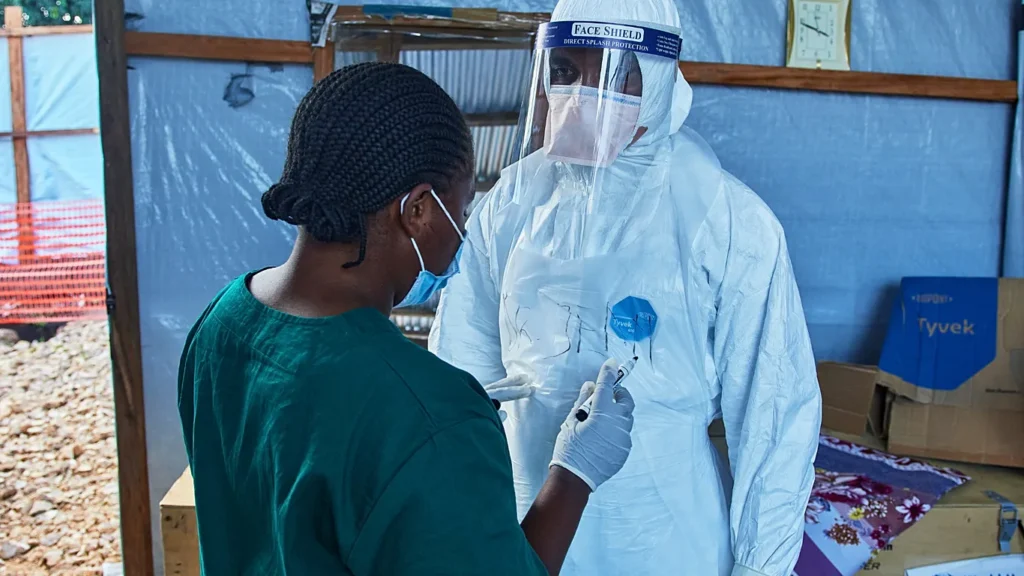
The Democratic Republic of the Congo (DRC) reported this Monday that a deadly Ebola outbreak in its eastern provinces has claimed 1,657 lives and infected 3,748 people since May.
The Ministry of Communication released its official bulletin on August 3, compiling data up to August 1, which reveals that the lethality rate of this epidemic stands at 44.2%.
According to health authorities, 690 patients currently remain under strict isolation or hospitalization in specialized treatment centers, while 708 individuals have successfully recovered from the disease.
RELATED: DRC Ebola Outbreak Now Second-Largest in History With 3,532 Cases
Medical brigades maintain a contact tracing rate of 80.1%, supported by continuous laboratory sample analysis and the processing of more than 1,000 daily alerts across the territory. This epidemiologic surveillance aims to mitigate the spread of the virus within highly vulnerable communities that lack proper hospital infrastructure due to historical state abandonment.
The critical lack of basic services significantly hinders timely medical attention for affected families living in the rural border regions of the eastern territory.
#EbolaRDC | Point de situation – 1er août 2026
La riposte contre la maladie à virus Ebola se poursuit dans les cinq provinces touchées : Haut-Uélé, Ituri, Nord-Kivu, Sud-Kivu et Tshopo. La situation demeure stable sur le plan géographique, avec 49 zones de santé affectées et… pic.twitter.com/q30AQ9FpJA
— Ministère de la Santé RDC (@MinSanteRDC) August 3, 2026
The current Ebola outbreak is active across five provinces: Ituri, which remains the epicenter, North Kivu, South Kivu, Haut-Uele, and Tshopo.
This wide geographical distribution makes the current health crisis the most severe in national history, surpassing the 2018-2020 epidemic, which accumulated 3,481 cases.
Economic and Social Factors
This health crisis represents the second-largest Ebola outbreak documented in world history, showing rapid transmission rates in resource-rich areas.
The fast spread of infections is heavily driven by the high mobility of artisanal mining workers who migrate through areas rich in gold and coltan. This complex economic dynamic severely complicates transmission tracing for public health brigades, as workers constantly move between informal mining camps.
The constant transit of people between these remote mining settlements facilitates the silent dispersion of the pathogen throughout the entire regional geography.
Compounding the crisis, the current infection corresponds to the Bundibugyo strain, a specific subtype of the virus for which there are no authorized vaccines or treatments.
Consequently, the World Health Organization (W.H.O.) has categorized the regional risk as high for Sub-Saharan Africa, maintaining a public health emergency of international concern.
Ebola: Disease is spreading rapidly in the Democratic Republic of the Congo, with deaths increasing and cases doubling every 20 days.
The UN is supporting the response, but warns the epidemic is worsening an already severe humanitarian crisis. pic.twitter.com/WoOhEJZBEW
— United Nations (@UN) July 30, 2026
The humanitarian response faces severe obstacles due to systematic violence perpetrated by armed groups, specifically the M23, which is backed by Rwanda. This armed group seeks to maintain control over strategic local mining deposits, generating insecurity that directly prevents medical teams from reaching affected rural populations.
Additionally, the persistence of traditional funeral rituals involving direct physical contact with deceased victims continues to hinder efforts to break the transmission cycle.
Local social movements have urged the state to address the structural inequality and corporate mineral exploitation that exacerbate the health crisis in the East.
From teleSUR English via This RSS Feed.