

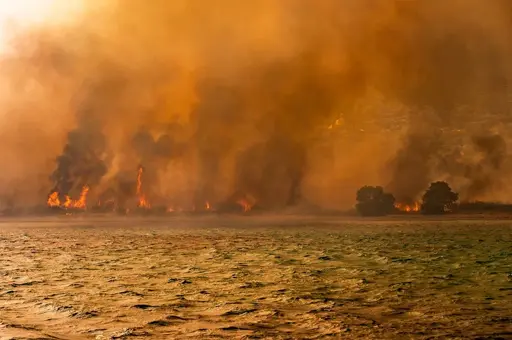
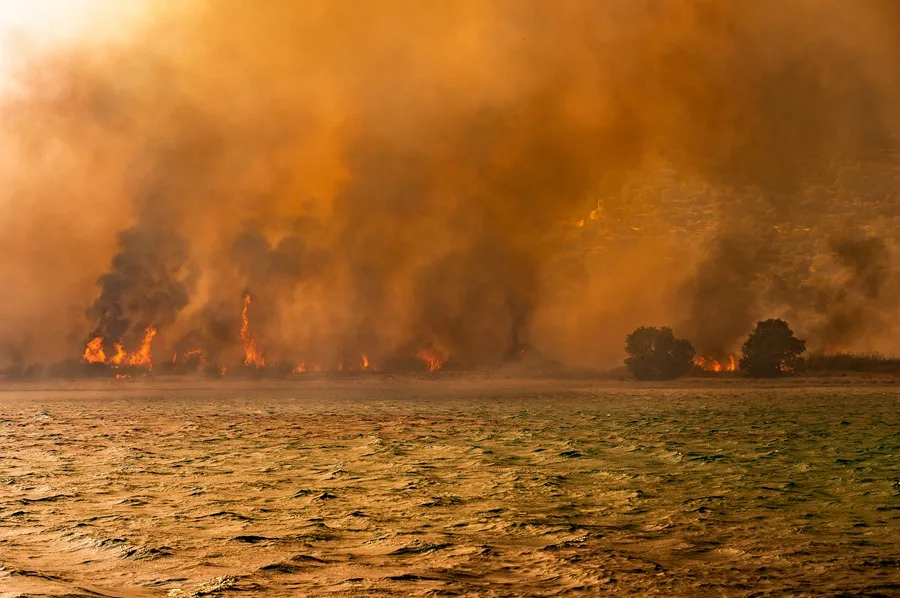
Greece’s firefighters battled uncontrolled wildfires threatening western suburban communities near Athens, forcing immediate emergency evacuation protocols due to extreme winds of over 100 kilometers per hour.
Uncontrolled wildfires continue to ravage multiple regions across Greece, threatening to penetrate the peripheral metropolitan areas of the capital city.
Meteorological authorities and rescue services warned that high-intensity wind gusts are feeding the flames, severely complicating containment efforts in the Hellenic territory and on the island of Cephalonia.
RELATED: France Places 36 Departments at High Wildfire Risk as Heat Wave Intensifies
The Prime Minister of Greece, Kyriakos Mitsotakis, confirmed that the nation faces extreme weather conditions characterized by wind gusts exceeding 100 kilometers per hour. This atmospheric situation has caused the rapid propagation of fire fronts in the regions of Attica, Boeotia, and Phocis, substantially increasing structural and material damage in the affected towns.
The Minister of Civil Protection, Evangelos Tournas, explained that severe air turbulence prevents firefighting aircraft from performing safe water loading and discharging maneuvers. Due to the relentless advance of the flames toward the western suburbs of the capital, local authorities ordered the preventive emergency evacuation of Porto Germeno and surrounding residential areas to prevent human casualties.
Today’s images from the wildfire show three horses running for their lives to escape the flames in the Kandili area of Megara, Western Attica, Greece. pic.twitter.com/7inRCAg14A
— Weather Monitor (@WeatherMonitors) August 3, 2026
Official reports confirm the complete destruction of dozens of family homes and extensive damage to agricultural lands in the Ionian Sea region, as well as on the islands of Crete and Paros. Ground firefighters are concentrating their primary efforts on establishing physical firebreaks to block the progression of the front and protect exposed population centers, working under extreme physical strain.
Νεότερη πυρομετεωρολογική ενημέρωση για τη δασική πυρκαγιά της Nότιας Βοιωτίας/Δυτικής Αττικής: Σταδιακή εξασθένηση των ενισχυμένων ανέμων από τις απογευματινές ώρες της Κυριακής 02.08https://t.co/P2byNxdQQI pic.twitter.com/gGoNYNablf
— meteo.gr – Ο καιρός (@meteogr) August 2, 2026
Demands for Climate Action
Community organizations highlighted the urgent necessity of strengthening public crisis management and civil protection systems to address the growing challenges of climate change in the Mediterranean basin.
The Greek government maintains its highest operational alert status to safeguard the lives of citizens threatened by the advancing fire fronts. Meanwhile, the civilian population remains organized in designated collection centers as local authorities coordinate international assistance to mitigate this severe natural disaster on European soil. Community volunteers are assisting displaced families by providing food and water.
The wildfire crisis in southern Europe follows a devastating month of July, during which wildfires ravaged thousands of hectares of forest land in Spain and France. The recurrent nature of these disasters in the Mediterranean region has intensified the public debate regarding state preparation. The current situation in Greece highlights the physical limitations of existing emergency protocols when facing wind speeds that prevent aerial support.
Currently, civil organizations continue to demand structural changes in how the state manages environmental emergencies. Local groups emphasize that fire prevention must receive the same priority as active suppression. As the fire advances toward Athens, the immediate priority remains the safety of human lives, while technical teams analyze the physical damage in Attica, Boeotia, Phocis, and the affected islands.
From teleSUR English via This RSS Feed.