

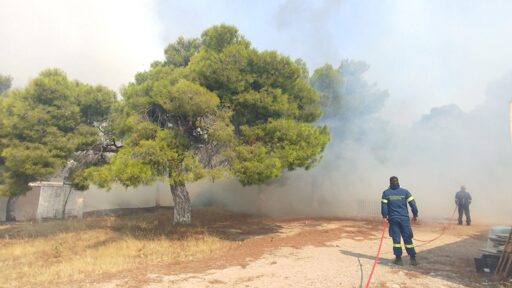

After days of devastating wildfires in France and Spain, Greece has become the latest European country to sound the alarm over rapidly spreading blazes. In recent days, five firefighters died as they battled the flames: this includes two aircraft crew members who were killed in a crash with another response helicopter on Sunday as they joined efforts to contain a fire northwest of Athens.
Authorities have recorded over 200 forest and agricultural blazes across the country in the past week alone, according to local media. Strong winds have hampered operations, including those conducted from the air. Evangelos Tournas, Minister for Climate Crisis and Civil Protection, stated that the wind had shaped “extremely difficult conditions resulting in many cases where aircraft either cannot draw water or cannot carry out drops due to extreme turbulence.”
However, extreme weather is not the only culprit for the struggles of Greek firefighters – echoing experiences from France and Spain. Recently, the Communist Party of Greece (KKE) once again criticized the New Democracy government for failing to develop a proper fire prevention plan or hire adequate staff. The KKE reiterated that the fire department suffers from “thousands of unfilled permanent positions and massive shortages of resources and essential equipment, which is why firefighters are fighting a battle under adverse conditions.”
Read more: How austerity policies wrecked Greece’s ability to respond to wildfires
European Union data shows Greece employed 17,400 professional firefighters in 2024, technically an increase of 1,200 from the previous year. Yet, this still represents less than 1% of the country’s total employment. This trend is not unique to Greece: while EU reports indicate firefighting numbers rose slightly over the past couple of years, the total remains below 400,000 across the bloc – accounting for only 0.19% of total employment. In contrast, still in 2024, there were 1,551,663 police officers across EU member states.
In May 2026, the KKE emphasized shortages in sectors crucial for fire response are still notable. “Based on the already ‘slashed’ organizational chart drawn up by the government, there are 3,500 vacant firefighter positions; Forestry Services have been decimated, with a shortage of approximately 1,500 foresters and 10,000 forest workers,” the party wrote. Combined with aging equipment, these gaps create exhausting workloads for firefighters and compromise their ability to respond effectively, threatening their lives and the lives of the communities they are protecting.
The KKE and other progressive groups are thus urging the government to adopt a fully funded national prevention strategy. These calls include regulating energy infrastructure linked to the commercialized concept of “green transition.” “The policy of so-called ‘green’ development has turned mountains into sites for wind turbines and power plants, with thousands of kilometers of cables running through forests, constituting a constant source of fire hazards,” the KKE argued. Sources suggest the current blaze in proximity of Athens originated from such a power plant.
Read more: Wildfires in Europe are spreading and intensifying thanks to neoliberalism, unions warn
Not even EU programs that claim to increase member states’ fire preparedness can replace adequately funded local strategies, left and progressive groups insist. In this context, the KKE suggested that the European Civil Protection Mechanism, which deploys response teams across borders in situation of crises, “legitimizes and perpetuates the lack of personnel, firefighting resources, and infrastructure in every country by shuffling meager resources from one Member State to another.” The party added that this puts “already insufficient firefighting and rescue crews – who risk their lives on the front lines – at great danger.”
Similarly, MeRA25, the progressive party led by former Finance Minister Yanis Varoufakis, shared similar concerns. They pointed out that full-time and seasonal firefighters, along with their unions, have long warned about “shortages of personnel and aerial resources, understaffed departments, aging equipment, inadequate prevention measures, exhausting work schedules, and a system that relies on self-sacrifice rather than planning.”
“Firefighters deserve investment that will protect them and the citizens whom they devote their lives to protecting – they don’t deserve austerity,” the European Federation of Public Service Unions (EPSU) stated on International Firefighters’ Day in 2024.
From BT News via This RSS Feed.