

Amelia Schafer
ICT
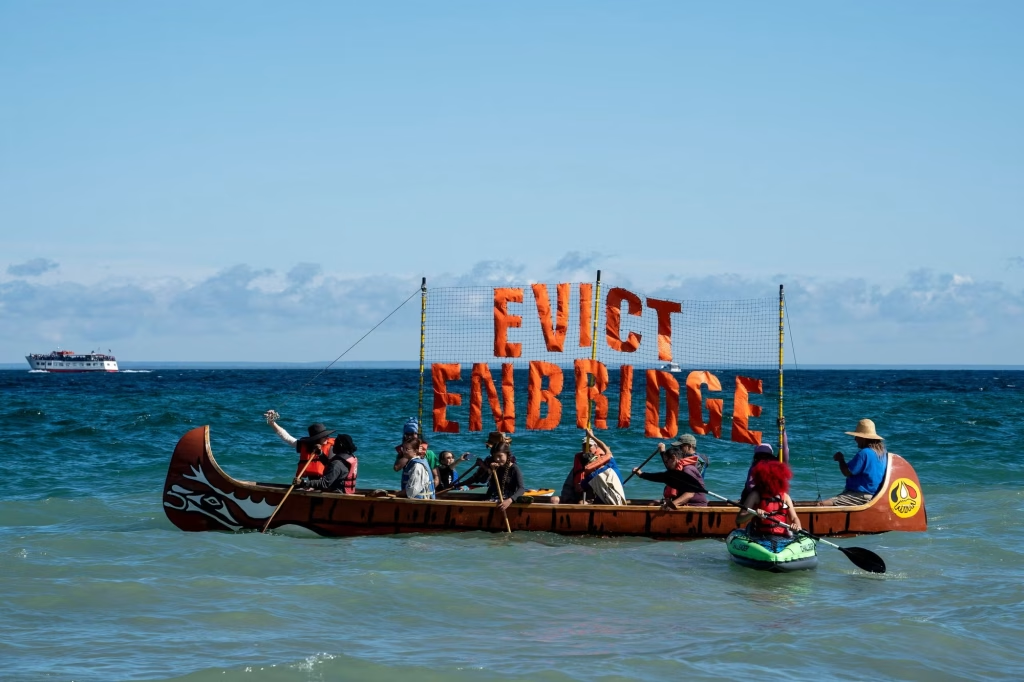
Michigan’s Supreme Court has rejected a key permit needed for the construction of a tunnel around a 73-year-old oil-pipeline in the Straits of Mackinac, an area sacred to the Anishinaabe (Ojibwe, Ottawa and Potawatomi) people.
The court rejected a permit issued in 2023 by the Michigan Public Service Commission allowing Enbridge, a Canadian energy company, to construct an underwater tunnel around a four mile segment of its Line 5 pipeline at the Straits of Mackinac, where Lake Michigan and Lake Huron meet.
The court’s 6-1 decision late Friday means that state regulators must reconsider the permit previously issued to Enbridge; however, it does not mean future construction on the aging pipeline is off the table.
Line 5 is a 645-mile long crude oil pipeline, which runs from Superior, Wisconsin, to Sanaria, Ontario, Canada, near Detroit. The pipeline was first constructed in 1953 and has operated since. For years Enbridge has proposed building a tunnel around the four mile segment within the Straits, but tribal leaders and environmentalist groups warn any new construction at this sacred site is problematic.
“The tunnel is not a solution to the risky pipeline, it is just another risky way to transport fossil fuels through the Great Lakes,” Debbie Chizewer, an attorney with EarthJustice, which is an Environmental Law nonprofit, told ICT in July.
The tunnel project itself proposes numerous risks, Chizewer said. The design is completely untested and unprecedented, she said. The tunnel itself has not been sufficiently studied, meaning there’s a high probability of the construction failing, she said.
“It can lead to collapse from groundwater intrusion, there could be an explosion if the tunnel boring machine encounters unexpected gas, there’s a number of other ways in which the tunnel itself can cause more harm or a problem along the way,” Chizewer said.
The Michigan Public Service Commission initially granted Enbridge the now rejected construction permit in 2023, leading four tribal nations, the Bay Mills Indian Community, the Little Traverse Bay Bands of Odawa Indians, Grand Traverse Band of Ottawa and Chippewa Indians, and Nottawaseppi Huron Band of the Potawatomi, as well as several environmental groups to launch a lawsuit against the decision.
Anishinaabe tribes in Michigan are strongly opposed to any new pipeline or tunnel construction through the Straits, citing an abundance of burial sites and cultural sites in the area. Tribal leaders celebrated Friday’s ruling.
“This decision gives us another opportunity to honor our treaty rights, protect our waters, and consider the generations who will inherit this place,” Whitney Gravelle, Bay Mills Indian Community President, in a statement. “The Straits of Mackinac are not simply a route for an oil pipeline to be abused. They are sacred waters, the heart of creation for Anishinaabe people, and a source of life for millions. Some things are simply too sacred to be buried beneath a tunnel. Our work continues, and we remain committed to protecting the Great Lakes for generations to come.”
The court’s decision doesn’t mean that the construction project is over.
Federal appeals court: Oil pipeline trespassing on Wisconsin tribal land
Michigan Governor Gretchen approved a separate permit for tunnel construction on July 15. The new segment would be constructed and housed within an underwater tunnel, and connect to two dual pipelines created in 1953.
Following the July 15 permit approval, Enbridge told ICT it would continue to work on tribal consultation as well as with federal regulators and guidelines such as the National Historic Preservation Act.
“Enbridge respects the cultural and historic significance of the Straits of Mackinac and is committed to protecting cultural resources as part of the Great Lakes Tunnel Project,” a spokesperson told ICT in July. “In all, Enbridge has completed more than 40,000 hours of cultural and environmental survey work in support of the Great Lakes Tunnel Project.”
The area surrounding the Straits of Mackinac and the straits itself have been home to Anishinaabe people since time immemorial and per the 1836 Treaty of Washington, Anishinaabe people are guaranteed the rights to fish, hunt and gather on those lands and waters.
Construction on a tunnel around the four mile segment of Line 5 in the Straits threatened trust and treaty rights guaranteed to all signatories of 1836 Treaty of Washington, which include Anishinaabe (three files council) tribes of the Grand Traverse Bay, Little Traverse Bay Band, Little River Bay Band of Ottawa Indians, Sault St. Marie Band of Chippewa and Bay Mills Band of Chippewa Indians.

Whitney Gravelle, President of the Bay Mills Indian Community, poses for a photo. (Courtesy of Whitney Gravelle).
“You can’t have a treaty right to fish if you don’t have clean water for fish to live,” Gravelle told ICT in July. “You can’t have a treaty right to hunt if oil has spilled in the forest or [if] our wetlands have been covered up. So when we really talk about treaty rights, we have to ask ourselves, what does that mean? And what is it intended to mean? And what do we want the future of those treaty rights to mean? … A treaty right to fish also means a treaty right to swim with fish and laugh with fish and dance with fish. And what that actually means is it’s the treaty right to live an Indigenous way of life. That includes ceremony, that includes song, that includes language, that includes passing teachings from elder to child, from uncle to son. And it is very much interwoven into our life ways. We could not be who we are as Anishinaabe without the Great Lakes. And our ancestors made sure to preserve that and protect it.”
Tribal leaders and environmental groups in Wisconsin celebrated a similar victory Friday morning, when a three-judge panel of the U.S. Seventh Circuit Court of Appeals ruled that a 12-mile segment of Line 5 is trespassing on tribal land.
Enbridge is currently engaged in a re-route project around the Bad River Reservation in northern Wisconsin, with plans to decommission the 12-mile segment on tribal lands once the re-route is complete.
The post Michigan Supreme Court rejects Line 5 oil pipeline permit appeared first on ICT.
From ICT via This RSS Feed.