

By the Zero Hour, August 3, 2026
The propaganda that never stopped—and how to stop it.
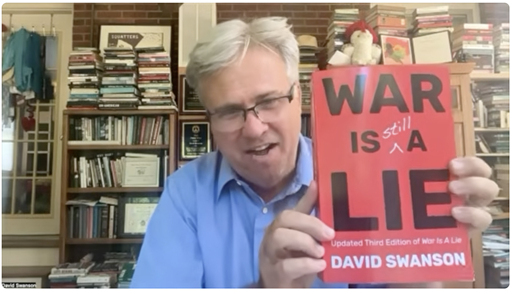
David Swanson is an author, activist, journalist, and radio host. He is executive director of World BEYOND War, campaign coordinator of RootsAction.org, and host of Talk World Radio. His latest book is War is Still a Lie, the third iteration of a 2010 publication (then called War is a Lie). In it, he skillfully dismantles the deceptions and misconceptions that have been used for centuries to persuade people to fight and die.
The book is an important contribution to the ongoing conversation about war and peace. Please give our conversation a listen. (Selected quotes and lightly edited transcript below.)
Selected Quotes
David Swanson:
“There has never been a war launched without a pile of lies, and very often those lies are literally recycled from previous wars.”
“Bravery is admirable. But heroism requires combining bravery with goodness, with some strategic improvement of the world for other people.”
“The great peace organizations, like Veterans For Peace, will tell you the way to honor veterans is to stop creating more of them.”
“There has never been a single documented case of PTSD from lack of war.”
Richard Eskow:
“If my neighbor and I disagree about the hedges, we don’t start saturation-bombing each other’s houses. Our natural instinct is to talk about it. That, and not war, is human nature.”
“When we arm another country … if two neighbors are in a fistfight on the street and I hand one of them a machine gun, I’m morally responsible for the deaths that follow.”
Transcript
Richard: First of all, David, welcome back to the program.
David: Great to be here. Thanks.
Richard: I think it’s an important book. It addresses so many of the questions people have about the necessity, or lack thereof, of war. But let’s start with this: I believe you first wrote the book in 2010, re-released it in 2015, and now again in 2026. So what’s changed, and what hasn’t?
Actually, let me back up. What’s the fundamental theme of the book, as you see it?
David: So I wrote this thing in 2010 called War Is a Lie, and I thought I’d update it with each war, or each year, but that didn’t turn out to be feasible. I updated it in 2015, War Is a Lie, 2nd edition. This time, a lot had gone by, a lot had changed, not just in terms of wars and politics, but in the types of lies being told, and which ones people were actually believing.
So I changed the title slightly and called it War Is Still a Lie. I explain that it’s really the third edition of War Is a Lie. I wrote a new section looking at how things have changed, and I tried to hit the highlights, that section alone grew to almost 100 pages in what’s now a book of well over 500 pages.
The idea was: in 2010, if anybody said “war,” Iraq was still the big topic, with Afghanistan a close second, and of course, as always, World War II somewhere in the background. People told me Iraq was a fluke, an exception, a violation of the norm, that wars were normally good, just, rational, fought for decent purposes, and grounded in truth and righteousness.
I knew that couldn’t be right. So I went and read, war after war after war. U.S. wars, other countries’ wars, ancient wars, recent wars, and I couldn’t find a single one that wasn’t built on a pile of lies. Including, yes, God forbid I say it, World War II.
There were recurring themes, similar lies used to start wars, to escalate them, to keep them going, and later to repaint them as “good wars” once everyone had forgotten how unpopular they actually were at the time. So I didn’t write a chronicle of this war, then that war, then the next. I wrote about the lies as themes, everything they tell us about war is a lie, and here are some of those lies. So I built chapters like “Wars Are Not Fought Against Evil,” “Wars Are Not Launched in Defense,” “Wars Are Not Waged Out of Generosity,” and so on, with examples drawn from throughout history and across the world to support each theme.
Richard: One of the things that came to mind when I was reading it was a quote from Howard Zinn, I’ll probably mangle it, where he points out that people say, “Well, the American Revolution was justified.” And he says, well, Canada got its independence from Great Britain without a revolutionary war. Or, “The Civil War was justified”, well, Great Britain ended slavery without a civil war.
One of the things I kept thinking about while reading the book, David, was the liberal audience, the kind of audience that thinks of itself as decent, humane, not warlike or bellicose. You quote an acquaintance of yours, someone I gathered was fairly liberal, saying that George W. Bush was the first president to lie us into a war, to actually tell a lie to bring us into a conflict. Which is deeply ahistorical, isn’t it?
David: Of course. There has never been a war launched without a pile of lies, and very often those lies are literally recycled from previous wars. It’s the only form of recycling the Pentagon has ever really embraced: recycling the lies. You’ve got not just the lies about the Lusitania, that no one was warned, that there was no ammunition aboard, and so on, but Franklin Roosevelt essentially copying the Lusitania story with various ships assisting Britain before the U.S. officially entered World War II, because it was such an effective, proven way to turn public opinion against Germany.
You have stories going back to World War I about German atrocities in Belgium. It’s not that Germany didn’t commit real atrocities there, every country does, in every war. But specific, fabricated stories about particular children being attacked were recycled from 19th-century wars and reused in World War I propaganda. There’s not always a lot of creativity involved. Sometimes it’s genuinely inventive; sometimes it’s crude and still works.
But there are no wars that aren’t built on lies. It’s just that sometimes the liars are really, really bad at it, or they simply don’t put in the effort. Telling everyone a war is about giant stockpiles of weapons that you’re about to discover don’t exist is spectacularly bad lying. It’s not “lying” in contrast to truth-telling, it’s just incompetent lying. I didn’t think anyone could top that until Trump came along and justified a war on Iran as necessary to reopen a strait that his own war on Iran had closed. That one was dead on arrival, and credit to the public, we largely didn’t buy it.
With Iraq and Afghanistan, Afghanistan especially, and arguably Iraq too, a majority of Americans polled were in favor at the start. It took a year and a half or so in each case before polls consistently showed a majority saying, “We never should have started this.” And I’d hoped people would catch on faster when I first wrote the book. But even then, you still had a majority saying, “Don’t end it, we never should have started it, but don’t stop now.” Because at that point you’re killing on behalf of the people already killed on your own side. It’s for the troops. The troops shall not have died in vain, unless, of course, we kill even more of them for no purpose.
That dynamic has faded somewhat now that we’re not fighting large ground wars with thousands of U.S. troops dying. It’s no longer driven by that “troop-ism.” It’s not about revenge either, a disgusting and legally baseless justification for war, but a very established and, apparently, respectable one when it can be deployed.
Richard: And effective, effective because it speaks to something primitive in the human brain. That, and the fact that we’re no longer seeing mass American casualties the way we did in Vietnam —
David: People are still dying. Just not Americans.
Richard: Right, I hope I qualified that by saying U.S. soldiers. That reminds me of a line from David Graeber, the anthropologist, who said that in a way, the ironic legacy of Abbie Hoffman and the 1960s peace movement is this: American boys, as it was framed then, before we had a gender-integrated military, aren’t fighting and dying the way they used to. We’re just killing other people now. That’s the legacy.
Which is maybe a good way to transition into something you write about in this latest, 2026 edition, that we’ve lost something you call “Iraq War syndrome.” Go back ten, eleven, twelve years, and there was a real sense that the country had been chastened, that this wasn’t a good idea, that it cost lives, hurt a lot of people, and probably shouldn’t have happened. That syndrome seems to be gone now. Was that part of why you put out a new edition?
David: Yes. I hope it’s not 100 percent gone, but it’s greatly diminished. It’s striking that both the “Vietnam syndrome” and the “Iraq syndrome” get labeled as diseases, as if a moment of clarity, where people recognize that wars are horrific crimes and decide not to repeat them, is itself a pathology.
It’s also worth noting: go back before the gender-integrated military, when for millennia wars were fought almost entirely by men. At some point we said, “Let’s add women to the mix.” We could just as easily have said, “Let’s subtract men.” And you’d have had nearly everyone, except a few unusual anthropologists, screaming that it’s human nature, it’s written in our genes, in our economics, it’s unavoidable. And yet if you look closely at any specific war, you find it was carefully engineered by people who wanted war and profited from it, and who worked hard to avoid peace. Still, people insist war is inevitable. Not a single documented case of PTSD from war deprivation, not one person on Earth suffering from a lack of war. Nearly everyone tries to avoid it. And then we’re told it’s just human nature, and we casually add women to the killing.
Why not subtract men instead? Wars keep happening, and we’re told they’re normal and inevitable, even though 96 percent of the world’s governments don’t wage war anywhere near the way ours does. But things have changed over the past twenty years. It’s true that we stopped killing “our boys.” But people generally don’t believe that. Polls have asked Americans about Iraq and Afghanistan, and a majority typically believed most of the war’s deaths were U.S. military personnel, when in reality it was 3 or 4 percent. And people actually resented Afghans and Iraqis for not being grateful for the “service” of having their countries destroyed, their land poisoned, their people killed.
That’s part of why we now hear, “All our money is going to Ukraine and Gaza, we need it here at home.” As if the money could possibly all go to just 4 percent of the population. In reality, there’s so much of it that you could transform the entire world with a fraction of it, and yet it’s not benefiting the people of Gaza, Ukraine, Iraq, or Afghanistan either.
When we try to sanitize war by hiding the “wrong” casualties, or by hiding casualties altogether, as Trump does even with these relatively small numbers, it doesn’t mean people aren’t dying. Air wars are often deadlier than ground wars, they’re just more one-sided, so it’s harder for us to see. We have to get to a point where we actually care about that. And maybe we’re getting closer, because the war on Iran is deeply unpopular.
Richard: It is. And I think access to information beyond U.S. mainstream media has helped with that, far too slowly, but it’s helped shift perceptions of what’s happening in Gaza and the West Bank, as people see for themselves through social media and other sources what’s really going on.
But what strikes me is how much hasn’t changed in how we think about war. A while back, I gave a talk for which I laboriously researched the anthropological literature on whether all human societies wage war. I could have saved myself hours by just reading War Is Still a Lie, it’s all in there. War is not some essential part of human nature. In fact, I’d argue, and I think it’s implicit in your book too, that it’s actually human nature not to wage war. When my neighbor and I disagree about the hedges, we don’t start saturation-bombing each other’s houses. We talk about it. That’s human nature, resolving disputes through conversation.
But there’s this strange willing suspension of disbelief when it comes to war, especially, I’ll say it, among people who might be considered the “good,” respectable segment of society. You might expect hostility toward peace from people written off as deplorable by some politicians, but I’m talking about the people who insist that war is simply part of human nature, that we’ve exhausted every other option, that there’s no talking to “these people.” I once wrote a column about a professional medical ethicist at Albert Einstein College of Medicine who argued that all pharmaceuticals should be withheld from Russian citizens because of the invasion of Ukraine, which would amount to the mass murder of cancer patients and infants. A medical ethicist arguing this. And a well-known liberal commentator, it turned out, when I looked into his background. So what’s the barrier here? Your book is obviously an attempt to break through it, and I think it does a great job, but why is there such fertile ground, even among people who’d claim to know better?
David: The good news is there’s less and less of it, 80 percent of Americans want to end the war on Iran. Maybe 70 percent falsely believe they have no power to influence government behavior, and that’s the big lie that needs to be overcome: the belief that we can’t get organized and actually change things. As for the other 20 percent who think the war on Iran is great, or beneficial to them or the world, or believe Iranians are simply evil and need to be killed, that’s a tougher case. But there’s rarely an insanity out there that doesn’t command at least 20 percent support. How perfect do we really need this to get?
I do agree that far more Homo sapiens have lived their entire lives without ever coming near a war than have come near one, it’s not even close. But I think it’s important to agree with Jean-Paul Sartre that we’re responsible for whatever we choose to do, and that we’re capable of doing almost anything. You can call mass murder “human nature,” and you can call peaceful cooperation “human nature”, but you’re never going to dissect a human being and find some discrete thing called human nature. It doesn’t exist, except as the lamest possible excuse for things people are ashamed of but want to keep doing anyway.
Then there’s the question of those of us who oppose a given war, why do we oppose it? Is it because of the illegality and mass murder, or because gas prices are up? Look at the politicians, the so-called opposition, we have an online action at RootsAction where people can email Democrats in Congress urging them not to oppose deals that might end the war on the grounds that “any deal is a bad deal.” Of course a deal to end a war is always going to look worse than never starting it. But the real question, if we’re not drunk on partisanship, is whether a bad deal that ends the war is worse than continuing it and risking escalation, or even nuclear war. And you have Democratic senators and representatives, nearly all of them, who won’t say a single word about the illegality, the mass murder, the cruelty, or the sadism of a war, they just want it “properly authorized,” or they’re upset about gas prices. That leaves me with real questions about how far we’ve actually come.
Richard: Along those lines, and I suppose it depends on whether you see the glass as half full or half empty, we see, in terms of support for the genocide in Gaza, and the incipient genocide, if it isn’t already past that point, in the West Bank, that ordinary Democrats and Americans in general are turning against these wars. Their leaders aren’t. There are structural reasons for that, and we can work to raise awareness of them. That’s the good-news piece. But we’re still, and this is one of the most delicate parts of your book, sacralizing warfighters.
You have a chapter titled “Warriors Are Not Heroes.” That’s a genuinely touchy thing to say in America, across the political spectrum. You argue that it’s possible to be brave and courageous without being a hero. Tell us about that distinction.
David: Well, obviously you can jump in front of a train, that’s very brave, but does it do the world any good? You can risk your life to murder a group of children, and that may be very brave, but it’s also evil. Heroism requires combining bravery with goodness, with some strategic improvement of the world for other people. Otherwise it’s not something you’d actually want to emulate.
If you just look at warfighting in isolation, ants are clearly braver than Homo sapiens. But from a distance, ants slaughtering each other also looks pretty absurd. Are we going to glorify the cause of one particular colony of ants? Probably not.
I saw that movie everyone’s talking about, the Odyssey adaptation.
Richard: Oh, you saw it?
David: I did. And in many ways it deglorifies war and puts veterans’ issues front and center. According to the film, the Greeks were lied into the Trojan War for economic reasons. Every warrior was coerced into fighting through threats against their families and towns. The war itself is shown as boring, wasteful, horrific, evil, and traumatizing, it destroyed the rule of law and spread fear and insecurity across the known world. Odysseus takes so long getting home because he’s recovering from moral guilt, horror, PTSD, and grief. Everywhere his troops go, there’s raping and pillaging. He encounters the dead, who ask him, “Why did you lie to me? Why did you abandon me?” The whole thing is portrayed as filthy and disgusting, except for the misplaced glorification of bravery.
And then, at the very end, what does Christopher Nolan do? He keeps the ending where Odysseus locks fifty people in a room and slaughters them out of revenge. After hours of “war is evil, war is traumatic, war is pointless,” you land on revenge as the payoff.
Richard: Revenge.
David: Why not just apply that same logic backward to the Trojan War itself? If revenge can purify locking fifty people in a room and murdering them, it can purify an entire war, as we’ve seen with Afghanistan, Syria, and so on. There’s still progress to be made.
Richard: Which brings up another sensitive point about warriors as heroes. I had three uncles who fought in World War II. One of them was engaged in hand-to-hand combat, a tough guy, a street kid from New York. Late one night, after a few drinks, his, not mine, he said something to me. He said, “Guys like me, who did what I did, we should be locked away on some island somewhere, kept away from society.” I asked why. He said, “Because we’ve killed people.” I said, “And?” He said, “And we know how easy it is.”
There’s something in that. I’m not trying to stigmatize all veterans, but glorifying them does neither them nor society any favors. They’ve been damaged, moral injury, psychic injury, psychological injury, if not physical. And glorifying them can actually box them in, making it harder for them to seek help for what’s been done to them. Does that resonate with you?
David: Completely, 100 percent. The great peace organizations, like Veterans For Peace, will tell you the way to honor veterans is to stop creating more of them. That doesn’t mean being hateful or bigoted toward existing veterans, it means we should stop pretending there’s no impact. There’s a documented rise in domestic violence among people returning from war. There’s an uptick in racist violence following U.S. wars. Mass shooters in this country are disproportionately veterans, people trained to shoot by our own government and thanked for their “service” in doing so. Statistically, almost no veterans become mass shooters; they’re a tiny fraction of the population. But they are disproportionately represented among mass shooters. If that correlation existed with redheads, or with gay people, or with Portuguese speakers, we’d have study after study on it. But because it involves people trained and thanked by the government for shooting people, it’s treated as irrelevant to even mention, offensive, even.
Richard: A lot of this is considered offensive to bring up, which is exactly why I went straight into it, because I think we need to get past the taboos around discussing war. Which brings me to my next question: why do you think these conversations are so hard? Even with people who seem entirely reasonable, I’ve been stigmatized, attacked, banned from certain spaces, simply for saying we shouldn’t escalate the Ukraine-Russia conflict, or that we shouldn’t have supported various bombing campaigns in Gaza. It’s as if it’s considered more hateful to oppose hate and murder than it is to support or rationalize it. It feels like the last real taboo in political conversation. Am I exaggerating, or getting this wrong?
David: No, this rot starts at the top. The U.S. government actively conflates peace activism with leftism, and equates opposition to genocide with the very violence it claims to oppose, rather than treating support for genocide as the offensive position. We’ve had people effectively abducted off the street for writing op-eds against a genocide. People sent to prison for decades for opposing genocide, or for opposing paramilitary violence on American streets. This isn’t a moment to worry about sounding hyperbolic, it’s genuinely over the top.
But there’s one easy thing you can say to people who insist you must support the war in Ukraine, or the war in Israel: just wait a year or two, and you and all your friends will come around to agreeing with me. Look at U.S. polling on Ukraine, it went from the most impressive propaganda success I’ve ever witnessed, in terms of sustained public support, to a majority now wanting the war over. When we used to say, “End the war, stop the weapons shipments, stop blocking negotiations,” the most common counter was, “We’re doing this for the Ukrainian people, it’s their decision, and the polling shows they want the war to continue. What business do you have saying anything, just because you happen to live on a planet that could be destroyed if this goes nuclear?”
Well, now look at the polling in Ukraine. A large majority now want negotiations and compromise over continued war, whatever the consequences. It’s true the polling once said the opposite, but wait long enough, and it changes. So why not be early? Why not get it right sooner?
Richard: Right.
David: When fewer people have died, fewer have been displaced, hostility is lower, and there’s a much better chance of reconciling and building something everyone can live with, why wait? Because you know you’ll get there eventually. You know the fever, the madness, will eventually break, and you’ll have to negotiate peace or destroy the world. So why not get there sooner?
Richard: And I want to add to that excellent point, what’s always gotten me about that “it’s up to them” argument is this: if two neighbors are in a fistfight on the street, and I hand one of them a machine gun, it doesn’t matter that “he wanted it”, I’m still morally responsible for the deaths of the other guy, his family, and the rest of the block. In a court of law, I’d be an accessory. So this argument that “it’s up to them” doesn’t hold. What they do may be up to them, but what we do is our own moral choice and our own responsibility. That’s always driven me crazy, along with the reflexive “so you like Putin? How much is he paying you?” line of attack.
But I don’t want to dwell only on the negative, David, because your book also discusses some genuinely constructive tools. Before we wrap up, I want to touch on those. One is the Kellogg-Briand Pact, right? And maybe others, some international legal mechanisms that could actually help prevent future wars?
David: There are quite a few existing laws we could actually use, both U.S. laws and international treaties the U.S. is already party to, like the Kellogg-Briand Pact, which I mention often because I wrote an entire other book about it and the activism that produced it. I like that it states, simply, that all war is illegal, full stop. The UN Charter says essentially the same thing, with a couple of very narrow exceptions that virtually no actual war ever meets. But the existence of those loopholes, which most people understand only vaguely, allows for the pretense that any given war must have somehow qualified under one of them, or that a “good” war like Afghanistan must have been properly authorized because Iraq, by contrast, was clearly bad.
Beyond the treaties, U.S. domestic law is extensive too. We can always write more laws, everyone gets excited about drafting new treaties, and it’s wonderful to create one banning nuclear weapons, even though we already have a treaty requiring the elimination of all nuclear weapons, and, most people don’t realize this, all weapons generally.
Richard: Right.
David: But every shipment of U.S. weapons to Israel violates at least a dozen existing U.S. laws.
Richard: Including the Leahy Law, presumably, the one that prohibits arming forces with a record of human rights abuses?
David: Yes, the Leahy Laws are violated by these weapons shipments and by direct U.S. participation in wars that are, in practice, foreign wars. There are even efforts underway right now in Congress to force a vote, essentially asking, “Do you support the Leahy Laws?” And if the answer is yes, then what do you make of the shipments to Israel? Meanwhile, buried in the Pentagon’s multi-trillion-dollar budget, there’s language effectively merging the U.S. and Israeli militaries in ways that may eliminate the need for future votes to give or sell Israel unlimited weapons. So there are good and bad trends happening simultaneously.
Still, I think we need the rule of law, however imperfect and biased it currently is. We need to universalize it, democratize it, and stop inviting war criminals like Benjamin Netanyahu to Washington to be applauded, while countries that actually respect the law are bound to arrest him under an outstanding warrant. We can’t do without the rule of law. But we have to be honest about how imperfect it is, and about what needs to change.
Richard: Absolutely. And people may forget that the Biden administration explicitly rejected the rule of law when it came to Israel and Gaza, and the Trump administration has disregarded it even more flagrantly. So I think it’s worth respecting an imperfect institution before we try to improve it.
One last tool I want to mention, and please add anything I’ve missed: I was fascinated by a passage on page 449 of my copy, the idea that one powerful way to ease public anxiety about disarmament, and to actually defend a country, is to train the entire population in unarmed civilian defense. When everyone refuses to cooperate, resists, and sabotages an occupier, occupation becomes essentially impossible. And you make the point that governments resist adopting this, not because it lacks a track record of success, but because training a population to resist injustice from abroad also trains them to resist injustice at home. I love this idea, honestly, I’d flip the sequence and start with resisting injustice at home. But either way, this reframes disarmament and nonviolence, which people tend to dismiss as fuzzy, abstract, “granola” thinking, as something genuinely gutsy, if you consider what Gandhi endured, what King and his followers endured, the real courage it took to face those beatings. Where does this idea come from, and how do we talk about it more?
David: Gandhi is a huge part of where these ideas originate. There’s a list at worldbeyondwar.org/list documenting successful nonviolent efforts to block invasions, overthrow coups and dictators, and prevent wars, situations where people were told, “It’s war or nothing,” and instead used mass protest, shutting down government functions, redirecting troops, and nonviolent noncooperation, and succeeded. There have certainly been failures too, but the scholarship shows that predominantly nonviolent campaigns succeed more often overall, and their successes tend to last significantly longer, on average, than victories achieved through violence.
Look at how the Baltic states nonviolently expelled the Soviet Union, that had nothing to do with NATO. Some of them understood something like the “Singing Revolution”, it sounds like a hippie fantasy, that they sang the Soviets out of their country, but they actually did it. They understood this power well enough to write laws establishing a national agency for unarmed civilian defense and to train the population accordingly. Of course, over time, it got diminished, marginalized, folded under conventional military defense. Why? Because no government really wants a population skillfully and strategically capable of resisting whatever injustice that government might impose on it. And Lithuania, like the rest of Western Europe, has since become fully invested in the NATO arms economy.
I think we need to recognize, first, that the perceived need to defend ourselves against evil invaders and occupiers is vastly overblown. If you disarm, demilitarize, build cooperation, uphold the rule of law, and work toward peace, invasion simply isn’t going to happen. Hitler isn’t coming for you tomorrow. But for people’s peace of mind, it helps to know this tool exists, that a population can be trained to be effectively unoccupiable. When everyone refuses to cooperate, refuses to obey, sabotages the occupier at every turn, you don’t need a single gun. In fact, you’re better off without them. There are dozens of documented examples of this working.
I think it’s important for people, and for international bodies like the UN, to recognize that on the rare occasions when peacekeeping has been attempted without weapons, it has succeeded far more often than the many failed, armed peacekeeping missions that don’t actually keep the peace.
Richard: And when it comes to war as an alternative, this country’s track record of actually winning wars over the past 75 years is pretty poor. So it’s not even a case where you can say, “Well, at least it works.” It doesn’t work, and it’s genuinely destructive. I love this idea. We’ve actually seen glimpses of it in the resistance to ICE in Minneapolis and other cities, the early stirrings of mutual aid, cooperation, Signal and Telegram chains tracking where enforcement is happening and what to avoid. It’s inspiring, and we’re seeing it here in the greater D.C. area too.
David: And the U.S. didn’t start losing wars after defeating the Nazis, it’s been losing wars not just since 1812, but since long before there even was a United States. There’s no such thing as “winning” a war, any more than winning a hurricane, as the late Jeannette Rankin used to say. They’ll point to Venezuela-era interventions as the exception among dozens of failures on their own terms. But even there, the damage to the rule of law and to foreign relations is real, and the blowback hasn’t even fully arrived yet. It also helped inspire the ongoing disaster in Iran, because Trump apparently believed he could pull off something similar there. So I wouldn’t put war on the scoreboard as a successful institution just yet.
The post VIDEO: War Is Still A Lie (w/David Swanson) appeared first on World BEYOND War.
From World BEYOND War via This RSS Feed.