

Bullets:
The Strait of Hormuz was closed in the early days of this year’s War on Iran, with severe impacts on the the global energy trade.
Now maritime shipping faces its worst crisis in modern times, as other major chokepoints are shut off.
The Houthis have again sealed off the Red Sea and the Suez Canal. The Panama Canal traffic is slowing, because of low rainfall. The Danube and Rhine Rivers in Europe are at record-low levels and shipping volumes are down 80%.
Shipping through the Turkish Straits is also threatened by the strikes on refineries and port facilities on the Black Sea.
We have no historical data to guide decisionmaking, in the case of multiple failures in the maritime shipping industry.
Inside China / Business is a reader-supported publication. To receive new posts and support my work, consider becoming a free or paid subscriber.
Report:
Good morning.
This is a map of the key bottlenecks for maritime shipping. They are numbered from West to East. #8, the Malacca Strait, is actually the busiest in the world, by volume. But global logistics are falling apart, right now, because of collapse in ship transits through the Suez Canal, the Red Sea, and the Strait of Hormuz. As it happens, there are also big problems for the Panama Canal, and another looming crisis at #4, and the Black Sea shipping traffic.
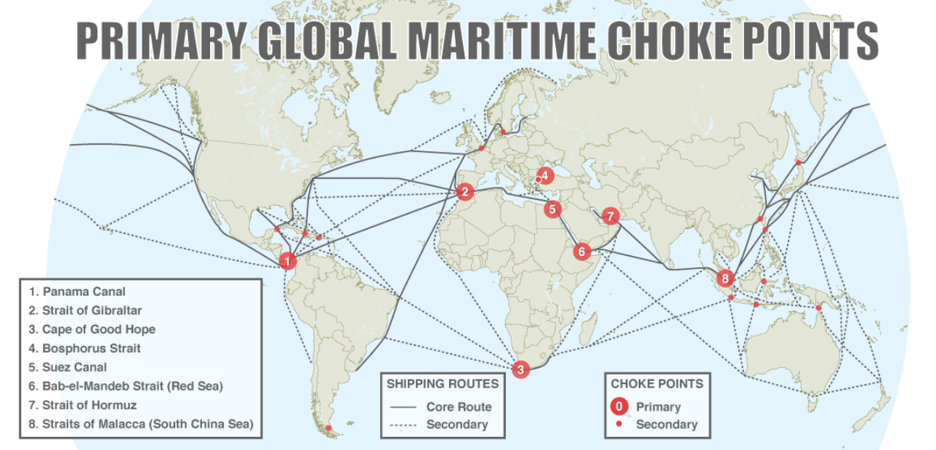
We have strong historical data on what happens when one of those chokepoints has a problem, and the impact on global trade when ships are forced to go around. We do not have any historical data if several of these critical nodes go offline at the same time, and that is where we are.
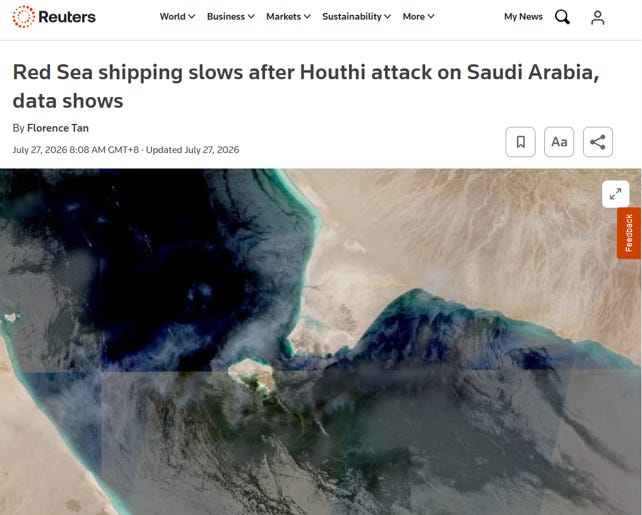
We can lump Bottlenecks #5 and #6 together, on that map. The Houthis have again closed much of the ship traffic through the Red Sea, and on to the Suez. Last Sunday 11 ships carrying commodities went through, and it’s instructive to note where they were going: 2 million barrels of crude were allowed to go through to Ningbo, China. Another million barrels of Russian crude are also on their way here. Another Very Large Crude Carrier with another 2 million barrels were outbound to Zhoushan. That made four Chinese supertankers allowed to pass through.
And that particular waterway was closed before. This is a JP Morgan report that covered what happened the last time. 30% of the global container trade goes through the Red Sea and Suez, and shipping costs went up 5 times for all the ships that used to head that way, because of the re-routing around Africa. That adds 4,000 miles, one way, for ships sailing between key ports in Asia and Europe.
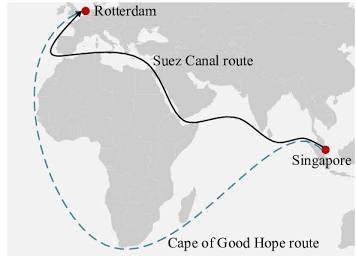
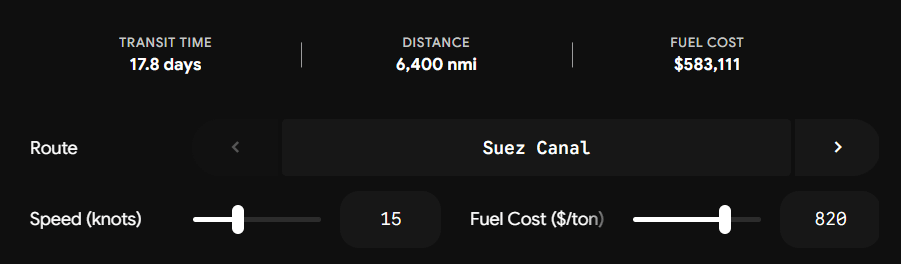
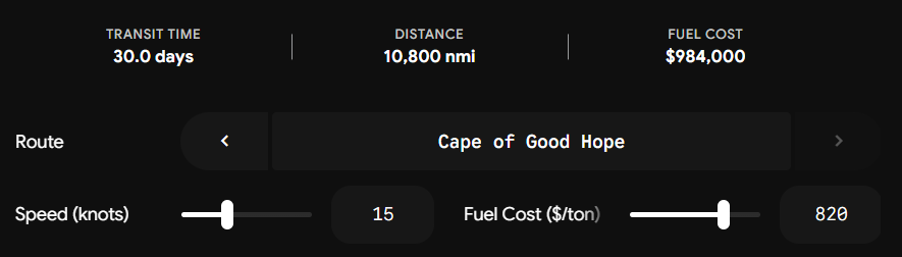
So going through the Suez takes about 18 days; going around takes 30 days. Bunker fuel costs are over $800 per ton, because of the closure of the Hormuz, so in increase in the fuel costs alone are nearly a million dollars, one way. Charter costs and longer crew times are passed along, eventually to consumers, and they are reflected in the data for container freight rates:
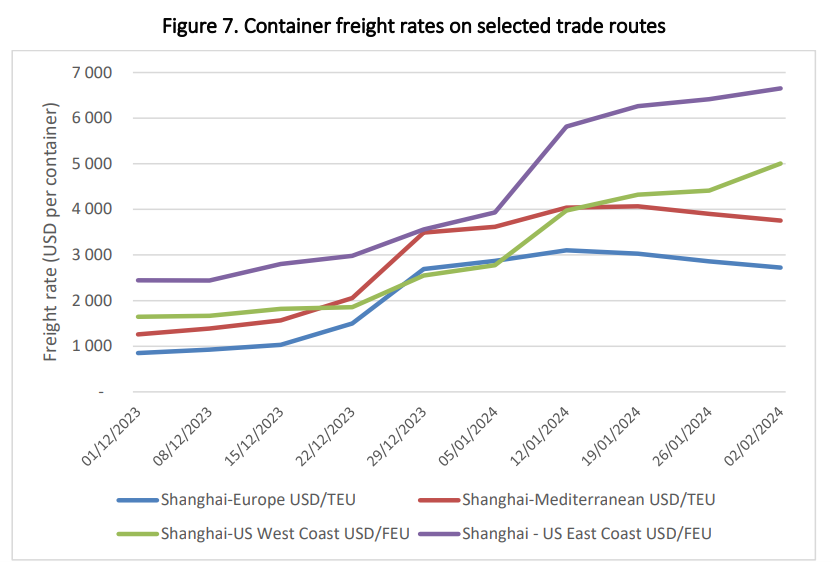
These are cost spikes that we will see again, and soon, for as long as the Red Sea is closed. So the War on Iran has blown up shipping routes through the Strait of Hormuz and the Red Sea, and so the timing isn’t great for anything to go wrong anywhere else.
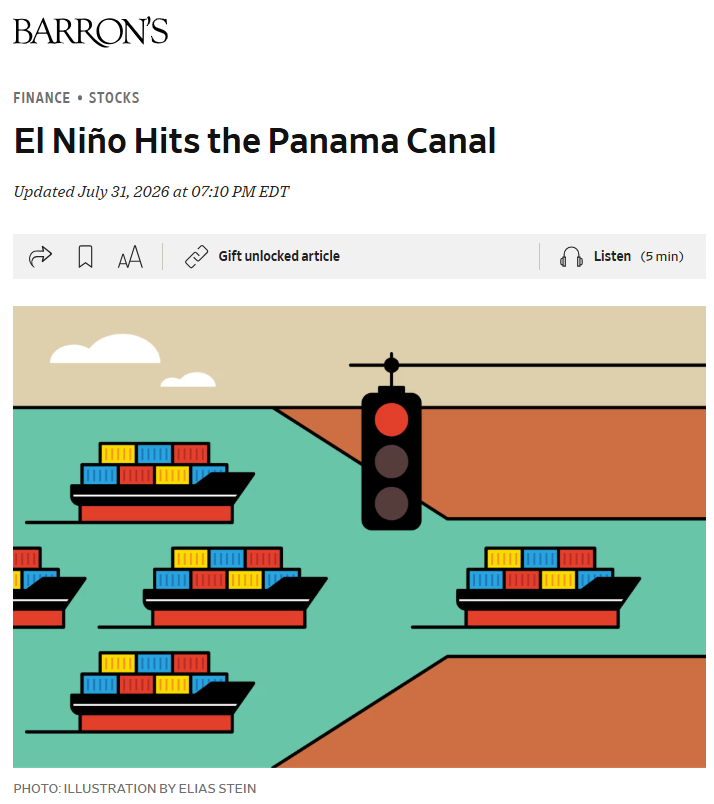
But Panama isn’t getting nearly enough rain to keep the Canal traffic at normal levels, and the canal authority is cutting transits through. There are strong historical data there, too: last time El Nino hit, the water warmed up, the water level dropped, and regulators reduced the flow of traffic.
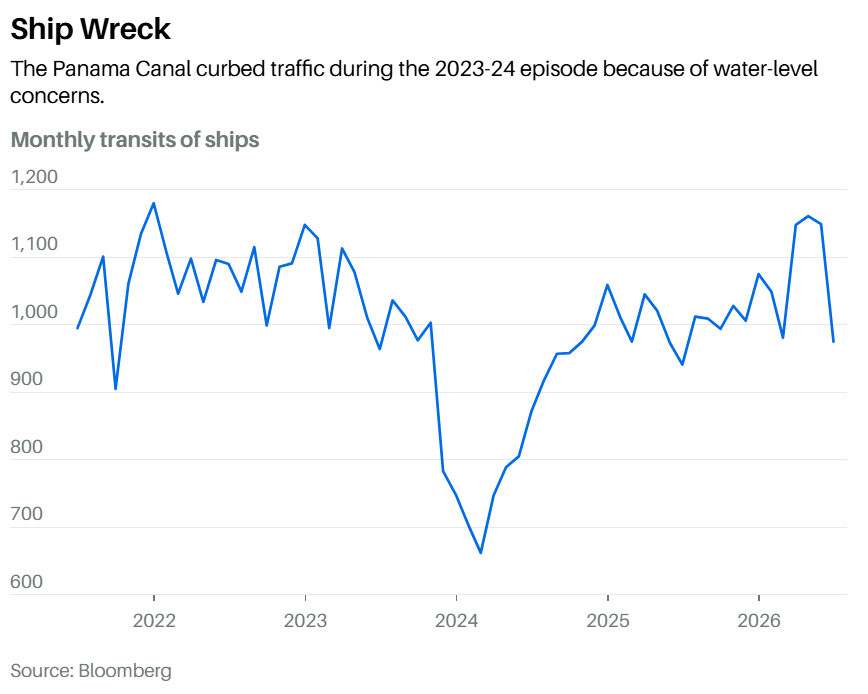
Monthly ship transits in 2024 dropped from over a thousand, to under 700. In 2026 the traffic is already trending down, and the authorities have halted new auctions from 25 July onward. Water levels are forecast to drop through September, and that means big problems for Panamax shippers in the third quarter.
Lousy weather is also deeply impacting shipping in Europe. The Rhine River is a critical artery for heavy industry in Germany, and the river is at record lows. As a result, ships are only able to transport small loads—around 20% of normal. Naturally that takes more time, and costs are going up. Shipping costs from Rotterdam to Karlsruhe have more than tripled in a single month, and remember again that it costs a lot more to get ships to Europe in the first place, with the Red Sea and the Suez blocked off.
We even got bad news from Brazil. The Amazon River is now more critical than ever for the agricultural trade, and shipping companies expect those channels to get cut off later in the year, as a result of El Nino-related weather patterns. This is the global advisory from Maersk, and means that unless Brazil gets a lot more rain, fast, capacity restrictions will begin in October, and will stay on through the end of the year. That impacts almost 40% of soy exports to Europe, with knock-on effects to livestock feed, and the European meat and dairy industries.
Summing up, the wars in the Persian Gulf have shut down ocean freight going through the Strait of Hormuz, the Red Sea, and the Suez. Shipping through the Panama Canal, and down the Rhine River, and the Amazon, won’t be back to normal until heavy rains fall again. Those are problems that are baked in to world trade, right now.
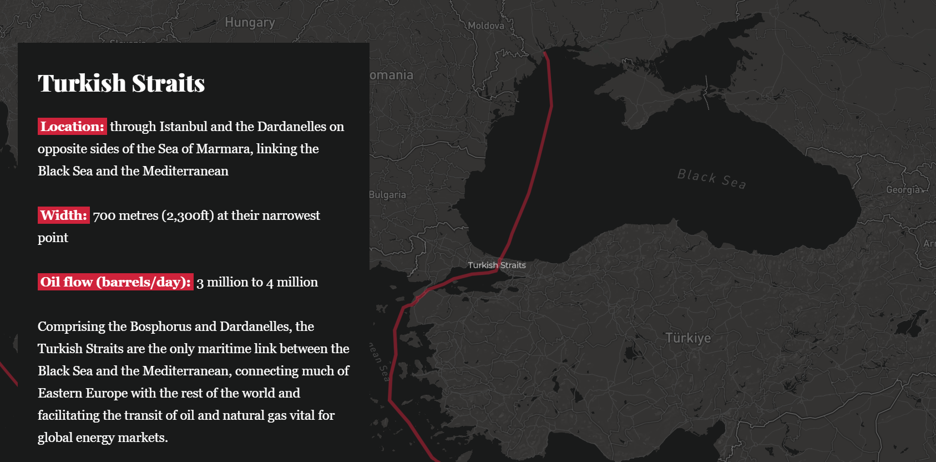
What we don’t know, yet, is the effect of the Russia-Ukraine War on Checkpoint #4. But it doesn’t look good. Over two million barrels a day of oil is shipped from ports on the Black Sea, through the Turkish Straits and the Bosphorus, to markets in Europe. We know that Ukraine is hitting refineries in Russia, and that Ukraine has lost a third of its export capacity for grain out of the Black Sea.
Ukraine is 6% of global wheat exports and 11% for corn, knocking each down by a third is a big problem for food supplies. Here again, though, there is recent historical data, on the impact on food commodity prices, with the price charts going vertical in the early days of the war.
And so we’re losing count, on the cumulative impact of these waterway closures. Focusing only on energy, the closure of Hormuz takes over 20 million barrels per day off global markets. Plan B is to build pipelines so Saudi and the Emirates could send some oil—over 4 million bpd—out through the Red Sea. But the Houthis have closed that off, so we’re now at 25% of the world energy supply offline. Now we’ve got the Black Sea route in trouble, which is another 2% of the world oil trade.
This is geography, and it’s not complicated. And the economic model for the world is to have backups, and go-arounds, if there is a single point of failure. There is no economic model to guide policymakers, or business executives, in the case of cascading, multiple failures. But we’re going to find out.
Be Good.
Resources and links:
Red Sea shipping slows after Houthi attack on Saudi Arabia, data shows
https://www.reuters.com/world/middle-east/red-sea-shipping-slows-after-houthi-attack-saudi-arabia-data-shows-2026-07-27/
What are the impacts of the Red Sea shipping crisis?
https://www.jpmorgan.com/insights/global-research/supply-chain/red-sea-shipping
Commercial navigation in the Red Sea under attack
https://www.itf-oecd.org/sites/default/files/repositories/red-sea-crisis-impacts-global-shipping.pdf
El Niño Hits the Panama Canal
https://www.wsj.com/wsjplus/dashboard/articles/el-nino-hits-the-panama-canal-a27222c3
Global Trade Faces Fresh Test as Panama Canal Curbs Bookings
https://www.bloomberg.com/news/articles/2026-07-21/panama-canal-to-suspend-some-vessel-bookings-on-water-outlook
Rhine water level drops to around record lows, costs for industry rise
https://www.reuters.com/business/environment/rhine-water-level-drops-around-record-lows-costs-industry-rise-2026-07-31/
Global Trade Faces Fresh Test as Panama Canal Curbs Bookings
https://gcaptain.com/global-trade-faces-fresh-test-as-panama-canal-curbs-bookings/
Rhine water level drops to around record lows, costs for industry rise
https://www.reuters.com/business/environment/rhine-water-level-drops-around-record-lows-costs-industry-rise-2026-07-31/
Rhine water level close to record lows, cargo vessels keep sailing
https://kfgo.com/2026/07/30/rhine-water-level-close-to-record-lows-cargo-vessels-keep-sailing/
River Conditions in Manaus (Brazil) – Dry Season Period 2026
https://www.maersk.com/news/articles/2026/07/17/river-conditions-manaus-brazil-dry-season
Temporary Suspension of the Daily Auction – Panamax Locks
https://nortonlilly.com.pa/temporary-suspension-daily-auction-panamax-locks/
The world’s most strategic straits and channels
https://interactive.aljazeera.com/aje/2026/mapping-oil-hormuz-chokepoint/
Ukraine’s Black Sea ports lose a third of grain export capacity, farmers’ union says
Inside China / Business is a reader-supported publication. To receive new posts and support my work, consider becoming a free or paid subscriber.
From Inside China / Business via This RSS Feed.