

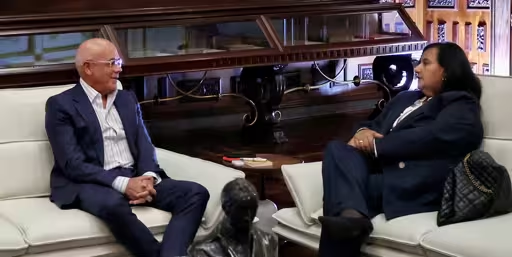
Caracas (OrinocoTribune.com)—Following last-minute reports and rumors that the resumption of political dialogue in Venezuela, scheduled for August 1, had been postponed, representatives of the Venezuelan government and a sector of the far-right opposition separately announced on Saturday night that the process had begun with a telephone conversation.
The call was held between National Assembly President Jorge Rodríguez, the government’s coordinator for the talks, and former Justice First deputy Dinorah Figuera, who represents former opposition legislators from the 2015-2020 parliamentary term.
Rodríguez reported that the conversation was intended to initiate an inclusive and effective political dialogue to benefit the country and the Venezuelan people, as well as to coordinate efforts to assist those affected by the June 24 double earthquakes.
In a statement, Rodríguez explained that the two representatives exchanged the names comprising their respective working delegations and agreed to hold the first in-person meeting in Caracas next week.
He added that the parties had established a working agenda with “clear and verifiable goals.”
A US-directed process
The talks are taking place under the shadow of the January 3 US bombing of Venezuela and the kidnapping of President Nicolás Maduro and his wife, National Assembly Deputy Cilia Flores.
The US military assault killed over 100 people, including 32 Cuban and 47 Venezuelan soldiers.
Since the attack, Washington has exercised what numerous analysts and Chavista political figures describe as a form of semicolonial tutelage over Venezuela’s acting government.
Meanwhile, the far-right opposition sector has maintained direct political and institutional ties with Washington for years, serving as one of the principal domestic instruments of the White House’s failed regime-change operation against the Bolivarian Revolution.
Upon returning to Venezuela after years abroad, Figuera acknowledged that her participation in the initiative was prompted by an “invitation” from the US State Department.
Many analysts are skeptical that the negotiation process will produce lasting results, given that the participating opposition group does not fully represent Venezuela’s fragmented anti-Chavista political sectors.
Other observers interpret Washington’s push for negotiations as shaped partly by US domestic politics. With the midterm elections approaching, Republican hardliners are demanding that President Donald Trump demonstrate tangible progress toward their long-standing objective of regime change in Venezuela.
Agenda and government delegation
The first in-person session will focus on three issues:
• Assistance for the victims of the double earthquakes;
• Strengthening democracy;
• Political rights and guarantees.
The Venezuelan government delegation will consist of:
• Jorge Rodríguez, coordinator;
• Ana María San Juan;
• Jorge Arreaza;
• América Pérez;
• Génesis Garvett;
• Pedro Infante.
Far-right opposition delegation
Simultaneously, Figuera released a similar statement, confirming the telephone conversation with Rodríguez and announcing the opposition delegation expected to participate in the Caracas meeting next week.
She reported that the delegation’s technical-political commission would include several figures with limited national profiles within Venezuela’s divided opposition landscape:
• Dinorah Figuera, coordinator;
• Marco Aurelio Quiñones;
• Ramón López;
• Jorge Millán;
• Juan Miguel Matheus;
• Sergio Vergara.
Figuera also announced a support commission composed of:
• Macario González;
• Desiree Barboza;
• Julio César Moreno;
• Elimar Díaz.
The former deputy confirmed the same three initial areas of discussion announced by Rodríguez: assistance for earthquake victims, strengthening democracy, and political rights and guarantees.
Washington’s expired parliamentary instrument
The so-called 2015-2020 National Assembly has been strongly condemned by Chavista sectors and other Venezuelans who regard its continued existence after the expiration of its constitutional term as a legal fiction sustained by Washington.
The Trump administration used the expired parliament as the political and legal foundation for the failed Juan Guaidó regime-change operation, despite the body’s elected term ending in January 2021.
Washington’s continued recognition of the defunct institution also contributed to the legal architecture used to freeze, seize, or transfer control over Venezuelan assets abroad, including CITGO and other state resources valued at tens of billions of dollars.
Allegations of corruption, embezzlement, and mismanagement involving those assets have been raised by Chavista officials and members of the far-right opposition itself, further intensifying public rejection of the parallel institutions created by US imperialism during the failed Guaidó operation.
Venezuela Launches Talks With Former Opposition Lawmakers, Demands End to Sanctions
These circumstances have fueled doubts over whether the current dialogue can produce durable, sovereign agreements or will merely provide a new institutional façade for Washington’s continued intervention in Venezuela’s political affairs.
Special for Orinoco Tribune by staff
OT/JRE/SF
From Orinoco Tribune via This RSS Feed.